• TechMediaNetwork
  • LiveScience
  • SPACE.com
  • Newsarama
  • TopTenREVIEWS
advertisement
Neil Armstrong: Self-Proclaimed 'Nerdy Engineer'
Thirty Years Ago: Lunar Explorers Take a Walk
Greatest Space Events of the 20th Century: The 60s
Apollo 11: Where Were You?
Don't Tread on Me: Group Wants to Protect Apollo Site
By Leonard David
Senior Space Writer
posted: 04:01 pm ET
18 April 2000

footprints

WASHINGTON -- We've all heard the pleas. Save the whales. Protect the redwoods. Guard the sea turtles.

Now add lunar footprints to the list.

Two New Mexico researchers -- Ralph Gibson and John Versluis -- want to establish as "off-limits" the dusty terrain on the moon's Sea of Tranquility where Apollo 11 astronauts Neil Armstrong and Buzz Aldrin romped more than 30 years ago.

Gibson and Versluis hope to preserve for posterity, humanity's first footfalls on the moon.

Everything at the Apollo 11 landing site, Versluis said, "is the culmination of great moments in our nation's history, and in the history of humankind."

Armstrong and Aldrin landed on the moon on July 20, 1969 aboard their fragile lunar lander, Eagle. The two spent more than two and a half hours roaming the surface around the area they named "Tranquility Base" during their 21-hour stay.

Preservation is important, Gibson and Versluis said, because private groups envision someday driving remote-controlled robots into the area. Those robots surely would leave tread marks on top of any footprints.

"We do view such endeavors as intrusions if they were conceived and planned without proper consideration for the potential adverse effects such projects may have," Versluis, an historian in Las Cruces, New Mexico, told SPACE.com.

"Without an accurate, scaled map of all the artifacts, including the footprints, any attempt to approach the site remotely could destroy important artifacts or erase important features," he said.

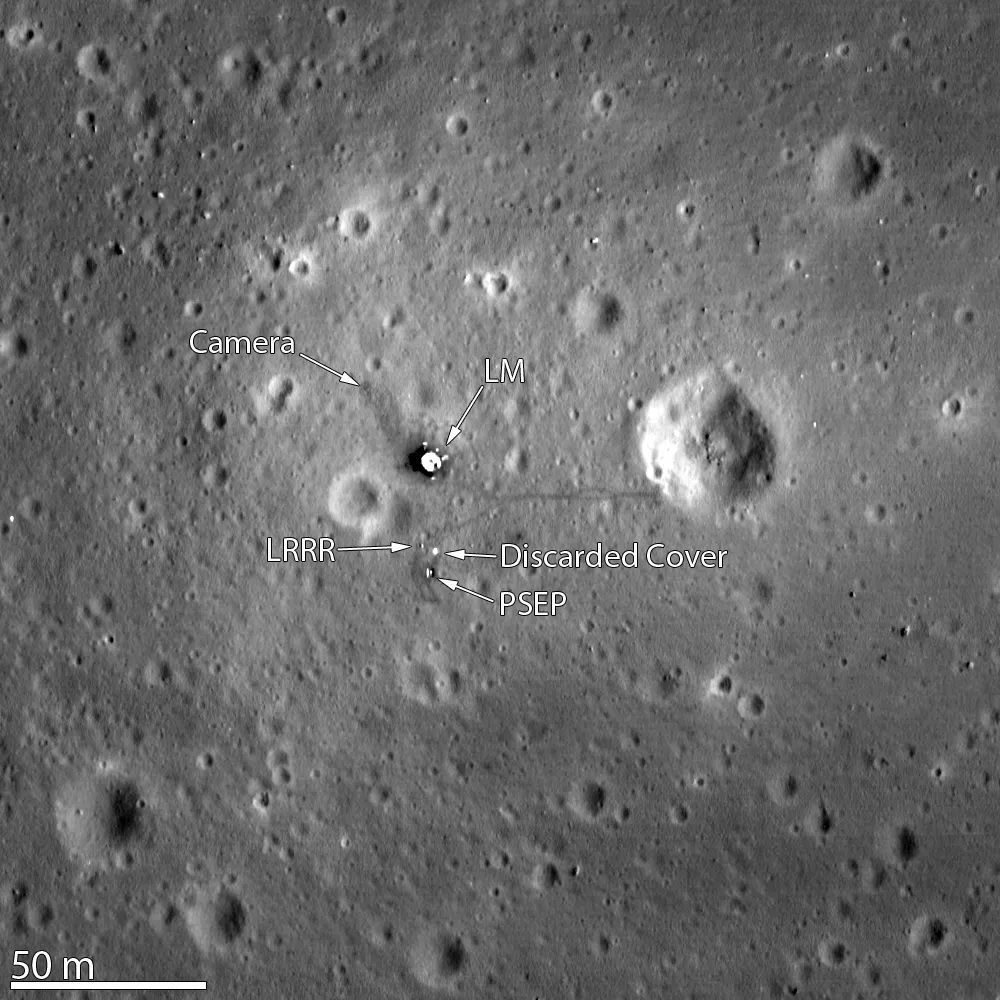
Apollo 11 landing site.

The two lunar preservationists have been awarded a $23,000 grant from the New Mexico Space Grant Consortium on behalf of NASA and with cooperation from New Mexico State University.

With the money, they'll map and research all artifacts at Tranquility Base for its nomination as a National Historic Landmark.

Lunar district

Gibson and Versluis, who have worked with the National Park Service since 1998, are urging that Apollo 11's leftover descent stage, the American flag and discarded hardware and science gear be legally sanctioned as a Tranquility Base "district of structures".

The flag was apparently toppled when Armstrong and Aldrin blasted off from the lunar surface.

The astronauts also left behind science instruments, cameras, tools, boots, bags, arm rests, brackets, a power cable, a tiny gold olive branch, commemorative medallions and their life-support backpacks.

Gibson, an anthropologist, said the tactic is straightforward.

"We are merging the National Historic Preservation Act (NHPA) of 1966 with the existing United Nations treaty which governs the moon. We are using NHPA to nominate the objects and structures left at the site as a National Historic Landmark," Gibson said.

That U.N. treaty, Gibson said, states that any country leaving items on the moon never loses ownership or jurisdiction over them. Foreign countries are not permitted to come near the items based on the treaty, he said.

What Gibson and Versluis propose is an "area of potential effect" -- suitable boundaries that curb the wanderings of robots trekking through the prized lunar locale.


"I want to see the day when citizens can travel to the moon themselves and visit the site where Neil and I first walked.... appropriate measures should be taken not to disrupt the historic nature of Tranquility Base."


For humans, that's another matter.

"A person walking could get very close to the site without the potential for having an adverse effect," Versluis said. "A rover or robot, however, would require a much larger boundary. With delayed times between a signaled instruction and the physical movement of the robot, as well as the potential for errors in engineering and navigation, a larger area of potential effect is needed to better preserve and protect the site," he said.

Neutral ground

Apollo 11 moonwalker Buzz Aldrin, now a consultant and writer living in Los Angeles, California, takes a neutral stance on the Tranquility Base site.

"First of all, we need to get serious about space tourism. I want to see the day when citizens can travel to the moon themselves and visit the site where Neil and I first walked," Aldrin said. "I do feel that appropriate measures should be taken not to disrupt the historic nature of Tranquility Base. However, by careful planning, robots could discreetly maneuver about the site," he said.

David Gump, president of LunaCorp in Arlington, Virginia, is a longtime advocate for robot stopovers at landing spots. His company has plotted out lunar "sight visits" for old Russian moon probes and Apollo landing sites.

"I haven't run across any lunar entrepreneurs that dispute the Apollo 11 site ought to be kept pristine," Gump said. "There are valid scientific and engineering reasons, though, for returning to other Apollo sites and taking a closeup look at them."

"We've said that our robots would be programmed to recognize footprints as extremely dangerous things to stay away from on Apollo 11. But we had hoped to get consensus that we could roll up to Apollo 17 and do some closeup views of what's happened to it over the past decades," Gump said.

"We may observe the Apollo 11 site from a distance but we're certainly not going to roll up to it," he said.

Declaring the entire lunar surface off limits to robot traffic, however, would be the wrong approach, Gump said.

There's much to learn about how certain materials left on the moon weathered decades of radiation and pings from speeding micrometeoroids.

Aging Apollo hardware might even harbor a biological bounty.

"What microbes may still be surviving? We could get a better idea of how clean we need spacecraft to be when we go to other planets," he said. "Could bacteria live for decades in a hostile environment?

Foot traffic

Ultimately, 21st-century tourists will surely find themselves visiting the Apollo 11 touchdown site in person, Gibson and Versluis believe.

"In the future, once it's economically feasible for the public to visit Tranquility Base, we would need to implement some type of border that would allow the public to see the site without intruding upon it," Versluis said.

A plastic sloped enclosure over the site might be feasible, he said, allowing people to walk over and look down on the artifacts, he said.

"There might be a strictly demarcated path in and out of the site that people always trod, so that everything else is maintained," Gump said. "It would be just like those wooden walkways through the Everglades and other sensitive environments."


Orion Scenix 7x50 Binocular
$99.95
Explore More


Site Map | News | SpaceFlight | Science | Technology | Entertainment | SpaceViews | NightSky | Ad Astra | SETI | Hot Topics
Image Galleries | Videos | Reader Favorites | Image of the Day | Amazing Images | Wallpapers | Games | Community | Reviews
about us | FREE Email Newsletter | message boards | register at SPACE.com | contact us | advertise with us | terms & conditions | privacy statement
DMCA/Copyright
  What is This?
<