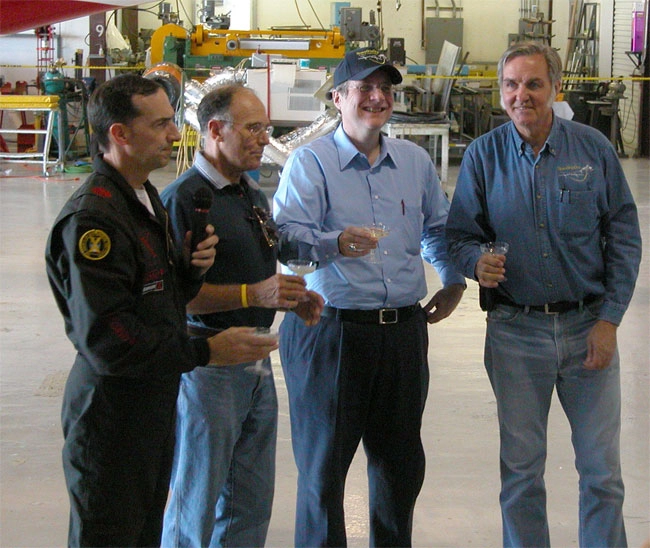
MOJAVE, California -- Nobody can claim that Burt Rutan, the innovative aerospace designer, doesn't have his head in the clouds...and his eyes focused on the stars.
Fresh from success of nudging the piloted SpaceShipOne's nose to record-setting heights and capturing the $10 million Ansari X Prize, Rutan and his team at Scaled Composites have clearly set their sights on far loftier goals.
One gets the feeling that in restricted niches of the Mojave Spaceport here, work is already underway on bigger and better spaceships. Asked directly about that prospect, Rutan is quick with a "no comment" that comes wrapped in a guarded smile.
"You think this is cool?" Rutan asked, pointing to the freshly flown SpaceShipOne. "Wait 'til you see SpaceShipTwo ... it is erotic," he added, alluding to the smooth lines of a craft that would seem tangible and touchable - not a minds-eye image of vaporware.
In an exclusive interview with SPACE.com the day after his design won the X Prize, Rutan discussed his passion for making the space frontier accessible to the public.
Simplicity of design
Standing in Scaled Composite's hangar alongside his creation, Rutan examined the spacecraft. It looks fresh and ready for flight; no worse the wear from its high-speed, back-to-back suborbital jaunts.
"Any damage is actually kind of hard to find," Rutan said. A slight charring in a couple of spots on the vessel is all that's visible. "You're hard pressed to find anything else."
Thermal protection is not an issue for suborbital space tourism, Rutan said. "We got to 3.3 Mach number, but we only go there momentarily. We don't sit there for about an hour like the SR-71 does," recounting the abilities of the super-fast military reconnaissance aircraft.
Looking into the hybrid rocket motor area of SpaceShipOne, Rutan underscores the simplicity of the power plant's design.
"The fewer things you have that can leak or can fail in a rocket motor the fewer problems you have," is a Rutan rule of thumb.
Similarly, there's the plumbing of the craft, pneumatic cylinders and valves to control the large movable tail section rather than using electrical systems. Like your garden hose under pressure, a turn of the valve and water is definitely going to come out, Rutan said. "It's just that reliable."
Tomorrowland upbringing
On any number of topics -- be it NASA, large aerospace contractors, or inept television reporters -- Rutan has an opinion, mischievously taking out a handmade ear from his shirt pocket and casually slipping it on.
Wording on the false ear speaks volumes: "Bull**** Deflector".
Time traveling back to when he was 12 years of age, Rutan recalls a seminal moment that triggered his yearning about space travel.
In 1955, Walt Disney took television viewers into Tomorrowland - a series of Disneyland presentations that included rocket genius Wernher von Braun detailing space travel in matter-of-fact prose. Those TV shows also talked about floating in weightlessness, lunar exploration, as well as the potential for life on Mars.
"It influenced my life like you wouldn't believe," Rutan recalled. Those television airings came before Sputnik in 1957, the selection of America's first astronaut corps, and the flight of the Soviet Union's Yuri Gagarin - the first human into Earth orbit.
"And we're sitting there amazed throughout the 1960s. We were amazed because our country was going from Walt Disney and von Braun talking about it...all the way to a plan to land a man on the Moon...Wow!"
The right to dream
But as a kid back then, Rutan continued, the right to dream of going to the Moon or into space was reserved for only "professional astronauts" - an enormously dangerous and expensive undertaking.
Over the decades, Rutan said, despite the promise of the Space Shuttle to lower costs of getting to space, a kid's hope of personal access to space in their lifetime remained in limbo.
"Look at the progress in 25 years of trying to replace the mistake of the shuttle. It's more expensive...not less...a horrible mistake," Rutan said. "They knew it right away. And they've spent billions...arguably nearly $100 billion over all these years trying to sort out how to correct that mistake...trying to solve the problem of access to space. The problem is...it's the government trying to do it."
Forecast of things to come
The flights of SpaceShipOne, Rutan said, permit a forecast of things to come.
"I predict in five or six years, the average kid is no longer just hoping and dreaming that he'll go to space. He knows he will. He'll at least take one of these suborbital flights that are flying every other day or every day here at Mojave," Rutan stated. While initially expensive, flights into space will drop in price over time, he added.
"And I predict that within 10 years from now, maybe 12 years, kids will know that they will go to orbit in their lifetime. They will know they will...not just dream and hope," Rutan explained.
IBM mentality
Turning his attention to the larger aerospace firms like Boeing and Lockheed Martin that offer pricey lines of boosters, Rutan offers free advice.
"They are thinking SpaceShipOne is a toy," Rutan said. That assumption is akin to the mentality of IBM in 1975. At that time, they believed people aren't going to have cheap computers. Computers are main frames and they have to be complex and very specialized. That was the view of IBM, he pointed out.
"IBM didn't know in 1975 that they were going to build $700 dollar computers for people and that they were going to build them by the tens of thousands. But then came Apple," Rutan said, "and they had to."
That being the case, Rutan made another prediction: "Lockheed and Boeing will be making very low-cost access to space hardware within 20 years. They just don't know it yet...because they're going to have to."
Thousands of probes
Rutan said that an upshot of public space travel is the creation of far less expensive boosters in order to satisfy growing numbers of customers.
That development -- coupled with advances in computers and sensors - will enable thousands of probes to be launched that flood the solar system 25 years from now, Rutan said.
"You'll be able to do a lot more exploration if you send thousands. And it'll be cheap because the boosters were developed because people can't afford to spend too much to get into orbit," Rutan concluded.
"I could be wrong...but these are the things that keep me up nights."