newsarama.com
advertisement
What is a Solar Maximum and What Happens?
Space Weather Oddity Sends Solar Particles Straight to Earth
Sun Shows Trace of Solar Moss
Solar Magnetic Field Spawns Tremendous Coronal Loops
Solar Eruption Jets In Our Direction
By Greg Clark
Senior Space Weather Correspondent
posted: 08:04 am ET
18 February 2000

fullhalo_cme_000218

Charged particle radiation from a solar burst is streaming toward Earth, and may turn on a brilliant show of aurora lights Saturday night. Solar weather forecasters cannot say for certain how intense the effects of Thursday's coronal mass ejection will be, but a weaker event last weekend caused northern-light displays that were visible as far south as New Hampshire.

"Our measurements indicate that this could be even better than that... It is stronger and more oriented toward Earth," said Ken Tegnell, a solar-monitoring technician at the Space Environment Center in Boulder, Colorado. The center is operated by the National Oceanic and Atmospheric Administration to monitor solar activity that affects Earth.


"It's like you're looking down the barrel of the gun. We're basically looking at the ejection head-on."


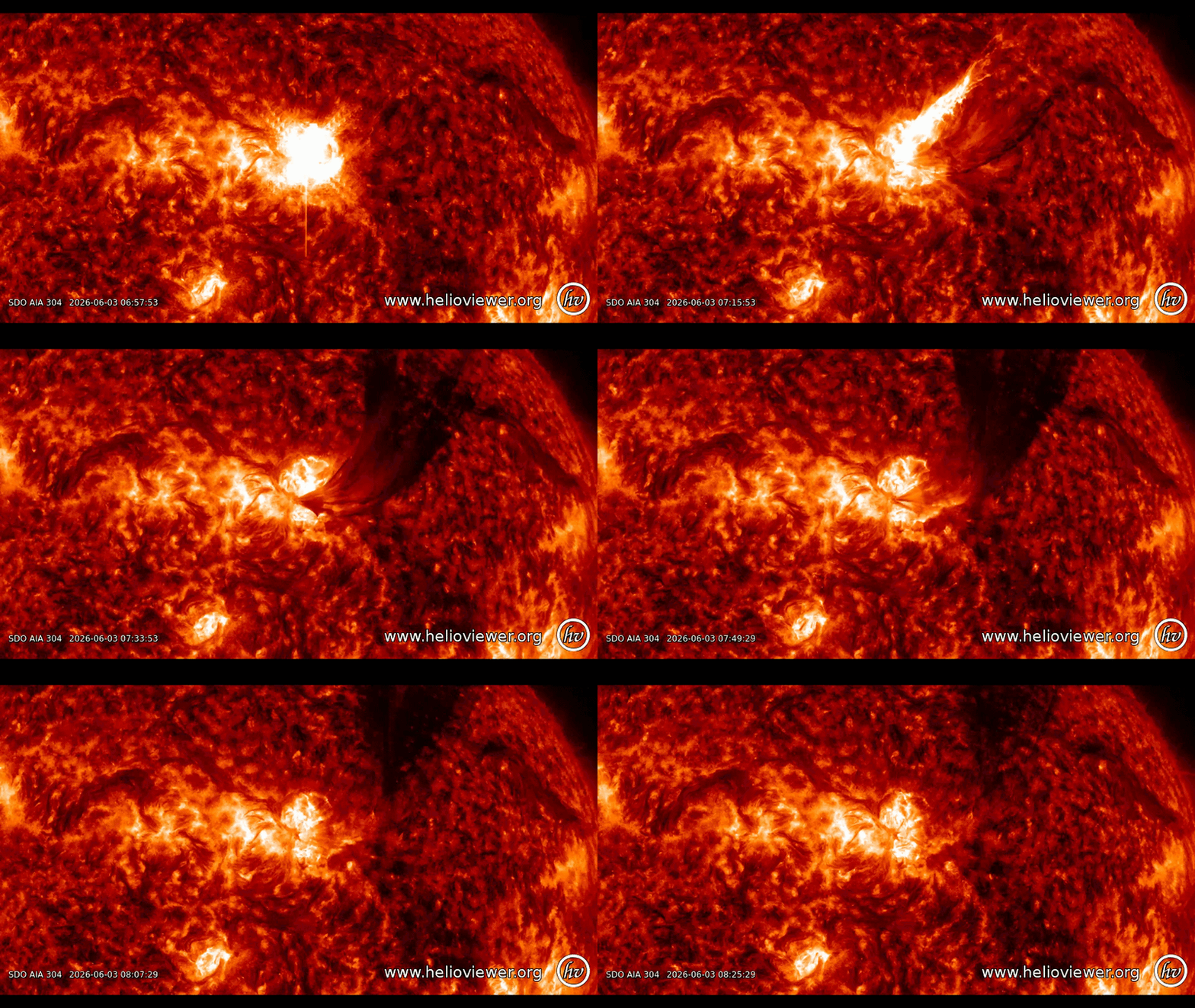
The Solar and Heliospheric Observatory (SOHO) spacecraft detected the event Thursday in images that showed a ring of plasma rolling out from the sun in all directions. The plasma was a sure sign of something called a coronal mass ejection -- an energetic eruption of material from the sun's superheated outermost layer called the corona.

This sequence, taken by the SOHO spacecraft, shows material from a coronal mass ejection puffing away from the sun on February 17. Credit: SOHO/LASCO, ESA, NASA.

An expanding ring, or "halo," around the sun indicates that the shot of plasma was aimed right at Earth.

"It's like you're looking down the barrel of the gun," Tegnell said. "We're basically looking at the ejection head-on, so we're seeing the entire thing coming at us and then spreading out as it comes."

Coronal mass ejections usually take about two days to reach our planet, depending on the speed of the particles, which often speed along at 2 million m.p.h. (3.2 million kilometers per hour). Tegnell said space weather forecasters expect the brunt of the material to reach Earth late February 19 or early February 20, U.S. time.

If skies are clear Saturday night, auroras might be visible all across Canada and the northern United States, Tegnell said.

Just how strongly the particle wave will affect Earth depends on the interaction between the magnetic fields of the plasma stream and Earth's magnetic field, as well as how directly it hits Earth. Results can range from increased auroral activity to disruption of satellite communications and even power-grid disturbances.

But forecasters won't be able to judge the severity of the impact until about 30 minutes before the ejection reaches the planet. That's when the plasma will hit NASA's Advanced Composition Explorer (ACE) -- a spacecraft stationed about a million miles (1.6 million kilometers) away, between the sun and Earth. Scientists will use ACE to judge the severity of the ejection just before it arrives at our planet. They will then issue any necessary warnings to ensure that satellite operators and power companies can prepare for potential geomagnetic disturbances.

"The key is not to warn them too early," Tegnell said, "Often with shift changes and whatnot, they'll forget. A couple of hours is plenty of lead time."


Starry Night High School
$169.95
Explore More


Site Map | News | SpaceFlight | Science | Technology | Entertainment | SpaceViews | NightSky | Ad Astra | SETI | Hot Topics
Image Galleries | Videos | Reader Favorites | Image of the Day | Amazing Images | Wallpapers | Games | Community
about us | FREE Email Newsletter | message boards | register at SPACE.com | contact us | advertise | terms of service | privacy statement
DMCA/Copyright
  What is This?