


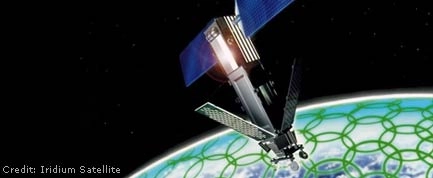
WASHINGTON — The in-orbit collision that destroyed an operational Iridium communications satellite over Siberia last week underscores the difficulty of predicting and avoiding such events despite the increasingly sophisticated orbital surveillance technology in use, U.S. government and industry experts said.
According to some experts, this Feb. 10 incident, the first known collision between two fully intact satellites — Iridium 33 and Russia's spent Cosmos 2251 communications craft — is a sign of things to come as the orbital environment gets more crowded.
"While it took 50 years for Earth orbit to become sufficiently congested that we would expect such an event, it will take only about 10 years before another can be expected," said Don Kessler, an orbital debris expert who previously worked for NASA.
"The probability of impact has been steadily going up and at some periods at an increasing rate," said John Higginbotham, chief executive of satellite control software provider Integral Systems of Lanham, Md. "We're definitely in one of those periods and I expect to see an increase in the coming years."
According to a Feb. 11 e-mail alert issued by NASA, Russia's 1,984-pound (900-kg) Cosmos 2251 — launched in 1993 but out of service since 1995 — collided with the 1,234-pound (560-kg) Iridium craft at 11:55 a.m. EST at an altitude of 490 miles (790 km). Bethesda, Md.-based Iridium Satellite LLC alerted the U.S. Air Force after losing contact with the Iridium 33.
Space traffic tracking
Although the Air Force operates a space surveillance network that currently tracks some 19,000 orbital objects, some as small as a baseball, the service cannot monitor all possible collision scenarios, experts said. Bob Hall, technical director of Analytical Graphics Inc. of Exton, Pa., said the Iridium 33-Cosmos 2251 collision was not even in the top 150 of potential close calls being monitored by his company during the week.
"It wasn't even the closest of all predicted Iridium conjunctions," Hall said, referring to close approaches between satellites.
Nick Johnson, an orbital debris expert with NASA's Johnson Space Center in Houston, said it is not the Air Force's role to stay on top of every potential collision involving satellites in Earth orbit. He said that with enough resources, it might be possible to have such a capability, in which case Iridium's loss potentially could have been avoided. But he added that it is impossible to predict with certainty whether a collision between two space objects will occur and said there frequently are near-misses involving the Iridium system, which consists of 66 operating satellites in low Earth orbit and eight in-orbit spares.
"There's no such thing as space traffic control and that's one of the problems," added Higginbotham.
According to Johnson, Cosmos 2251 drifted down from a higher orbit to the Iridium satellite's altitude.
In a written response to questions Feb. 13, Iridium spokeswoman Liz DeCastro said the company was not notified by the Air Force of the danger posed by Cosmos 2251, and did not attempt to maneuver its satellite out of danger. Industry sources said that typically, satellite operators conduct their own analyses and request information from the Air Force when it appears that a close approach, or conjunction, involving one of their craft is likely.
In a statement issued to media Feb. 11, Iridium said it would move one of its in-orbit satellites within 30 days to permanently replace the lost satellite. The company announced Feb. 13 that it had completed a "service hole patch" as a stopgap measure against limited services disruptions resulting from the loss of the satellite.
Watching the wreckage
NASA and the Air Force are monitoring the potential threat posed by the debris to any U.S. spacecraft, including the International Space Station. Johnson characterized the risk to the space station posed by the debris as "very, very low."
NASA's large Earth observation satellites, which orbit at 705 kilometers, "are of highest interest for immediate consideration," NASA said in its notification about the incident.
Two years ago, a group of commercial satellite operators began exchanging information to help monitor the risks of collision.
"As the fleets of the commercial satellite operators have grown in size and complexity, operators have had to be creative and resourceful in how they manage those fleets," said Richard DalBello, vice president of legal and government affairs at Intelsat General, Bethesda. "The first thing the operators did was to establish protocols for sharing data and communications between operators. Recently, this has led to a proposal among the large operators to create a data center where information could be exchanged rapidly ... in a common format."
An insurance industry source said the collision could affect the way insurance policies are written and rates are figured in the future. "Until a few days ago, this was seen by the insurance industry as a non-issue. Now everyone's taking a hard look at this," the source said.
Asked whether a given company's process for monitoring potential threats factors into how insurance rates are calculated, the source said, "We have not in the past but we will be now."
Tariq Malik contributed to this article from New York. Leonard David contributed to this article from Golden, Colo.