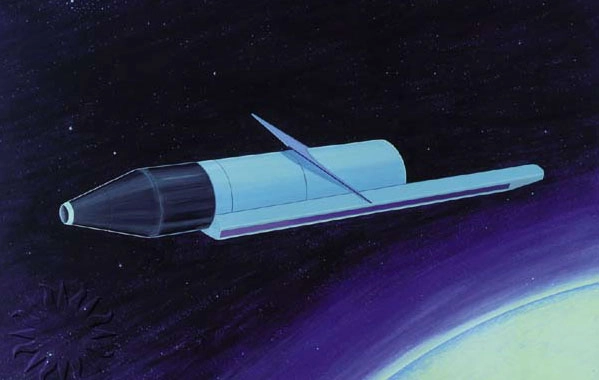
Spinning around the Earth
for more than two decades, an old Soviet satellite, replete with a nuclear
reactor, has acted up.
Launched by the former
Soviet Union in February 1987, Cosmos 1818 was the first of two vehicles
designed to evaluate an advanced nuclear power supply in low Earth orbit.
But ground-watching
surveillance gear has picked up dozens of small particles spewing into space
from the 21-year-old satellite. Why the unexpected debris cloud? It's
still what industry types call an unexplained debris generation event.
Information on the event,
first spotted in July 2008, has been highlighted in the January issue of the Orbital Debris Quarterly News - produced
by the NASA Orbital Debris Program Office at the space agency's Johnson Space
Center in Houston, Texas.
Interesting history
The newsletter notes that
Cosmos 1818 and its sister spacecraft, Cosmos 1867 both toted into orbit a
thermionic nuclear power supply. That nuclear power gear was more advanced than
earlier thermoelectric
nuclear devices that energized the well-known Radar Ocean Reconnaissance
Satellites (RORSATs) during the 1970s and 1980s.
The most infamous RORSAT
was Cosmos 954. It made an out-of-control nose dive in 1978, raining a mess of
radioactive debris over Canada.
Unlike their RORSAT cousins
that operated in very low orbits, Cosmos 1818 and Cosmos 1867 were directly
inserted into much higher orbits, thereby eliminating any threat of premature
reentry, the Orbital Debris Quarterly News
notes.
Russian space authorities
have said in the past that the nuclear reactors onboard Cosmos 1818 and Cosmos
1867 functioned for roughly five and 11 months, respectively. For the next two
decades, the two inactive spacecraft orbited the Earth without significant incident.
Special
observations
But on or about July 4,
2008, the dormant Cosmos 1818 satellite seemed to be involved in its own
Independence Day fireworks. The U.S. Space Surveillance Network spotted debris
of various sizes being shed from the spacecraft.
"Special
observations" of a few of the debris revealed characteristics generally
indicative of metallic spheres – perhaps bubbles of sodium potassium reactor
coolant, according to the space debris newsletter.
One idea floating around is
that a coolant tube on Cosmos 1818 became thermally stressed and breached after
coasting between sunlight and dark temperatures over the two decades.
"Alternatively, the
hyper-velocity impact of a small particle might have generated sufficient heat
to melt some of the NaK, which then would have formed spheres with metallic
properties," the newsletter explained.
Trail of droplets
This is not the first case
of former Soviet satellites casting off a trail of droplets in Earth orbit –
dendrites of a dangerous kind to other spacecraft.
Back in March of 2004 I
reported on the case
of the leaking RORSATs – and whether or not the drips of NaK were, indeed,
still radioactive.
Meanwhile, according to the
space debris newsletter, more analysis of the Cosmos 1818 debris is underway in
hopes of pinning down the nature of
the debris and the possible cause of their origin. "To date, no
similar debris generation by Cosmos 1867 has been observed," the
newsletter advised.
Collision
space
"I can only
guess for now what may be going on with RORSATs," said Don Kessler, a
former NASA expert on orbital debris and now an orbital debris and meteoroid
consultant in Asheville, North Carolina.
These
RORSATs were placed at an altitude above 500 miles (800 kilometers),
he added, in the hope that their orbit would not decay until after their
radioactivity had decayed hundreds of years from now. However, this also placed
the RORSATs in a region of space that has the highest collision probability
with other debris.
"Most of the
small debris in this region is NaK droplets, released from
the RORSATs prior to 1990. Consequently, as a result of collisions with
other debris, RORSATs are not likely to remain intact before they
reenter," Kessler told SPACE.com. The most frequent type of collision
would be with the older NaK droplets, impacting with very high
velocities, he said.
"These
smaller impacts would penetrate the RORSAT radiators, and
release some of the remaining NaK. Impacts with larger debris would
cause the entire RORSAT satellite to fragment," Kessler advised.
As for the
wandering droplets of reactor coolant being radioactive, Kessler said. "I have
never resolved the issue of whether these droplets are radioactive or
not....they were certainly exposed to the RORSAT radiation. A specialist
in radioactive would best answer the question as to how long NaK would remain
radioactive."
Any experts
out there capable of talking on this question? If so, give me a shout.
Leonard David has been
reporting on the space industry for more than four decades. He is past
editor-in-chief of the National Space Society's Ad Astra and Space World
magazines and has written for SPACE.com since 1999.