





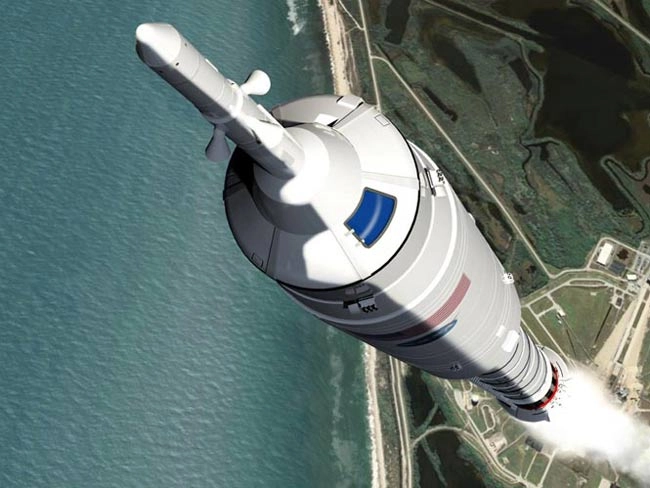
WASHINGTON - NASA shot backWednesday at recent news reports suggesting the Ares I rocket in developmentfor the past three years is doomed to failure.
Although NASA officials didnot mention any media outlet by name, they took issue with an Oct. 26 story inthe Orlando Sentinel claiming that concerns that Ares I could crash intoits launch tower under certain wind conditions were the latest setbackthreatening to undo the U.S. space agency?s plans for returningto the Moon.
Doug Cooke, NASA?s deputyassociate administrator for exploration systems, was up-front about the motivebehind Wednesday?s Constellation program media teleconference.
"Some recent newreports about Ares have been inaccurate and draw false conclusions and could beavoided if we are given the opportunity to give the facts of the case,"Cooke said.
Steve Cook, manager of theAres project at NASA?s Marshall Space Flight Center in Huntsville, Ala.,acknowledged that the so-called launch vehicle drift mentioned in the newspaperreport was discussed during the Ares I?s preliminary design review that wrappedup in September as something that would have to be addressed. But Cook saidthat news reports had blown the issue out of proportion.
"First of all, launchvehicles experience lift-off drift primarily due to winds at the launch pad andit?s a manageable phenomenon," Cook said. "In the very heavy windconditions that we are designed to - 34 knots, which is significantly higherthan what shuttle uses today ? Ares Ican use its built-in thrust vector controls to steer away from the padtower ? or fly within reduced wind constraints more similar to those used todayon the shuttle. Either one of those by themselves will avoid the issueswe?ve got here."
The space shuttle isdesigned to launch in winds up to 19 knots, or roughly 22 mph (35 kph).
Cook also said thatcomputer simulations showing Ares I crashing into the tower only under certainvery specific weather conditions.
"The wind conditionthat we are concerned about is a southerly wind at 34 knots. In our estimatethat would only happen about 0.3 percent of the time in any case," Cooksaid. "So this is another issue that?s been taken very much out ofcontext."
Cook said Ares I emergedfrom preliminarydesign review with multiple, straightforward options for addressing theunlikely scenarios where lift-off drift could cause re-contact with the launchtower.
The Orlando Sentineland various Web sites also have reported on low morale among engineers workingon Ares and the OrionCrew Exploration Vehicle. The newspaper reported in its Oct. 26 story thatduring Ares? preliminary design review NASA "had to quell near-revolts byastronauts and scientists" concerned about some of the decisions beingmade by the program. The story quoted an astronaut who left NASA in 2005.
During the Oct. 29teleconference, NASA astronaut Brent Jett, director of fight crew operations atNASA?s Johnson Space Center, denied any near revolt that had to be tamped down.
"Both [AstronautOffice Chief] Steve Lindsay and I have actively solicited our office for anyonethat has a dissenting opinions on whether Ares 1 should proceed forward to[critical design review] and ultimately to become an operational launch vehicle? and we have not found one person in our office with a dissenting opinion so Idon?t know where these stories are coming," Jett said.
During the teleconference, NASA?sConstellation program director Jeff Hanley told reporters that he wasexpecting a report by early December outlining options for speeding up thefirst crewed flight of Orion and Ares should NASA be given the direction andresources to do so. NASA is currently shooting for a first crewed flight inSeptember 2014, six months ahead of the date it has promised the White Houseand Congress it can have the vehicle ready to do. The study, which kicked offin October, is being led by Ralph Roe, the director of the NASA Engineering andSafety Center at Langley Research Center, Hampton, Va.
Hanley also said NASA isnow targeting July 12 for the first major flight test of the Constellation program,the launch of an Ares 1 prototype dubbed Ares I-X.
NASA had been shooting forApril for the Ares I-X, but modifications to Kennedy Space Center launch padselected for the flight are largely onhold until NASA completes a space shuttle mission to service the HubbleSpace Telescope. That mission was postponed last month from October to noearlier than February.
Hanley said the July 12target for Ares I-X assumes the Hubble mission goes in February. If the Hubblemission does not occur until May, as has been discussed, Hanley saidConstellation officials would have to revisit the Ares I-X schedule.
- Video - Mock Orion Capsule Crashes to Earth
- Video - NASA's Constellation Journey Begins: Part 1, Part 2
- Video - Back to the Moon with NASA's Constellation