





Thisstory was updated at 7:52 a.m. EDT.
As NASA?s50th anniversary approaches, the agency finds itself at a crossroads betweenthe waning era of the U.S. space shuttle and serious hurdles ahead to build areplacement spaceship while still keeping American astronauts flying.
The U.S. spaceagency turns 50 years old on Oct. 1 with the last flight of its three agingshuttles already set for May 31, 2010 aboard the orbiter Atlantis.
NASAofficials in charge of the developing the shuttle?s replacement - the OrionCrew Exploration Vehicles and their Ares I boosters - hope to have thespaceship ready for manned flights by 2014, though unless Congress steps insoon American astronauts will likely be grounded beginning in 2012 due torestrictions on NASA?s ability to buy seats aboard Russian spacecraft.Meanwhile, the agency is simultaneously taking an academic look at what?sneeded to extend shuttle missions through 2015 to be ready for any questions fromthe new administration after November?s presidential election.
?It?s kindof a unique juncture of history that we are engaged in at this point in timewith so many issues, and the tasks are pretty large and quite daunting,? saidRoger Launius,a former NASA historian and senior curator with the Division of Space History at theSmithsonian Institution?s National Air and Space Museum in Washington, D.C.?It?s time to move on.?
Shuttleto Orion
NASA?s hasplanned to retire its three shuttle fleet since 2004 under the Vision for SpaceExploration, which includes bringing Orion and Ares I online by 2015 andsending astronauts back to the moon by 2020. The plan calls for Ares I rocketsto launch Orion capsules to orbit on flights to the International Space Stationor to link up with a lunar transfer stage and Altair moon lander loftedseparately atop a planned Ares V heavy-lift booster.
Budgetshortfalls and recent shuttle flight delays prompted NASA?s Constellationprogram to push back internal targets for test flying Ares and Orion crewvehicles, though officials hit a milestone earlier this month when anengineering panel signed off on the preliminary design for Ares I rockets.
?You?realways going to find out that there are things you don?t know, which can befixed. So figuring out and fixing them is what we do,? NASA Administrator MikeGriffin said in a televised agency-wide update on Sept. 12. ?Ares and Orion aregoing very well for development projects on a scale that the agency has nottackled for decades.?
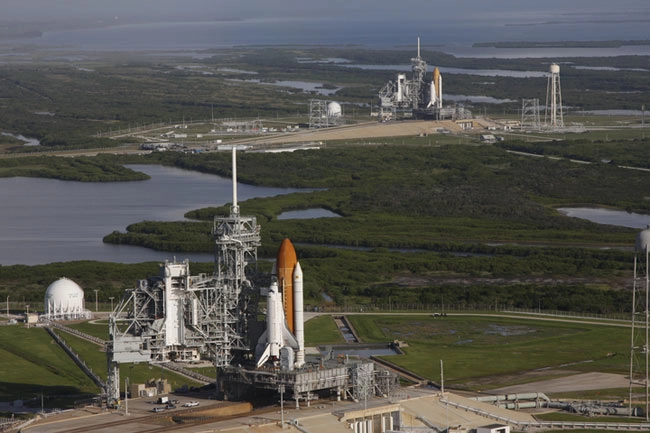
The agencyhad hoped to launch the first Ares I test - dubbed Ares I-X - from the KennedySpace Center in Florida by April 15, 2009, under a plan to begin manned flighttests as early as 2013. But delays to the next shuttle flight - Atlantis?STS-125 mission to overhaul the Hubble Space Telescope - pushed the AresI-X test flight to no earlier than next June because NASA must hold the Arespad in reserve for a second shuttle, which is serving as a rescue ship in caseof an emergency.
The Hubbleflight is slated to lift off Oct. 10, after being pushed from an earlier Augustlaunch date due to fuel tank delays.
Fundingconstraints, meanwhile, have hindered design review plans for the Orion CrewExploration Vehicle. NASA is currently spending about $3 billion per yearthrough 2010 on Orion and Ares I, but could have been farther along ifadditional funds were available, program managers said.
?We neededabout $1 billion for each of the next two years to really put us on the glidepath to make that a high confidence plan,? said John Hanley, manager of NASA?sConstellation program overseeing Ares and Orion development, of the 2013 targetin a Sept. 10 briefing. ?When that didn?t materialize, we of course had to adjustour schedule in order to allow the work to fit the money, and that?s what we?vedone.?
Newspaceship hurdles
Challengesin developing any new human spaceflight system are to be expected, and NASA?sOrion and Ares have their fairshare.
?I thinkthey?re obviously making progress toward fielding a new vehicle, but they dohave enormous technical challenges,? Launius said of NASA, adding that the U.S.has not designed a manned spacecraft from scratch since the birth of theshuttle fleet in the early 1970s. ?We basically do this once a generation andwe?re now at that point where we?re doing it.?
The currentAres I design, a two-stage rocket that uses a five-segment version of the spaceshuttle?s solid rocket booster as a first stage, shakes too much. Engineershave come up with a novel shock absorber plan to mitigate the excessivevibration.
Designteams have also been dogged by the Orion capsule?s weight, which they have beenworking to slim down for extra launch margin since the spacecraft will be usedfor rides to the International Space Station and planned long duration treks tothe moon. The design review process for that component has been delayed to sometime next year.
Early workis underway to modify the Ares I rocket?s launch pad at the Kennedy SpaceCenter to ward off lightning and other hazards. Meanwhile, Ares I engineers aretackling time-consuming, but not insurmountable problems like smoothing out therocket?s stage separation and deciding to safeguard the booster to fly throughrain, hail or direct lightning strikes, said Ares project manager Steve Cook.
?We?vecertainly got design challenges ahead, but if we didn?t have challenges wewouldn?t need engineers,? he added.
Americanaccess to orbit
Whileengineers tackle plans for Orion and Ares, NASA has already set the lastflights for each of its three remaining space shuttles - Atlantis, Discoveryand Endeavour.
Under thecurrent schedule, Atlantis would launch its last flight, STS-131, to the spacestation on Feb. 11, 2010. Discovery and Endeavour would follow, lifting off onApril 8 and May 31 of that year, respectively.
NASA hadhoped to rely on Russian Soyuz spacecraft to launch American and partnerastronauts to the International Space Station between the shuttles? retirementthe first manned Orion flights.
But unlessCongress extends the agency?s exemption from part of the Iran-North Korea-SyriaNon-proliferation Act (INKSNA) by year?s end, American and NASA partnerastronauts will miss at least one of the space station crew rotation flights in2012. Russia?s recent military conflict with neighboring state Georgia in earlyAugust has cast a pall over the waiver talks.
?I?ve beenputting every bit of political capital that I might have or can borrow behindsecuring an extension of that wavier until we can get Ares and Orion flying,?Griffin said last week. ?But it?s tough and the Hill is not of one mind on thatsubject.?
Somesupporters include Sen. Bill Nelson (D.-Fla.), who has been advocating awaiver extension for astronaut seats, but has urged NASA to commit to U.S.commercial launch services for station cargo. Others, like Rep. Dave Weldon(R-Fla.), believe relying solely on Russia for U.S. access to space to be agrave misstep.
?Laying offthousands of experienced space program workers and relying on Russia to get theU.S. into space was a bad idea then, and it is even a worse idea now,? Weldonsaid in a Sept. 12 statement. ?By granting the Russians a waiver, as he nowadvocates, we will guarantee thousands of pink slips to workers at KSC. Russiacontinues to sell dangerous technologies directly related to weapons of massdestruction to Iran, defies sovereign rights in Georgia, and threatens Polandwith intervention.?
Shuttlefutures
Alsoclouding the issue is the upcoming presidential election, which has promptedNASA to take a second look at what steps would be required to extend itsspace shuttle flights through 2015 in order to answer any questions fromthe new administration.
Last month,Republican presidential candidate John McCain (R-Ariz.) and other senators senta letter to President George W. Bush beseeching his administration from institutingany policies that would prevent U.S. shuttles from flying beyond 2010.Democratic presidential candidate Barack Obama (D-Ill.), too, has pledged tocontinue the Constellation program and has said in the past that extra spaceshuttle flights might be an option.
Griffin hassaid that the odds of a loss of vehicle or crew failure during shuttle missionwill increase dramatically if the program is extended to fill the gap betweenorbiter retirement and Orion operations in 2015. Adding two shuttle flights peryear would shift the odds from a 1-in-80 chance of a failure to 1-in-8 flights.
?That?s thefacts. That?s where we are,? Griffin said this month. ?I?d rather work towardspending our money toward building a safer system.?
And whileNASA has begun terminating some of its contracts that support space shuttlemissions, there is some flexibility as to what it might be able to do ifdirected by the new administration. John Shannon, NASA?s space shuttle programmanager, said earlier this month that while extending shuttle flightsthrough 2015 may not delay plans for Ares I launches, it would likely delayAres V rocket development that would support new manned missions to the moon.
?We have been aggressively retiringthing that we do not need for the space shuttle program,? Shannon said. ?But wehaven?t reached the point of no return.?
- NASA?s Space Shuttle: The Final Missions
- Video - NASA's Constellation Journey Begins: Part 1, Part 2
- Video - Back to the Moon with NASA's Constellation
