


The Indian Space Research Agency (ISRO) has proposed starting a humanspaceflight program, with the first manned flight taking place by 2014 leadingup to landing an Indian national on the Moonby 2020, ahead of China.
The controversialrecommendation marks a huge shift in ISRO's oftrepeated policy that it will use space technology for national developmentneeds such as telecommunications, health care, education and environmentalmonitoring. In the past the agency has stayed away from manned flightbecause of the huge costs involved.
"Thatpolicy - pronounced four decades ago by Vikram Sarabai, father of India's space program -- had to changefor two reasons," ISRO chairman Gopalan Madhavan Nair said in a Nov. 9 interview.
"We believethat pushing forward human presence in space may become essential for planetaryexploration, a goal we have set for ISRO 20 years from now," he said."Secondly, with India's booming economy, costs should not be a hurdle."
A humanpresence in space, Nair said, is important in the future if India wants aleadership role. The manned space mission "will be a national effort and mostlyindigenous," he added.
Nairpresented ISRO's new plans to Prime Minister Manmohan Singh Oct. 17 and, on the latter's advice, threwopen the topic for a brainstorming session by a cross section of the scientificcommunity who met Nov.7 in Bangalore.
"Themeeting unanimously agreed that manned missions are a logical next step andendorsed our proposal," Nair told Space News.
A detailedreport will be submitted to the government before the end of the year for aformal approval that is a foregone conclusion given the fact India's PresidentA.P.J. Abdul Kalam, a former ISRO scientist, ishimself backing the mission. Initial funding of the program would begin April1, 2007, the beginning of the country's fiscal year.
While ISROis just now revealing its plans, it has been quietly preparing for manned spacemissions ever since China put anastronaut in space in 2003.
It hasredesigned an existing satellite launcher - the GSLV -- to carry a crew of twoand has already built a space recovery capsule, said B.N. Suresh, director ofthe ISRO centre in Trivandrum that will build theversion of the Polar Satellite Launch Vehicle (PSLV) that will be used for theunmanned moon mission and the modified GSLV that will be used for the mannedflights.
ISRO willattempt to validate its re-entry technology in January 2007, when a new spacerecovery capsule will be launched into Earth orbit. It will then be de-orbitedand recovered in the sea.
If thehuman spaceflight program is approved by the government as expected, India willjoin the exclusive club of the United States, Russia and China, nations thatall have an independent ability to launch humans into space.
ISRO saysits project leading to a first manned flight will cost $2.5 billion to $3billion a year (more than three times the agency's current annual budget).
"The amountof money is not very large considering India spends the same amount for every2,000 megawatt power plant it builds" said Udipi Ramachandra Rao, a former ISROchairman and a key proponent of manned space missions.
Nair saidthe Moon would be the ultimate target of the manned mission's project becauseit is being considered as an intermediate base for planetary exploration andalso as a possible source of minerals such as Helium-3, a nuclear fuel.
ISRO hasreleased no details - technical or financial - of the moon landing program, thesecond phase of the manned mission project.
Critics,including some in ISRO, say India could better spendthe money eradicating poverty and improving health and education of itspeople. But Rao said these problems are beingaddressed by the government separately.
"The mannedmission gives ISRO a new goal and its spin-off would benefit people and theindustry in the long run," he said. "Unless we set a new goal with challenges,the staff will get jaded doing the same type of work," he told Space News Nov.9.
Accordingto Rao, ISRO has constantly been engaged intechnology developments such as air-breathing rocket engines, but in theabsence of a well defined goal, their progress has been tardy. The mannedmission project will breathe new life into these activities acceleratingprogress, he said.
"Thisproject will certainly make millions of Indians feel proud but in my opinion,the priority still has to be about understanding and protecting our home planet,"said Santhosh K. Seelan aformer ISRO scientist and now professor of space studies in John D. Odegard School of Aerospace Sciences of the University ofNorth Dakota.
"As long asthe intellectual challenges of exploring the moon and beyonddoes not cut into our commitments to care of the planet Earth, it [themanned mission project] is welcome."
YagnaswamiSundararajan, who was closely associated with ISRO inthe early years, and is now principal adviser to the Confederation of IndianIndustry in New Delhi says India's growing economy and constantly changinggeopolitical equations are arguments in favor of Indiaembarking on the project. He cautioned, however, that there is a big differencebetween now and the 1970s and 1980s when India had to catch up with advancednations that already had space technology.
"Thetechnology gap then was narrow and we could bridge it easily," he told Space News Nov. 9. "Today, with spaceshuttle, international space station and all that, the gap in manned missiontechnologies that exists between India and countries like Russia and the UnitedStates is so wide it is going to be tough catching up without collaboration,"he said. "If we shun collaboration and begin to reinvent the wheel, we will getnowhere."
But Rao feels differently. "We cannot do experiments in [the]space shuttle as the shuttle is not ours," he points out. "We have to developour own technologies...that is the route Chinese havetaken."
Objectivesof manned missions by other countries have a commercial angle and collaborationis not easy to come by Rao says. He notes forinstance that a U.S. offer to include an Indian astronaut in futuremanned-space missions -- an offer made by U.S. President George Bush duringPrime Minister Manmohan Singh's visit to Washington,in July 2005 - has not made any progress.
As for thequestion about whether India should use the money for more innovative ventureslike developing a solar power satellite network to meet the growing energyneeds of the country - instead of following the beaten track of lunar landing --Nair says the space solar power technology is not mature enough.
"Unlesssatellites can convert 50 per cent of the sunlight falling on its solar panelsinto electricity the solar satellites will be uneconomical."
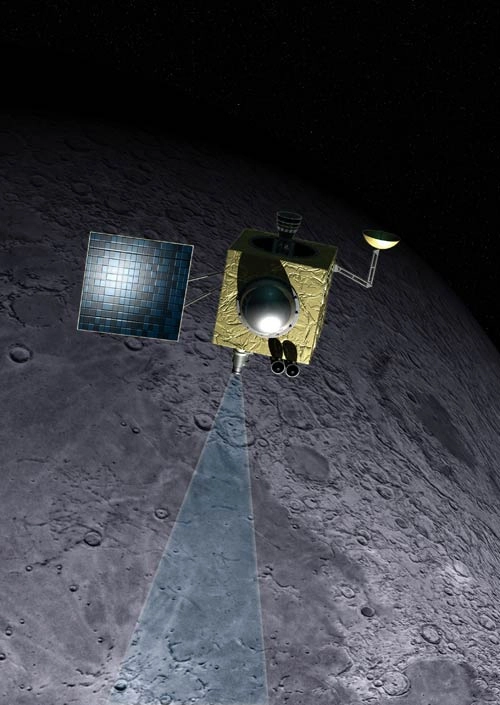
The agencyis already working on the launch of its first unmanned mission to orbit themoon early 2008. The fresh funding will be used to create facilities fortraining a corps of astronautsand developing crew life support systems, and raising the necessary manpower,ISRO officials said.
- India's Moon Probe to Carry Two NASA Experiments
- Multi-Nation Moon Collaboration Backed
- Top 10 Cool Moon Facts
- IMAGES: Full Moon Fever