





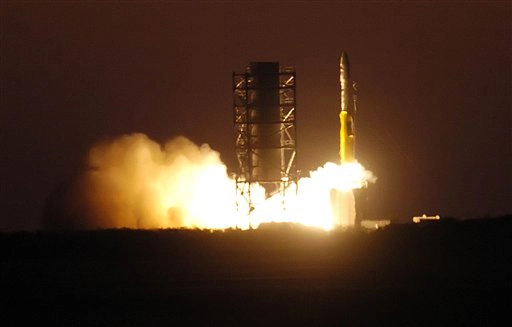
Virginia's Wallops Island hosted itsfirst space launch in seven years this morning when a Minotaur rocketblazed a trail into orbit with a U.S.Air Force demonstration satellite.
Liftoff of the 69-foot tallbooster occurred at 7:00 a.m. EST (1200 GMT) from the Mid-Atlantic RegionalSpaceport on the southern tip of Wallops Island, Va [image].
The four-stage booster flewtoward the rising Sun as it headedsoutheast away from the U.S. East Coast. Deployment of the TacSat 2primary payload came 11 minutes after launch, according to the NASA WallopsFlight Facility.
NASA's tiny GeneSat 1research craft was released into space ten minutes later, and controllerslater confirmed they had received the first signals from the nanosatellite.
The diminutive satellitewill conduct a four-day series of biological tests to observe the behavior ofE. coli bacteria in space. The samples are housed within a miniature laboratoryinside the craft [image].
The Minotaur was targetinga circular orbit about 255 miles high with an inclination of around 40 degrees.
The mission marked thefirst rocket flight into orbit from Wallops since 1999, when an air-launchedPegasus rocket hauled seven communications satellites into space [image]. The lastground-based space launch attempt was more than 11 years ago, and the mostrecent successful orbital launch before Saturday was in 1985.
Saturday's launch waspostponed from Dec. 11 after last-minuteconcerns with TacSat 2's flight software. Engineers spent much of the weekanalyzing the issue before finally clearingthe satellite for launch.
Managed by the Air ForceResearch Laboratory, TacSat 2 is a test bed for potential tactical applicationsfor future military satellites. The 814-pound spacecraft was built by MicroSatSystems, Inc., and the program's partners come from every branch of the U.S. armed forces [image].
TacSat 2's mission isslated to last from six to 12 months, and controllers plan to declare the craftoperational after just one day of test and checkout procedures. The project isdesigned to demonstrate an accelerated manufacturing process and launchschedule with a rapid transition to normal operations after the satellite isdelivered to orbit, according to the Air Force Research Laboratory.
The Air Force's JointWarfighting Space initiative seeks to transform the military's role in space toinclude a fleet of tactical satellites that can serve troops more quickly thancurrent programs.
Another objective of the initiativeis to "operationalize" space to benefit deployed military forces,according to a 2005 presentation by Air Force Brig. Gen. Larry James, formervice commander of the Space and Missile Systems Center.
Officials also hope theprogram will eventually demonstrate the ability to rapidly launch satellites asnecessary, decreasing preparation time from weeks to hours.
TacSat 2 is the first in aseries of planned spacecraft to put the goals of the Joint Warfighting Spaceinitiative to the test.
TacSat 1 is scheduled forlaunch on a Falcon 1 rocket next year, while another Minotaur will launchTacSat 3 in late 2007. TacSat 4 could follow in 2008.
These satellites willconduct further tests for the Joint Warfighting Space program.
Loaded with 11 experiments,the microsatellite will attempt to respond to tactical requests from militaryforces deployed in the field. TacSat 2 carries a 20-inch optical telescope thatshould be able to produce photos of targets soon after orders are given bymilitary commanders.
Imagery will be downlinkedto a ground site at the U.S. Naval Air Warfare Center facility at China Lake, Calif. Officials hope this experiment will lead to reduced response times forimage requests from deployed troops.
"TacSat 2 willdirectly benefit the troop on the ground," said Neal Peck, TacSat 2program manager. "By demonstrating that it can communicate directly withthe China Lake facility, TacSat 2 can directly talk to any common data linkcompatible ground station across the globe."
Also among TacSat 2'sexperiments are an ion thruster, a global positioning system occultationreceiver and an experimental thin film solar array. The spacecraft alsofeatures software for autonomous operations, according to an Air Force writtenstatement.
Copyright 2006 SpaceflightNow.com, all rightsreserved.
- Air Force Satellite Cleared for Launch After Glitch
- Software Glitch Delays Commercial Spaceport's First Launch
- Early Morning Rocket Launch Could Surprise East Coast Residents
- Minotaur Rocket to Star in Spaceport's Launch Debut