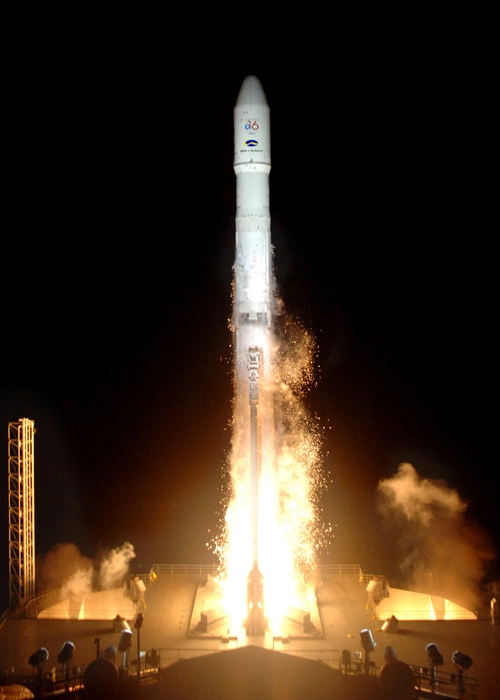
A new broadcastingsatellite for high definition television across the United States roared intospace Sunday from a floating platform in the Pacific Ocean.
The commercial Sea LaunchZenit 3SL booster began the successful 60-minute ascent carrying the Galaxy 16spacecraft at 3:50 a.m. EDT (0750 GMT) from a converted oil-drilling platformpositioned in equatorial waters of the Pacific about 1,400 miles (2,253kilometers) south of Hawaii.
"Another greatlaunch," said Rob Peckham, president and general manager of Sea Launch."We're obviously delighted with today's mission."
The satellite will use anonboard engine to reach a circular geostationary orbit 22,300 miles (3,701kilometer) above the equator where it can match Earth's rotation and seemparked over one spot of the globe. That slot will be 99 degrees West longitudeto cover the continental United States, Alaska, Hawaii, Canada and Mexico.
Once in service, thesatellite will replace the Galaxy 4R craft currently in that orbital position.The satellites are operated by PanAmSat, which flies a fleet of two dozenspacecraft capable of reaching over 98 percent of the world's population.
"We promised customersthat we would have the most extensive and reliable neighborhood of satellitesin the U.S. to deliver standard and HDTV television channels and Galaxy 16expands on that reality. We've also promised shareholders to build satellitesin a capital efficient manner and to launch them with our customers' designrequirements. And that's exactly what we've done: Galaxy 16 takes over forGalaxy 4R and the satellite is nearly sold out," said Joe Wright,PanAmSat's CEO.
"Galaxy 16 is abroadcasters' dream satellite. With its remarkable power and expansivefootprint reaching from Maine to Alaska and Hawaii, it can deliver today andtomorrow's technological advancements. In addition to providing the veryclearest broadcast signal, this versatile spacecraft has the digital muscle todeliver IPTV, HDTV or VOD. Galaxy 16 is one blockbuster of a satellite forexisting and emerging technologies."
This is PanAmSat's 43rdsatellite since Galaxy 1 in 1983 and likely the company's last launch beforeits merger with Intelsat.
"This is our fourthflawless launch," Ken Lee, a PanAmSat vice president, told the crowd ofVIPs monitoring the liftoff from Sea Launch Home Port in Long Beach,California. "Thank you very much."