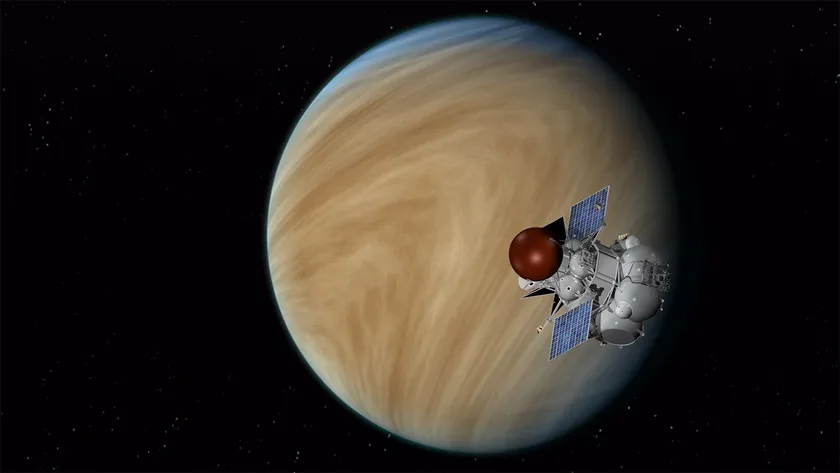
European scientists are
reasonably confident their Venus Express spacecraft will launch to Earth's
nearest neighbor before the tight window of opportunity when the planets are
aligned slams shut in a few weeks.
The mission was supposed to
blast off Wednesday from Baikonur Cosmodrome in Kazakhstan. But contamination
found on the satellite forced launch preparations to stop, putting Venus
Express into an unplanned holding pattern.
The spacecraft was already
mated to its Soyuz rocket inside an assembly building in advance of being
rolled to the launch pad. Then came the discovery of some insulation material
that had come off the Fregat upper stage and was floating free inside the
rocket's nose cone where Venus Express sat encapsulated for launch.
Over the weekend, the
Fregat and spacecraft still tucked inside the nose cone were detached from
the Soyuz for train transport to another facility 25 miles (40 kilometers)
away. The shroud was opened Monday, enabling inspections of Venus Express by
technicians to determine if any damage had occurred by the insulation.
European Space Agency (ESA)
officials said Tuesday that the spacecraft appeared to be in good health.
"The scenario is so
far very encouraging, as only fairly large particles, pieces of the insulating
material initially covering the launcher's Fregat upper stage, have been found
on the body of the spacecraft," ESA said in a press statement.
"These have been easy
to identify by naked eye or with UV lamps, and are being carefully removed with
tweezers, vacuum-cleaners or nitrogen gas airbrushes, according to size."
The cleaning will continue
for the next few days, followed by re-installation of the nose cone and
transfer back to the Soyuz rocket's assembly building.
Although a new launch date
has not been set, liftoff is expected to be targeted for sometime between
November 6 and 9. Venus Express must launch by November 24 to catch the
necessary trajectory from Earth to its destination.
"The ESA Project team
is confident that Venus Express will be launched well within the launch
window," the press statement said.
The probe should reach
Venus five months after launch. It will fire the onboard main engine to enter
orbit around the planet for the most comprehensive examination of the
mysterious Venusian atmosphere and new observations of its surface.
The mission, Europe's first
exploration of Venus, will last two Venusian days or 486 Earth days.
"There are so many
interesting questions about Venus. For example, why is the atmosphere rotating
so fast around the planet while the planet itself is rotating so slowly? We
believe that long ago the temperature was much less than now and that water was
flowing on Venus, but how and when did it disappear?" said Håkan Svedhem, the Venus Express project scientist.
"The whole surface of
Venus has not long ago (in geological terms) been completely changed by
material from the interior streaming out through volcanoes and cracks in the
crust. Is this process still active somewhere on the planet?
"Perhaps the most
fascinating question about Venus is that Venus was once quite similar to Earth,
but now the two planets are very different. Why are they so different now and
when did this change start?"
Venus Express will fly in a
highly elliptical orbit looping from 155 miles (249 kilometers) at its closest
point to 41,000 miles (65,983 kilometers) at the most distant. The EADS
Astrium-built craft carries seven instruments mostly derived from Europe's Mars
Express and the Rosetta comet mission.