JACKSON HOLE, Wyoming - Those work-a-day robots - Spirit and Opportunity - remain steadfast in their Mars research duties. But scientists must face the day when each rover surrenders to electronic or mechanical breakdown, or falls victim to Mars itself.
Both rovers long ago finished their three-month primary missions and even their first mission extensions. The twin robots began their second extra-inning sessions earlier this month.
Although engineers are nursing a nagging problem that affects the steering of Spirit, the rover continues to probe the Columbia Hills at Gusev Crater. Spirit has driven a total of 2.3 miles (3,647 meters) since landing, more than six times the distance set as a goal for the mission.
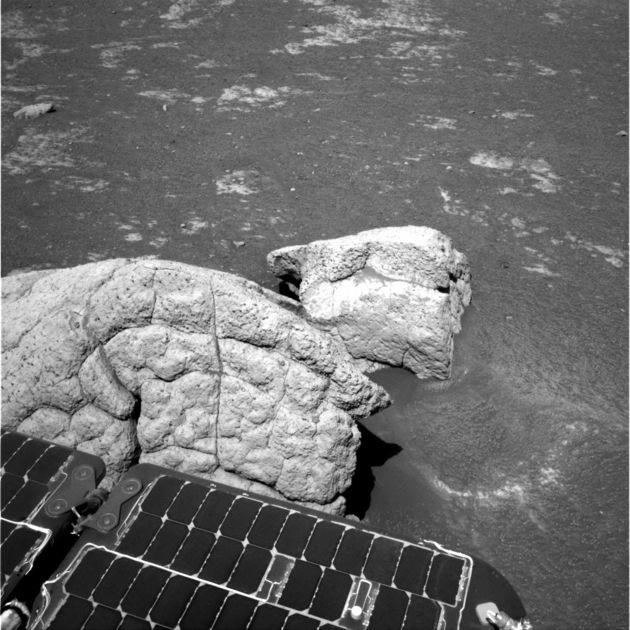
For its part, Opportunity at Meridiani Planum has driven just over a mile (1,619 meters). It has completed observations on a lumpy boulder nicknamed "Wopmay" inside Endurance Crater.
The robot's next assignment is to trek towards "Burns Cliff" on the way to exiting Endurance Crater...and heading out for more adventure.
Digesting volumes of data
"We'll never be finished. I know that the day each rover dies, there's going to be something wonderful just out of reach...because there's been something wonderful just out of reach the entire mission," said Steve Squyres of Cornell University and leader of the science teams for the dual Mars Exploration Rover (MER) project.
How do you prepare for the eventual demise of the Mars machines?
"It's going to happen...and we've just got to deal with it," Squyres told SPACE.com during the Second Conference on Early Mars: Geologic, Hydrologic, and Climate Evolution and the Implications for Life, held here Oct. 11-15.
Digesting the volumes of data from the MER mission is going to take many years, Squyres said. "We've known that from the start. That's the nature of scientific investigation."
Squeezing out science
Squyres pointed out that Mars experts are still purging good science out of the NASA Viking missions - twin sets of orbiters and landers -- sent to the red planet in the 1970s.
The number one duty for the MER team is to squeeze out as much science from each rover as possible, every single day, Squyres explained. "There will be plenty of time to analyze the data."
"We are moving as rapidly as we possibly can to get our results published and out in the scientific literature. But right now, the primary focus and responsibility of my team is the continued operation of those vehicles that are, literally, priceless assets on the surface of another world."
Change of scenery
While the Spirit rover is deep in science at Columbia Hills, a change of scenery awaits Opportunity. To date, the rover has spent over 130 sols perusing Endurance Crater.
A first stop is inspecting a piece of Opportunity's cast off Mars entry hardware that plopped down nearby.
From there, scientists have their eyes set on a huge crater at Meridiani Planum tagged Victoria. "Whether or not we will ever get there...I have no idea," Squyres said.
Victoria Crater is big - six times larger than the stadium-sized Endurance Crater, the feature in which Opportunity is now wrapping up its exploration tasks.
Sand traps, steep slopes, cracks of death?
Yet driving the rover some three miles (5 kilometers) to the south to reach Victoria won't be an easy stroll through rock and sand.
Between the rover and Victoria there is what's called etched terrain.
"Whether or not we will be able to fight our way through that barrier, I haven't the slightest clue," Squyres said.
Imagery snapped by Mars orbiters of that bizarre looking area yield only naive interpretations, Squyres added. There could be sand traps, steep slopes, cracks of death, and other rover-challenging impediments. Nobody knows for sure.
"The point is that if we get to the etched terrain we've got great science to do there. And if we get through the etched terrain, then there's another wonderful target beyond that," Squyres explained. "But it's exploration. We'll go and we'll see."
- Mars Rovers: Special Report