
CAPE CANAVERAL, Fla. -- The fourth in the latest series of Intelsat satellites was safely sent into Earth orbit Saturday.
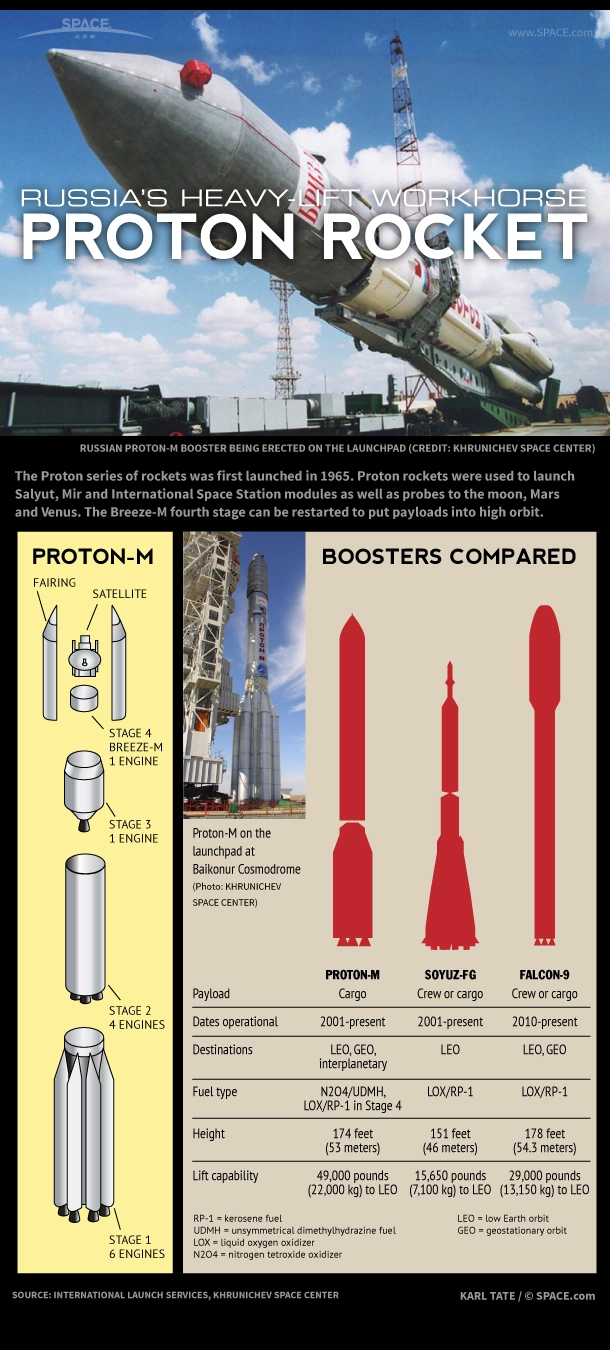
Known as Intelsat 903, the high-power communications spacecraft built by Space Systems/Loral was carried into space by Russia's workhorse Proton K rocket -- launched on a commercial mission marketed and managed by International Launch Services (ILS), a joint venture of Lockheed Martin and Khrunichev.
Liftoff of the four-stage booster from the Baikonur Cosmodrome in Kazakhstan came right on time at 12:25 p.m. EST (1725 GMT).
With its six first-stage main engines glowing white hot, the 200-foot (61-meter) launcher vaulted off its launch pad and brightened the cool night sky over the Kazakh desert.
Some 11 minutes and three spent rocket stages later, Intelsat 903 was in a parking orbit 100 miles (161 kilometers) high -- still attached to the Proton's fourth stage, which is also called the Block DM upper stage.
Two more engine firings from the Block DM took place as scheduled later in the day, setting up a successful spacecraft separation -- and the official conclusion to the launch phase of the mission -- at 7:08 p.m. EST (0008 Sunday GMT), said ILS spokeswoman Fran Slimmer.
The Proton K mission was the 281st for the historic booster that, more recently, was responsible for lifting two major pieces of the International Space Station: namely the Zarya space tug in 1997 and the Zvezda service module in 1999.For Intelsat, this spacecraft launch continues a very busy period as the company deploys its ninth series of communications satellites.
"Intelsat is engaged in the most agressive launch campaign in its history, four satellites a year," said Ramu Potarazu, president of Intelsat Global Service Corp. "Every launch is an operational and engineering marvel."
Hovering over a point on the equator, above the Atlantic Ocean, Intelsat 903 is intended to provide enhanced communications coverage to vessels traveling over the high seas, as well as services targeted for Europe and North America.
Those services include a range of high-powered features such as broadband Internet connectivity, corporate teleconferencing, public telephone service and other telecommunications options.
From a more technical standpoint, the spacecraft is loaded with 76 C-band transponders and 22 Ku-band transponders that have an electronic reach that stretches from the United States and South America to Western Europe and Africa, with some coverage touching Greenland and the edges of Antarctica.
It will take engineers several weeks to fully check out the satellite and declare it operational.
Meanwhile, ILS's next commercial Proton launch will be a DirecTV satellite possibly in April. The company's next Atlas launch will be the inaugural flight of the Atlas 5 Evolved Expendable Launch Vehicle from Cape Canaveral in July. A Eutelsat satellite will be the customer for that historic shot.