

| More About Garuda, Proton's Payload |
| Garuda The ACeS (ASIA Cellular Satellite) Garuda 1 Global MobilePersonal Communications Systems satellite is the worlds first regional satellite-based mobile telecommunications system specifically designed for the Asdian market. |
ACeS began in 1995 as a joint venture between three large Asian communications companies: Pacific Satelit Nusantara (PSN) of Indonesia, the Philippine Long Distance Telephone Company (PLDT) and Jasmine International Overseas of Thailand. In December 1998, a wholly owned subsidiary of Lockheed Martin, called Global Telecommunications, also joined the venture. Not coincidentally, Lockheed Martin builds the Garuda spacecraft, based on its large A 2100 bus.
The Garuda spacecraft is equipped with giant 15-meter (49-foot) umbrella-like L-band antennas, which dwarf the antennas of previous commercial satellites -- usually not larger than 4.5 meters (14.8 feet). They allow it to transmit 16,000 phone calls simultaneously, within 140 spot beams, from a geostationary orbit 36,000 kilometers (22,370 miles) over the equator.
The spacecraft's control center is located on Batam Island, Indonesia.
A hand-held 200-gram (7-ounce) Ericsson phone and a detachable antenna for the ACeS network will cost around $900. Phone calls are expected to cost $1 per minute or less.
Three other cellular satellite networks -- Iridium, ICO and Globalstar -- use a multitude of the low-orbiting spacecraft instead of a geostationary satellite. The industry has been struggling to make ends meet -- Iridium and ICO declared bankruptcy last year.
Garuda 2 and 3
In the first year of operation, the ACeS network will depend entirely on a single spacecraft, which will cover Asia from Papua New Guinea to Pakistan, and from Japan to Indonesia. Operational phone service via the satellite is expected to start in mid-2000.
If Garuda 1 reaches its orbit 123 degrees east over the equator and operates successfully, the second spacecraft, originally conceived as a backup for the original satellite, will eventually extend the ACeS service coverage to Eastern Europe, northern Africa and the Middle East.
ACeS signed an agreement with Lockheed Martin to build Garuda 2 in December 1998. Adi R. Adiwoso, CEO of ACeS, said that the second satellite can be completed within 18 to 20 months, and launched in 2001.
A third spacecraft potentially extending AceS' outreach farther west is also under consideration, Adiwoso told SPACE.com. The spacecraft design will likely have upgrades, such as antennas as large as 16 to 20 meters (55 to 65 feet).
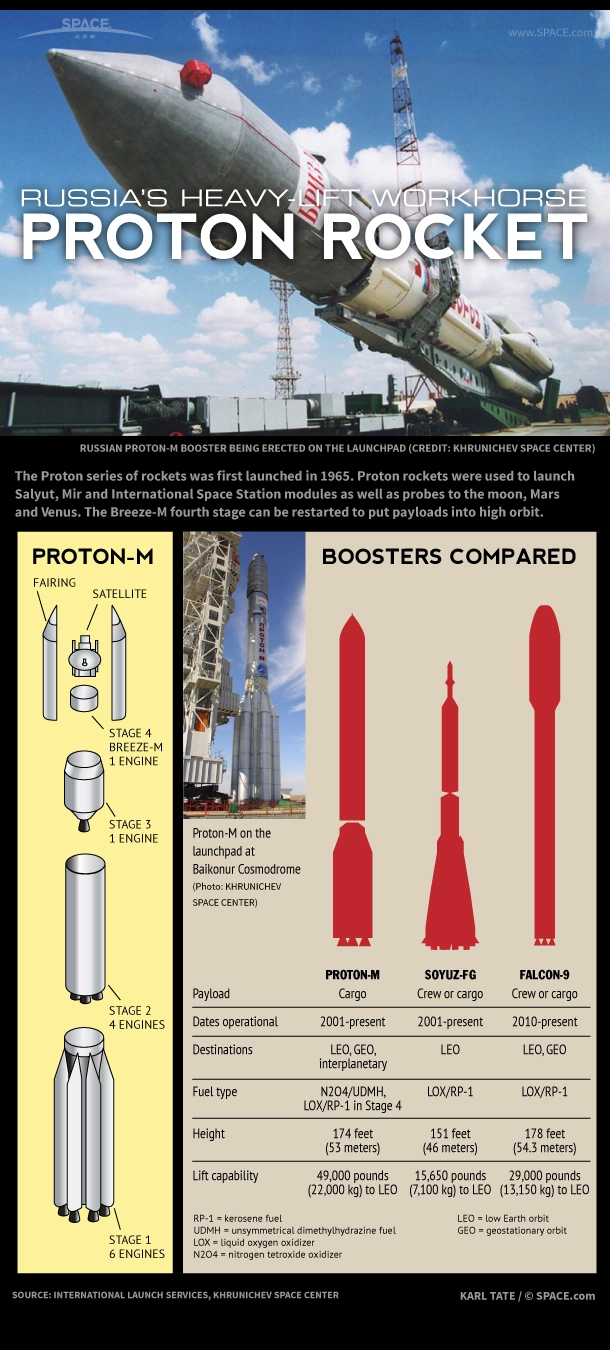
ACeS have not yet chosen a launch vehicle for Garuda 2, however, Adiwoso said that four types of boosters are currently capable of lifting it: Russia's Proton; Europe's Ariane 4-L and Ariane 5; China's Long March 3, as well as the Zenit 3 of the international venture, Sea Launch.
Because Garuda's manufacturer is American, U.S. export restrictions practically eliminate the possibility of using Chinese rockets, leaving three remaining companies as contenders for the second ACeS order. Today, the Proton launch may cost as much as $120 million, comparable to that with Arianespace.
Long road to launch
Back in the middle of the 1990s, when ACeS was choosing a rocket for its first heavy-weight bird, no other commercial launcher could compete with Proton in launch capabilities, price and reliability. At the time, when the agreement to launch Garuda on Proton was reached, the estimated price for the ride on Proton was around $50 million to $70 million.
When Garuda 1, after several production delays, finally made it to Baikonur in the fall of 1999, the Proton schedule was wrecked by a launch failure in July. Encouraged by two successful Proton launches in September, Garuda's launch team crossed the "point of no return" on October 6, loading the spacecraft's tanks with toxic and easily flammable propellants.
As reported in SPACE.com (http://www.space.com/space/launches/proton_launches_991008.html) in October, Garuda had to trade places with Russian Express A 1 communications satellite, since the latter had a priority as a government payload over commercial launches. To make matters worse, a leak in the Block DM upper stage, which was supposed to push Garuda into its geostationary orbit, had recurred shortly before its launch, then scheduled for October 31.
After Express was lost in the October 27 Proton failure, the ACeS faced a difficult choice. The company could either keep its fueled satellite at the launch site, or to return the spacecraft to the manufacturer and look for another launcher. "We ruled out the possibility of draining the fuel and returning the spacecraft back to the U.S.," Adiwoso told SPACE.com.
Instead, the company resorted to leaving the satellite in Baikonur, providing the security personnel to guard the payload. Since the spacecraft could not be stored with the propellant on board for more than six months, the company was anxious to see it to go up as soon as the Proton was declared safe. The insurers, however, pressed the ACeS not let the spacecraft go on the first post-accident launcher.
According to the analysis by INS Baring LLC, the Garuda 1 costs over $420 million, including launch vehicle, insurance and incentive payments.
At the same time, short of cash, the Russian Aviation and Space Agency (Rosaviacosmos) struggled to complete any potential payload which could ride the first Proton in February. "We looked realistically at the possibility of waiting for another several weeks, to allow a [Russian] federal payload to go up first, however, [we] decided it wasn't worth it," Adiwoso said. "We strongly believe [the] Russians have done everything possible to make Proton safe."
Proton corrective measures
Although the commission charged with investigating the Proton crash concluded that all potentially defective engines have been used up in the previous launches or ground tests, Khrunichev wanted to take no chances. The company hired an independent German firm to conduct a thorough inspection of the engines, using the newest methods and equipment.
Reportedly, only a minor imperfection, a piece of hair, had been found in the rocket intended for Garuda -- hardly enough to cause the failure. To further prove the engine's safety, KB Khimmash, the engine's manufacturer, staged a test firing on January 31, intentionally inserting contaminants into the engine. It performed flawlessly in the test.
Finally, the turbopumps that remain from a defective production batch of 1993 have been dissected and analyzed. Although, they worked fine during earlier test firings, the inspection showed erosion of the pump's blades -- the condition that is believed to have downed the Protons in 1999.
RELATED STORIES: