





This story was updated at 6:27 p.m. EST.
DARMSTADT, Germany -- The first pictures revealing the surface of Saturn's moon, Titan, were shown from Europe's Huygens probe, showing what look like drainage channels on the surface of what until today has been a planet totally hidden from view.
The image unveiling marked the end of a successful journey for the hardy Huygens probe and the culmination of 25 years of work by mission managers, scientists, engineers and supporters.
"The European Space Agency deserves a tremendous amount of credit," said NASA's Al Diaz, NASA's associate administrator of the Science Mission Directorate, while appearing to hold back tears during one of many press briefings on the probes status today. "There will only be [one] first successful landing on Titan, and this was it."
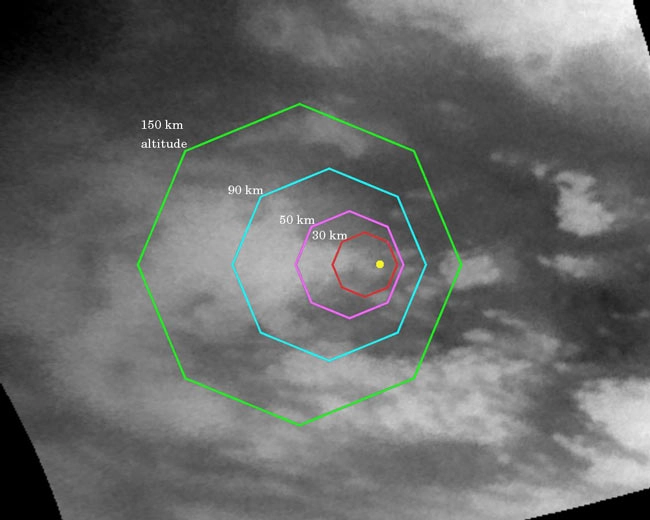
Huygens' first image, taken from an altitude of 16 kilometers, has a ground resolution of about 40 meters, said Martin Tomasko, principal investigator for Huygens' Descent Imager/Spectral Radiometer (DISR). Tomasko said that Huygens research teams now have about 350 pictures to work with. [Scroll to the bottom of this story to see raw image files of the Titan descent taken by Huygens. All images courtesy of ESA/NASA/University of Arizona.]
The image appears to show ravines that could have been carved by the liquid hydrocarbons thought to cover much of Titan's surface. The ravines, stubby drainage-like channels, appeared to funnel toward what appeared to be a shoreline, researchers said during their initial reactions to the image.
"If it's not a sea, it appears to be a lake of tar-like material," said John Zarnecky, principal investigator for the Huygens' Surface Science Package, which is taking data from the surface of Titan.
Zarnecky said the 350 images taken by Huygens of Titan's surface were only about half the anticipated photographic harvest researchers were expecting.
Huygens was originally expected to send more than 700 pictures taken during its 2.5-hour descent to the Titan surface, but one of the two communications channels on the satellite apparently malfunctioned, cutting by about half the number of images received by NASA's orbiting Cassini satellite and relayed to mission control here.


Resounding success
Officials with the European Space Agency (ESA) continued to characterize Huygens as a resounding success despite the disabled communications line, saying almost all Huygens data was sent in duplicate version on both channels and thus has been preserved.
"You have enough information in this one photo to produce several scientific papers," Huygens mission manager Jean-Pierre Lebreton said.
Titan's thick atmosphere has hidden its surface from view from passing satellites.
"Today we are discovering a new world," ESA Director-General Jean-Jacques Dordain said.
During a previous interview with SPACE.com, Tomasko said that finding a new understanding of Titan's surface was one of the fundamental goals of his team's DISR instrument.
"We hope to ultimately get 20 panaromic images," Tomasko said then via telephone, adding that during its parachute descent, the DISR camera had a resolution akin to that of the human eye.
A teary landing


There was much celebration at Huygens mission control here when the successfully landed on Titan between 1345-1346 local time here (CET), which was about 7:45-7:46 a.m. EST.
But there was even more jubilation at 11:19 a.m. EST, when confirmation that Huygens had relayed quality data home.
"We have it? We have it!" said one mission team member before the mission control room erupted with applause and triumphant shouts
Communications signals took just over an hour to traverse the vast distances between Titan and Earth.
U.S. and European officials had trouble holding back tears and cheers as they learned, after long minutes of tense staring into computer screens at mission control center here, that data from the descent was finally reaching Earth.
"We have a scientific success,'' Dordain said in a press briefing. "We will now be able to start breaking Titan's secrets."
Earlier in the day, Dordain and other ESA officials were touting Huygens as a marvel of human engineering for its spot-on landing and near-clockwork descent toward Titan.
Originally expected to send perhaps 2.5 hours worth of data to the NASA's Cassini orbiter for later delivery to Earth, Huygens was still sending signals five hours after activation, and researchers said the probe's robust battery could last up to seven hours total.
Huygens has also been sending limited data directly to Earth, where it has been picked up by a network of telescopes. The detailed data about what it found on its way through Titan's thick atmosphere has been sent to NASA's Cassini orbiter overhead.


NASA's Cassini orbiter has also sent an initial data set of its own to ground teams. It will be several hours more before scientists decipher this information. But the mission has already cleared several of its biggest hurdles and ha s demonstrated enough to be declared a major event in the history of space science.
"This is a historic event," ESA Science Director David Southwood said. "The torch has now been passed from the engineers who delivered the probe and got the data sent to Cassini to the scientists who will evaluate the data."
Choking back tears, Diaz, who worked on the Cassini-Huygens mission for years before taking up his current post, said "It's up to ESA to take this data and turn it into science."
Diaz and Dordain embraced after they learned that Huygens' initial data was received by Cassini and ground telescopes confirming the initial success of the mission.
Officials said Cassini would continue to send its data packets in the coming hours. It is this data that will disclose details of what Huygens saw on its two-hour descent.
SPACE.com Staff Writer Tariq Malik contributed to this report from New York City.
Touchdown on Titan: Huygens Probe Hits its Mark
SPACE.com Special Report: Cassini-Huygens at Saturn and Titan


