





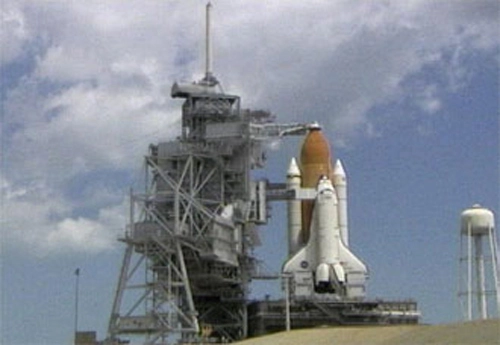
CAPECANAVERAL - NASA faces a number of hurdles in its bid to return the shuttlefleet to service, but managers are confident Discovery will fly in July.
Nowperched on Kennedy Space Center's launch pad 39B, Discovery is scheduled toroll back to the Vehicle Assembly Building on Thursday for extra safetymodifications.
Thespaceship will be outfitted with a new external tank and then moved back to thepad. The ultimate aim is to have Discovery ready for a test flight to theInternational Space Station at the opening of a launch window that extends fromJuly 13 to July 31.
"Weroll back out to the pad in mid-June, and that sets us up fine for thebeginning of the launch window," said Mike Leinbach, a Scottsmoor residentwho leads the shuttle launch team.
"Theonly thing that would change that is if we determine that we want to do someother testing," added Bill Parsons, a Merritt Island resident and NASA'stop shuttle program manager.
Challengesahead include passing extra safety inspections and completing work on therecommendations of the Columbia Accident Investigation Board.
Amongthe unresolved issues:
- Landing gear door inspections.
NASAis delaying Discovery's rollback so technicians can inspect mechanical linkagethat opens the shuttle's main landing gear doors and holds them in place.
Asmall crack was found on the linkage on Atlantis' right main landing gear door,and engineers want to make sure Discovery doesn't have the same problem. Thelinkage on Atlantis is being replaced. No cracks were found on Endeavour.
- An external tank swap.
OnceDiscovery is back in the 52-story assembly building, technicians will removethe shuttle orbiter from its external tank and attached solid rocket boosters.
OnJune 7, the orbiter will be connected to a tank-booster set NASA had planned touse on its second post-Columbia flight.
Thenew tank is being outfitted with a heater designed to keep ice from buildingaround a 70-foot propellant line on the outside of the fuel-reservoir.
NASAmanagers decided the heater is needed after a dangerous amount of ice formed onthe propellant line on Discovery's current tank when it was filled withsupercold liquid hydrogen and liquid oxygen during a mid-April fuel-loadingtest.
Engineersfeared ice could break off during flight and damage the shuttle's heat shield.
A1.7-pound chunk of external tank foam insulation blasted a six- to 10-inch holein Columbia's left wing, allowing hot gas to tear the ship apart during re-entry.
- A potential third fueling test.
NASAwill decide by early June whether to conduct another tanking test beforeclearing Discovery for launch.
Aninitial test was done to check out safety changes that have been made to thetank since the Columbia accident. A second test was carried out last week topinpoint the causes of valve and sensor problems that cropped up during thefirst test.
ShouldNASA decide another is needed, the planned July 13 launch likely would bedelayed a few days, Parsons said.
- The completion of an independent review.
Agroup of experts led by former astronauts Tom Stafford and Richard Covey mustcomplete an assessment of NASA's work to implement recommendations made byaccident investigators.
NASAhas finished work on seven of 15 return-to-flight recommendations, which rangefrom fixing the tank to providing astronauts with ways to make emergencyrepairs in space.
Thegroup will meet with shuttle program officials the week of June 6 to reviewwork done on six of the recommendations. Work on the other two recommendations-- fixing the tank and hardening the skin of shuttle orbiters -- is expected tobe complete by late June.
Published under license from FLORIDATODAY. Copyright ? 2005 FLORIDA TODAY. No portion of this materialmay be reproduced in any way without the written consent of FLORIDA TODAY.
- Fixing NASA: Complete Coverage of Space Shuttle Return to Flight