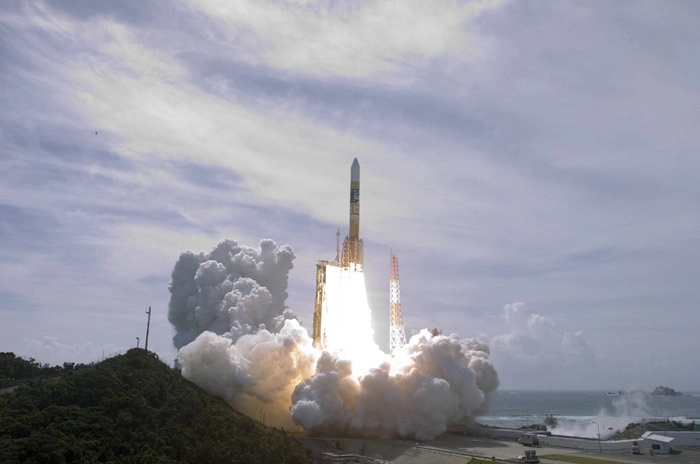
TOKYO (AP) -- Japan's spaceagency said Wednesday that its lunar probe has performed flawlessly so far,five days after the craft's launch marked a giant step forward for Tokyo inAsia's undeclared space race.
The Selenologicaland Engineering Explorer -- or SELENE -- probe was launchedlast Friday and is slated to orbit the Earth twice before proceeding to themoon where it will gather data to be used to study its evolution.
"The flight has beenproceeding smoothly to this point. We haven't had any reports of problems withany of the equipment," said Seiji Toyama, a spokesman for the JapanAerospace Exploration Agency, or JAXA.

The 32-billion yen (US$279million; euro201 million) SELENE began the first of a series of courseadjustment maneuvers Wednesday morning as it neared the end of its firstorbit around the Earth, Toyama said.
JAXA describes the SELENEproject as the largest lunar mission since the U.S. Apollo program in terms ofoverall scope and ambition, outpacing the former Soviet Union's Luna programand NASA's Clementine and Lunar Prospector projects.
The SELENE's missioninvolves placing the main satellite in orbit at an altitude of about 100kilometers (60 miles) and deploying the two smaller satellites in polar orbits.Researchers will use data gathered by the probes to study the moon's origin andevolution.
The mainorbiter will remain in position for about a year.
The probe's launch, whichcame four years behind JAXA's original schedule, comes as China is rumored tobe planning to launch its own lunar probe.
The country's minister ofdefense and technology told China Central Television in July all was ready fora launch "by the end of the year."
China'sChang'e 1 orbiter will use stereo cameras and X-ray spectrometers to mapthree-dimensional images of the lunar surface and study its dust.
Japan launched a moon probein 1990, but that was a flyby mission, unlike SELENE, which is intended toorbit the moon.
It canceled another moonshot, LUNAR-A, that was to have been launched in 2004 but had been repeatedlypostponed because of mechanical and fiscal problems.
TheSELINE was launched aboard one of the space program's mainstay H-2A rocketsfrom Tanegashima, the remote island where the agency's space center is located.
- VIDEO: An Unusually Cool Lunar Eclipse
- IMAGES: Full Moon Fever
- Top 10 Cool Moon Facts