





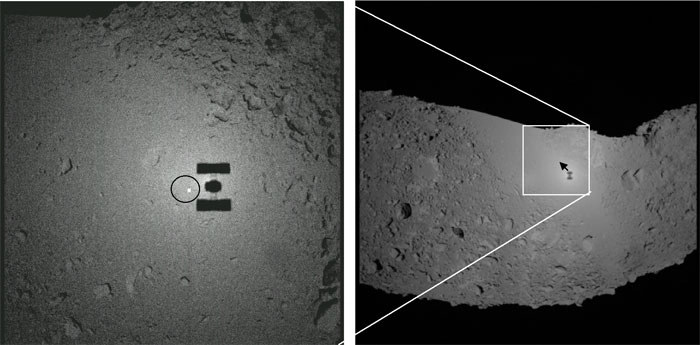
TOKYO (AP) -- Japan's space agency saidWednesday its spacecraft had successfully touched down on an asteroid 180million miles from Earth despite an earlier announcement that it had failed.
On Sunday,JAXA officials had said the Hayabusa probe, on a mission to land on theasteroid named Itokawa, collect material, then bring it back to Earth, failedto touch down after maneuvering within yards of the surface.
However,the agency said Wednesday that data confirmed that Hayabusa had landed on thesurface Sunday for a half-hour, although it failed to collect material.
JAXAofficials had said earlier that Hayabusa dropped a small object as a touchdowntarget from 130 feet above the asteroid and then descended to 56 feet from thesurface, at which point ground control lost contact with the probe for aboutthree hours.
But afteranalyzing data, the agency said the probe landed on the asteroid within about99 feet of the initial landing target.
The agencyofficials were still analyzing the data and will decide by Thursday whether toconduct a second landing attempt Friday, according to Seiji Koyama, a spokesmanfor the space agency.
The missionhas been troubled by a series of glitches.
A landing rehearsalearlier this month was aborted when the probe had trouble finding a site, and asmall robotic lander that deployed from the probe was lost. Hayabusa alsosuffered a problem with one of its three gyroscopes, but it has since beenrepaired.
Hayabusawas launched in May 2003 and has until early December before it must leaveorbit and begin its long journey home. It is expected to return to Earth andland in the Australian Outback in June 2007.
Theasteroid is named after Hideo Itokawa, the father of rocket science in Japan, and is orbiting the sun between Earth and Mars. It is 2,300 feet long and 1,000 feetwide.
Examiningasteroid samples is expected to help unlock secrets of how celestial bodieswere formed because their surfaces are believed to have remained relativelyunchanged over the eons, unlike those of larger bodies such the planets ormoons, JAXA said.
A NASAprobe collected data for two weeks from the Manhattan-sized asteroid Eros in2001, but did not return with samples.