


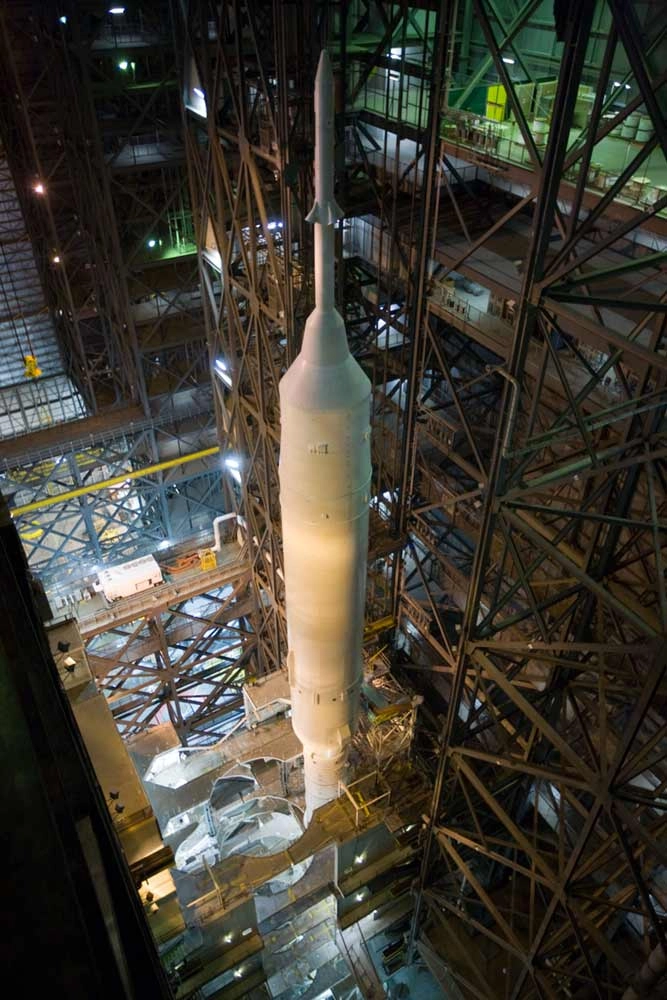
NASA has pushed back the launch target for the space shuttle Atlantis to Nov. 16 — a four-day slip — to give its new Ares I-X rocket an extra chance to blast off, agency officials said Monday.
The new shuttle target will allow NASA to squeeze in a third launch try for its Ares I-X mission, a suborbital rocket test flight slated to blast off Oct. 27 at 8 a.m. EDT (1200 GMT).
"This opens up three launch opportunities for Ares I-X," NASA spokesperson Allard Beutel told SPACE.com today.
The towering Ares I-X rocket is due to roll out to its seaside Pad 39B launch site at the Kennedy Space Center in Florida at 12:01 a.m. EDT (0401 GMT) tomorrow. The test flight has a four-hour launch window each day between Oct. 27 and Oct. 29.
The test flight will be the demonstration debut for NASA's 327-foot (100-meter) Ares I rocket, a two-stage booster designed to loft the Orion capsules slated to replace NASA's space shuttles. It is aimed at testing ground operations and demonstrating the Ares I launch concept through first stage separation, mission managers have said.
The Ares I-X rocket includes a four-segment solid rocket booster capped with a dummy fifth segment (to complete the first stage), as well as a dummy second stage, Orion capsule and abort system. The Orion mock-up and dummy abort system and second stage will be dumped in the Atlantic Ocean after launch.
NASA will broadcast the Ares I-X rocket's launch pad rollout live on NASA TV beginning tonight at 11:45 p.m. EDT (0345 Oct. 20 GMT). The process of hauling the 1.8 million-pound (816,466 kg) rocket out to Launch Pad 39B, a 4.2-mile (6.7-km) trip, is expected to take seven hours.
More realistic target
Atlantis was initially targeted to lift off Nov. 12 from the Kennedy Space Center, though NASA faced hurdles for that liftoff because of a schedule conflict with an unmanned Atlas 5 rocket also due to launch from the nearby Cape Canaveral Air Force Station next month.
Beutel said the new launch target removes that concern and eases other conflicts between shuttle preparations and the Ares I-X flight.
Some of the workers preparing the Ares I-X rocket for flight are also required to help Atlantis' six-astronaut crew perform a launch dress rehearsal, which was originally scheduled for this week. Shuttle commander Charlie Hobaugh and his crew arrived at the Kennedy Space Center earlier today for the training session.
To smooth over those conflicting duties, NASA rescheduled the launch dress rehearsal for Nov. 3, Beutel said. In the meantime, Hobaugh and his crew will tackle some training work this week, then return to the space center next month for the final launch practice, he added.
"This provides a more realistic target date,' Beutel said.
Despite the new launch date, NASA still does not currently have time booked on the Eastern Range — which it shares with the Air Force for space launches — to make the Nov. 16 liftoff attempt. Any launches on the Eastern Range, a region that stretches out over the Atlantic Ocean, are typically separated by least two days as a flight buffer.
An unmanned Delta 4 rocket carrying a communications satellite currently has a firm Nov. 18 launch date from the Cape Canaveral Air Force Station, Beutelsaid. But NASA would also like at least several launch opportunities before its November window closes Nov. 19, he added.
Making matters more convoluted are meteor showers that peak in November and December, as well as a space station crew rotation scheduled for December. NASA is currently working Atlantis' flight around those potential conflicts as well.
"It is very complicated. It is very complex," said John Shannon, NASA's space shuttle program manager, in a Friday briefing. "It's very difficult to put very complicated plans in place."
The window to launch Atlantis closes around Nov. 19 due to unfavorable sun angles at the International Space Station, which can lead to heating and power concerns for a visiting shuttle. If the shuttle cannot lift off in November, NASA could try again during a seven-day window that opens Dec. 6. The next chance after that would be in February, Shannon said.
Atlantis' STS-129 mission will be NASA's fifth shuttle flight of the year. The 11-day spaceflight will launch six astronauts on a delivery run to ferry vital, and large, spare parts to the space station. Three spacewalks are planned during the flight.
The shuttle astronauts said last week that they were not worried about the lack, at that time, of a firm launch date.
"It's not a big issue for us. We'll go whenever," Hobaugh told SPACE.com last week, adding that the uncertainty affects the crew's loved ones more since they are trying to attend the liftoff. "A shuttle mission's a tough thing to see, but it's also a very unique and special event. You'd like to think that people would be able to make it."
SPACE.com will provide full coverage of NASA's Ares I-X test flight with Managing Editor Tariq Malik and Staff Writer Clara Moskowitz. Click here for full mission coverage. Live rollout coverage begins at 11:45 p.m. ET.
