The Mars rover Spirit is keeping scientists' spirits up by doing some science while it is stuck in soft soil on the red planet.
The rover has been immobile, trapped hub-deep since May 6. Engineers have replicated the landscape in lab back home and, using an identical rover model, tried to figure out what to do, so far to no avail.
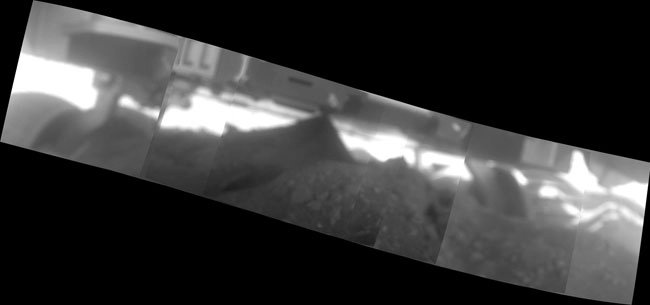
A rock seen beneath Spirit in images from the camera on the end of the rover's arm may be touching Spirit's belly, NASA said in a statement today. It appears to be a loose rock not bearing the rover's weight.

Meanwhile, the rover is examining its surroundings, a colorful, layered region called Troy, next to a low plateau called Home Plate and about 2 miles (3.2 km) from its 2004 landing site. And fortuitously, one of the rover's wheel's dug into the layers of soil, exposing stuff to study.
"By serendipity, Troy is one of the most interesting places Spirit has been," said Ray Arvidson of Washington University in St. Louis. Arvidson is deputy principal investigator for the science payloads on Spirit and its twin rover, Opportunity. "We are able here to study each layer, each different color of the interesting soils exposed by the wheels."
Lucky misfortune
The wheel exposed colored sandy materials and a miniature cliff of cemented sands. Some disturbed material cascaded down, evidence of the looseness that will be a challenge for getting Spirit out. But at the edge of the disturbed patch, the soil is cohesive enough to hold its shape as a steep cross-section.
Spirit has been using tools on its robotic arm to examine tan, yellow, white and dark-red sandy soil at Troy. Stretched-color images from the panoramic camera show the tints best.
"The layers have basaltic sand, sulfate-rich sand and areas with the addition of silica-rich materials, possibly sorted by wind and cemented by the action of thin films of water. We're still at a stage of multiple working hypotheses," Arvidson said. "This may be evidence of much more recent processes than the formation of Home Plate…or is Home Plate being slowly stripped back by wind, and we happened to stir up a deposit from billions of years ago before the wind got to it?"
Scientists said initial readings suggest that iron is mostly present in an oxidized form as ferric sulfate and that some of the differences in tints at Troy observed by the panoramic camera may come from differences in the hydration states of iron sulfates.
While extraction plans for the rover are developed and tested during the coming weeks, the team plans to have Spirit further analyze the soil from different depths.
In April and May, winds blew away most of the dust that had accumulated on Spirit's solar panels, so power is not a problem.
"The exceptional amount of power available from cleaning of Spirit's solar arrays by the wind enables full use of all of the rover's science instruments," said Richard Moddis, a rover team member from the Johnson Space Center. "If your rover is going to get bogged down, it's nice to have it be at a location so scientifically interesting."
Back at the lab
The rover team at NASA's Jet Propulsion Laboratory has developed a soil mix for testing purposes that has physical properties similar to those of the soil under Spirit at Troy. This soil recipe combines diatomaceous earth, powdered clay and play sand. A crew is shaping a few tons of that mix this week into contours matching Troy's.
The test rover will be commanded through various combinations of maneuvers during the next few weeks to validate the safest way to proceed on Mars. Spirit's right-front wheel has been immobile for more than three years, magnifying the challenge.
While acknowledging a possibility that Spirit might not be able to leave Troy, the rover team remains optimistic, NASA said today.
Diagnostic tests on Spirit in early June provided encouragement that the left-middle wheel remains useable despite an earlier stall.
"With the improved power situation, we have the time to explore all the possibilities to get Spirit out," said JPL's John Callas, project manager for Spirit and Opportunity. "We are optimistic. The last time Spirit spun its wheels, it was still making progress. The ground testing will help us avoid doing things that could make Spirit's situation worse."
- Video Show – Rover Tracks
- Another Mars Rover Is Stuck ... in California
- Video – Spirit: The Little Rover That Could