


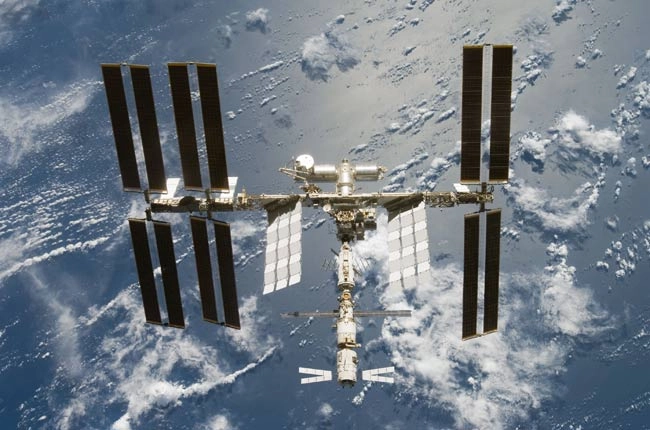
NASA engineers are keeping close tabs on a piece of Soviet-era space trash to decide whether to move the International Space Station before the arrival of the shuttle Discovery on Tuesday.
Discovery launched toward the station with seven astronauts aboard on late Sunday, and is due to dock at the orbiting lab tomorrow at 5:13 p.m. EDT (2113 GMT). But the offending piece of space debris, a remnant from the Soviet navigation satellite Cosmos 1275, will zip close by the station before the shuttle arrives.
"We haven't gotten data in our office yet on how big it is," said NASA spokesperson Kylie Clem at the Johnson Space Center in Houston.
Clem told SPACE.com that flight controllers know the debris is expected to make its closest pass by the space station at 3:14 a.m. EDT (0714 GMT) at a distance of about 2,600 feet (793 meters), Clem said.
If NASA engineers decide they need to move the space station to dodge the space junk, they would fire the rocket engines on the outpost's Russian-built Zvezda service module at about 9:54 p.m. EDT (0154 March 17 GMT) for a short maneuver.
"We don't necessarily need to do the burn until we get more data," station commander Michael Fincke radioed down to Mission Control.
Discovery's STS-119 crew, commanded by Lee Archambault, plan to inspect their space shuttle's heat shield for damage in the first of a series of in-flight surveys to ensure their spacecraft is healthy.
Space debris redux
The Cosmos 1275 debris is the latest piece of wayward space trash to buzz the space station.
Last Thursday, Fincke and his two crewmates had to take shelter inside their Russian Soyuz TMA-13 spacecraft, which doubles as a lifeboat, because of a close shave with a piece of a spent satellite rocket motor.
Flight controllers learned of that conjunction too late to plan an engine burn that would move the space station clear of the debris, which was about 5 inches (13 cm) wide — larger than initially reported — and travelling about 19,800 mph. The space station orbits the Earth at about 17,500 mph.
As a safety precaution, Fincke and flight engineers Yury Lonchakov of Russia and Sandra Magnus of NASA spent about 10 minutes inside the Soyuz. They were ready to shut the spacecraft's hatch and evacuate the space station if the debris slammed into the space station and breached its hull. NASA estimated they would have only had 10 minutes of air if the impact occurred.
NASA typically moves the space station if a piece of debris threatens to fly past the station within an imaginary box around the orbiting laboratory. The box extends about 2,400 feet (732 meters) above and below the space station, as well as 15 miles (24 km) to either side of the outpost.
The amount of space trash has increased in recent months after the Feb. 10 collision of a U.S. and a different Russian satellite, which spewed two debris clouds after the two spacecraft crashed into each other 490 miles (790 km) above Siberia. The new debris has increased the damage risk to NASA's space shuttle and station flights by about 6 percent, or 1-in-318, NASA officials have said.
Discovery is carrying a $298 million set of U.S. solar arrays and a new crewmember, Japanese astronaut Koichi Wakata, to the space station. The new solar arrays and a final segment of the station's backbone-like main truss will be installed during three spacewalks planned for Discovery's flight.
Wakata will replace NASA astronaut Sandra Magnus as a station flight engineer. He is Japan's first long-duration astronaut and due to return to Earth later this summer.
Discovery is due to dock at the space station on Tuesday at 5:13 p.m. EDT (2113 GMT).
SPACE.com is providing continuous coverage of STS-119 with reporter Clara Moskowitz and senior editor Tariq Malik in New York. Click here for mission updates and SPACE.com's live NASA TV video feed.
