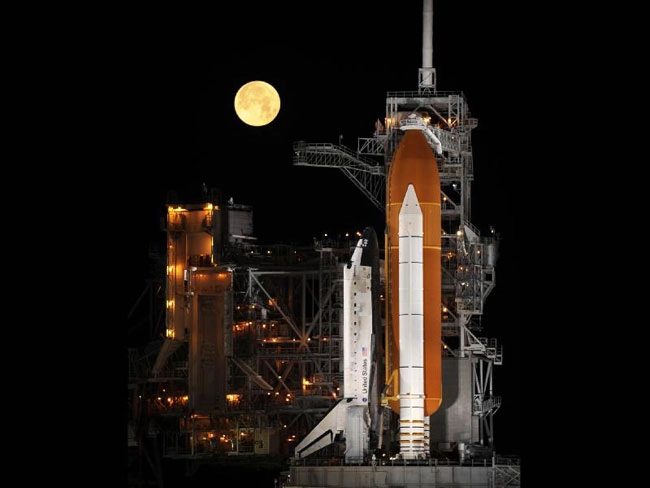
CAPE CANAVERAL, Fla. - The space shuttle Discovery is set to ferry upthe last big American-made piece of the International Space Station after adecade of construction when it launches Wednesday night.
Discovery is poisedto lift off at 9:20 p.m. EDT (0120 March 12 GMT) from a seaside launch padhere at NASA's Kennedy Space Center carrying seven astronauts and the lastsegment of the station's backbone-like main truss, along with a final set of power-generatingsolar arrays. The elements are the last major U.S.-built contribution tothe now 10-year-old space station, which will be 81 percent complete by the endof Discovery?s STS-119 mission.
The new truss, massive girder called Starboard-6 (S6), weighs about 30,000pounds (13,607 kg), and will push the station's total weight to nearly 1million pounds (453,592 kg).

When complete, the space station?s complete 11-segment main truss willspan a distance of 310 feet (94 meters), longer than a U.S. football field. Thestation can already be seen by the naked eye from Earth as a bright, rapidlymoving object.
The $298 million S6 segment was assembled for NASA by Boeing. It is 45feet (13.7 meters) long with two wing-like solar arrays that will have awingspan of nearly 240 feet (73 meters) when fully unfurled. The new solarwings are the station?s fourth set of U.S. solar arrays and will complete itsAmerican-built power grid.
"This is a very special moment to see our last Boeing-designed-and-builttruss go into orbit," said Chuck Hardison, Boeing CAPPS mission managementand operations director. "The space station now is a massive orbitingitem, and something the United States and its international partners should bevery proud of."
NASA plans to launch Discovery?s STS-119 flight and at least eight more shuttlemissions before retiring its three-orbiter fleet in 2010. Eight of those ninemissions are space station construction flights. While there are other NASAcomponents of space station still yet to fly - most notably the European-builtNode 3 module and its Cupola window - none are as large as the S6 segment.
Discoveryastronauts will install the S6 truss segment on the starboard, or right-most,side of the space station during the four spacewalks planned for their mission.
The new additions to the station represent a significant step towardoutfitting the outpost to host crewsof six people, doubled from its current capacity of three. The new solarpanels are expected to boost the station's power-generating capability by 25percent, to a total of about 120 kilowatts of generating capacity, or enough topower about 55 average American houses, Hardison said.
"One of the primary purposes for the power that S6 will beproviding is for going from three- to six-person crews," said Discovery'spayload manager Robby Ashley. "All of the crew systems that are requiredfor that sized crew, takes a lot of power draw."
SPACE.com is providing continuous coverage of STS-119with reporter Clara Moskowitz at Cape Canaveral and senior editor Tariq Malikin New York. Click herefor mission updates and SPACE.com's live NASA TV video feed. Live launchcoverage begins at 4:00 p.m. EDT (2000 GMT).
- New Video - Meet Discovery's STS-119 Shuttle Astronauts
- New Video - Discovery's Mission: Space Station Power Up!
- New Show - NewSpace: The Orbital Industrial Revolution
