This story was updated Mondayat 10:22 a.m. EDT.
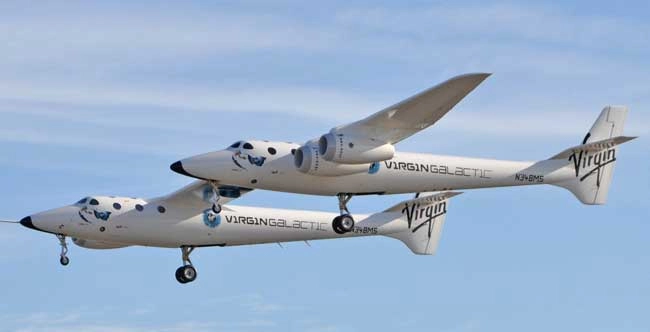
A carrier aircraft designedto be the first stage of a commercial spaceline system made its maiden testflight today at the Mojave Air and Space Port in California.
Designed by ScaledComposites, the huge and uniqueWhiteKnightTwo mothership rolled down the runway and muscled itself intothe air using four Pratt and Whitney PW308A turbofan engines. TheWhiteKnightTwo flew for about an hour, departing the runway at roughly 8:17a.m. Pacific Standard Time, safely touching down at the Mojave Air and SpacePort at approximately 9:17 a.m. PST.
"It's a big day,"said Stuart Witt, general manager of Mojave Air and Space Port. "I thinkit's a real reflective time. When everybody's looking for a bailout, there arestill people that are doing something for a much larger reason," he told SPACE.com.
After a number of shakeoutflights, the WhiteKnightTwo is to be outfitted with the now-under-construction SpaceShipTwo.That rocket plane is also being built by Scaled Composites of Mojave,California. Ultimately WhiteKnightTwo is to carry the space plane to altitude,where it will then detach and head for suborbital space flights.
The WhiteKnightTwo/SpaceShipTwocombo is to serve as the backbone of Sir Richard Branson's Virgin Galactic suborbitalspaceline operations.
Virgin Galactic has onorder five SpaceShipTwo rocket planes and two of the carrier craft, withoptions on more.
Given a progressive rosterof test evaluations at the Mojave Air and Space Port, the spaceline system isto be commercially operated at the now-under-construction Spaceport America inNew Mexico. The price tag per seat on the two pilot/six passenger suborbitalSpaceShipTwo is $200,000.
Flight details
The hour-long test flightof WhiteKnightTwo made use of a minimum flight test crew.
"And here we are on aSunday morning...in a place out here in the middle of nowhere and really neatstuff is happening. It just looked beautiful," Witt said. "Whatbrings people to this desolate landscape on a Sunday morning in December is moreabout what forced them here. Innovation by the private sector is a voidbeing filled because NASA deserted 90 percent of the sandbox and left it openfor us to fill."
A witness to the flight wasDick Rutan who in December 1986 piloted the Voyager aircraft around the worldnon-stop with the assistance of Jeana Yeager. He is brother of Burt Rutan,Chief Technology Officer and Chairman Emeritus of Scaled Composites.
"It all went well...allthe big things worked well," Rutan told SPACE.com."Overall, 99 percent on target and everybody is really happy. You get anairplane that's this weird and get it up and get it down...and it's safe ondeck."
The aircraft'sfirst flight means that Virgin Galactic expects 2009 to be an exciting periodof time, explained Will Whitehorn, President of Virgin Galactic.
"White KnightTwois the world's largest all carbon composite aviation vehicle," Whitehorn told SPACE.com."And of course she really is also a first stage space launch system capable ofcarrying enormous weight to the edge of the atmosphere, training astronautswith her zero to six G flying capability and being a scientific payloadplatform at the same time."
"Mycongratulations to a great team that worked very hard to get our first flightflown before our Christmas break. We had a fun day at Mojave and now know wehave a solid performer that flies beautifully and will soon be moving on to itstasks of launching Spaceships," added Burt Rutan.
Commercial spaceprogram
In 2004, a smallerWhiteKnight carrier plane cradled SpaceShipOne - a launch system that madepossible the first non-governmental piloted rocket ship to fly to the edge ofspace. Back-to-back flights of SpaceShipOne that year earned the ScaledComposites team, $10 million in Ansari X Prize money.
On Dec. 15, the New MexicoSpaceport Authority (NMSA) announced that SpaceportAmerica has received its Record of Decision and license for vertical andhorizontal launch operations from the Federal Aviation Administration's Officeof Commercial Space Transportation.
In related news, a few dayslater, the NMSA announced the selection of Gerald Martin ConstructionManagement of Albuquerque, New Mexico, to oversee the construction of SpaceportAmerica.
The governmental approvalsand the selection of the construction firm are the next steps along the road toa fully operational commercial spaceport, noted NMSA Executive Director StevenLandeene. "We are on track to begin construction in the first quarter of2009, and have our facility completed as quickly as possible," Landeenesaid in a press statement.
The NMSA is expected tohave a signed lease agreement with Virgin Galactic later this month.
The NMSA currently projectsvertical launch activity at Spaceport America to increase in 2009 andconstruction to also begin next year on the terminal and hangar facility to beutilized for Virgin Galactic operations. Those structures would be completed bylate 2010.
- Video - Space Tourism: Virgin Galactic Way - Part 1, Part 2
- Video - SpaceShipTwo Revealed
- Images - SpaceShipTwo Mothership Unveiled
Leonard David has beenreporting on the space industry for more than four decades. He is past editor-in-chiefof the National Space Society's Ad Astra and Space World magazines and haswritten for SPACE.com since 1999.