


BANGALORE,India - India's Chandrayaan-1 lunar orbiter has successfully tested a vital cameraand performed an orbit-raising maneuver that puts it on course to reach the moonby this weekend.
TheIndian Space Research Organisation (ISRO) said Tuesday that Chandrayaan-1, thecountry?s first-evermoon probe, entered its lunar transfer trajectory after a fifth and finalorbit-raising maneuver carried out early that day. During the maneuver, thespacecraft's rocket engine fired for about 150 seconds, raising its apogee toabout 236,121 miles (380,000 km) - the moon's average distance fromEarth.
"Chandrayaan-1will approach the moon on November 8, 2008, and the spacecraft's liquid enginewill be fired again to insert the spacecraft into lunar orbit," ISROofficials said. All systems onboardthe spacecraft are performing normally, they added.
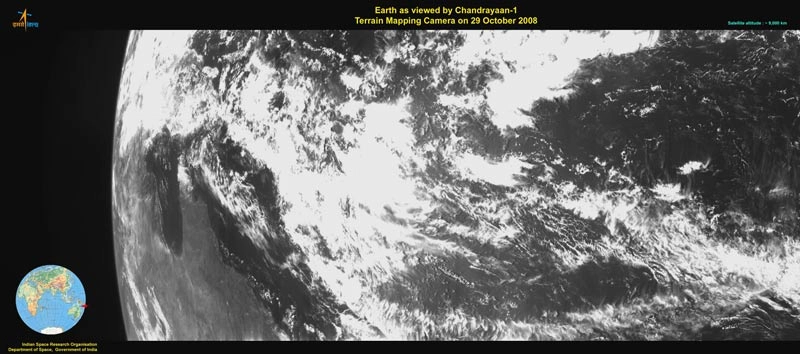
The 3,042-pound (1,380-kg) Chandrayaan-1 has already beamed back the first imagesfrom the Terrain Mapping Camera it will use to map the lunar surface.
ISROofficials unveiled some of the images Friday, revealing a view of Australia fromhigh above Earth. The camera, to be used to map the lunar surface with a groundresolution of 16.4 feet (5 meters), is one of 11 instruments aboardChandrayaan-1.
Chandrayaan-1snapped the photos on Oct. 29, spotting first the northern coast of Australiafrom an altitude of about 5,592 miles (9,000 km) at about 8:00 a.m. Local Time in India. About 4 1/2 hours later, the probe caught country?s southern coast from aheight of 43,495 miles (70,000 km).
Indialaunched the $87 million Chandrayaan-1 spacecraft toward the moon onOct. 22. The lunar orbiter includes a 64-pound (29-kg) impact probe,which it will release to crashinto the lunar surface, and carries five Indian instruments and six othersprovided by the U.S., Britain, Sweden, Germany and Bulgaria.
Chandrayaan-1will join Japan?sKaguya orbiter and China?s Chang?e 1 spacecraft at the moon when it arrivesin lunar orbit this weekend. The Japanese and Chinese probes launched in 2007.NASA plans to launch its next moon probe, the Lunar Reconnaissance Orbiter, inSpring 2009.
SPACE.com staff contributed to this report from New York City.
- New Video - Chandrayaan-1: India's First Moonshot
- Video - Japan's Kaguya Sees Full Earthrise!
- Mooncrash! The Greatest Lunar Impacts Ever