


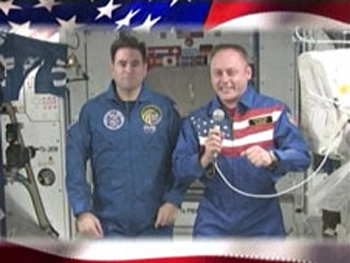
While mostAmericans will flock to the polls Tuesday to cast their vote for the next U.S.president, two U.S. citizens will beam their ballots down from theInternational Space Station as they fly 220 miles (354 km) above Earth.
Like allU.S. spaceflyers since 1997, NASA astronauts MichaelFincke and Gregory Chamitoff can vote in their local and national electionsthanks to a handy Texas state law that ensures their ballots can be counted, evenfrom space.
?So I?mgoing to exercise my privilege as a citizen and actually vote from space onElection Day,? Fincke, the space station?s Expedition 18 commander, told SPACE.combefore he left Earth. ?I think the candidates this year are exciting in and ofthemselves. But hopefully we get people to realize what a privilege it is, andthey exercise and get a chance to vote.?
Only four Americans in NASA?s 50-year history have voted from space, largelybecause the Texas law allowing was passed just 11 years ago, said NicoleCloutier-Lemasters, a spokesperson with NASA?s Johnson Space Center in Houston,Texas. And just one of those four, now-retiredspaceflyer Leroy Chiao, voted during a presidential election in 2004 whilecommanding the space station?s Expedition 10 crew.
?I was sobusy preparing for my ISS mission in 2004 that I almost forgot about the factthat I would be in space during that U.S. presidential election,? Chiao told SPACE.com,adding that it was his wife Karen who remembered he?d be in orbit on ElectionDay. ?As she and NASA looked into it, the process turned out to be fairlystraightforward. Another astronaut had already voted from space earlier for astate election, so the law allowing this was already established. It wasjust a matter of applying it to the presidential election.?
The 1997 Texasbill allowed NASA?s first orbital voter David Wolf to cast his ballot fromRussia?s Space Station Mir, Cloutier-Lemasters told SPACE.com. AstronautsMichael Lopez-Alegria and Clayton Anderson also voted during their separatemissions to the International Space Station in 2006 and 2007, respectively.
Fincke andChamitoff have been encouragingthe American people to remember that no matter which presidential candidatethey choose, be it a ballot for Barack Obama (D-Ill.) of John McCain (R-Arizona),that they remember to vote above all else.
?Voting isthe most important statement Americans can make in fulfilling a cherished rightto select its leaders,? Fincke said in a NASA TV video with Chamitoff. ?So thisElection Day, take time to go to the polls and vote. If we can do it, so canyou.?
Howastronauts vote from space
The processof voting from space actually begins on the ground. According to the 1997 bill,astronauts in space can cast an absentee ballot from their spacecraft with thehelp of the County Clerk of Harris and Brazoria counties, which contain Houstonand its surrounding area.
The CountyClerk?s office prepares a secure electronic ballot that is then relayed to theInternational Space Station via NASA?s Mission Control room at the JohnsonSpace Center. Meanwhile, the Clerk?s Office sends a separate e-mail to theastronaut with login information to access the ballot and vote.
?So there?sthis plan in place and I?ll have an electronic ballot and be able to vote fromup here,? Chamitoff told SPACE.com from the space station recently.
Thecompleted ballot is then beamed back to Mission Control and sent back to theCounty Clerk?s office to be tallied.
Theprocess, Chiao explained, is an appreciated link to life on Earth among NASA?sspaceflyers.
?I wasthankful for everyone making it possible for me to vote from space,? he said,adding that he too hoped it encouraged others to vote. ?I think it was animportant symbolic gesture. Also, it was important to me personally.?
Coincidentally,Chiao is also outside the U.S. during this presidential election, but not in space. He made sure to vote early before departing the country on travel, he told SPACE.com.
There isone drawback to voting from space. Unlike the privacy of a booth on Earth, atleast one other person besides the astronaut will actually know who thespaceflyer voted for, since a voting officer must decrypt the secure form inorder to count it, Fincke said.
?So oneother person, she's going to see who I voted for,? he said. ?If you can't trusther, you can't trust anyone. So it's a pretty solid system.?
- New Video - Two Votes From Space!
- New Video - Space Tourist's Life Aboard ISS
- Video - The Garriotts: An American Space Legacy Part 1, Part 2
