





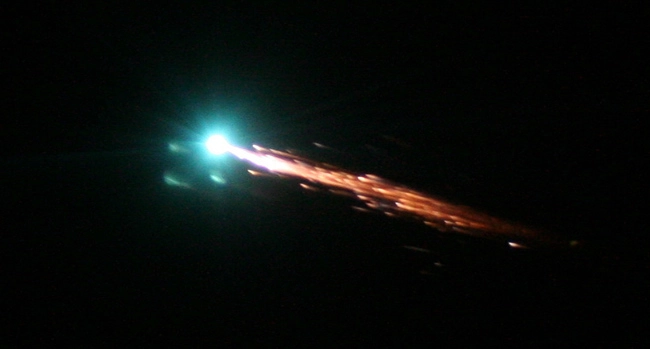
GLASGOW,Scotland — Europe's unmanned space cargo vehicle successfully reentered theatmosphere over the south Pacific Ocean Sept. 29, breaking up into dozens offragments that fell into the ocean along a pre-selected path that had beencleared of maritime traffic, European Space Agency (ESA) officials said.
Programmanagers expect that photographic data from twoaircraft ESA hired from NASA, and an imager aboard the international spacestation flying overhead at the time, will provide precise data on the amount ofdebris that survived reentry.
The agencyreleased pictures of the reentry Sept. 29 that had been taken from one of theNASA planes. The photos showed what they said was ATV as it burned up intoseveral pieces. The reentry had been planned to occur at night to facilitatephotography of the event.
TheAutomated Transfer Vehicle (ATV) undocked from the space station Sept. 5 andthen was guided into position under the station. It had been launched March 9to deliver food, water, fuel and supplies to the station.
ESAcontracted with NASA to lease twospecially fitted aircraft, a Gulfstream 5 and a DC-8, to be in the vicinity ofthe predicted atmospheric reentry.
ATVmanagers had estimated that the vehicle, which had been filled with garbagefrom the space station before undocking, would weigh about 13,400 kilograms onreentry into the atmosphere at an altitude of about 120 kilometers. Simulationstudies concluded that it would break up into some 600 pieces weighing between10 and 150 kilograms each. Of these, several dozen were expected to survive thedescent and to fall into the ocean.
Bycomparison, Russia's Mirspace station weighed more than 100,000 kilograms when it reentered theatmosphere, also in the South Pacific, in 2001.
ATVcontrollers had advised maritime authorities in the region that a no-go zonemeasuring 2,700 kilometers long and 200 kilometers wide should be established.
ESA is expectedto ask its 17 member governments in November for funds to enhance ATV so thatit is capable of surviving reentry to return space station cargo.
SimonettaDi Pippo, ESA's director of human spaceflight, said the successful completionof the ATV mission should help persuade ESA governments that it is worth 200million euros ($300 million) to transform ATV from a one-way asset into avehicle capable of returning several hundred kilograms of experiments back toEarth.
"Thehardest part of the ATV mission had already been accomplished with therendezvous and docking with the station," Di Pippo said here at theInternational Astronautical Congress. "But we still needed to demonstratethe full mission capability. We have now done that today."
- Video: ATV's Successful Mission
- Video Player: "Jules" heads to the ISS
- From Earth to the Station: Europe's First Space Cargo Ship
