


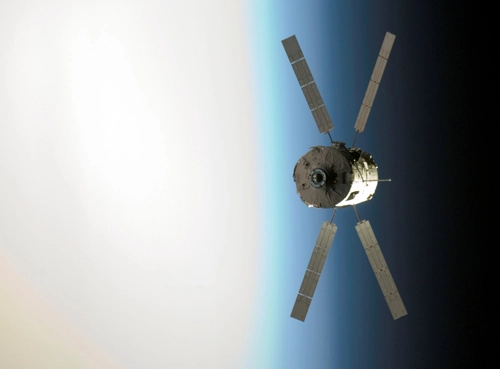
Europe?sfirst orbital cargo ship is pulling double duty as an astronaut washroom and will spend an extra month at the International SpaceStation (ISS).
The EuropeanSpace Agency (ESA) extended the mission of its unmanned spacefreighter Jules Verne, the first of a new fleet of disposable AutomatedTransfer Vehicles (ATV), to September to give the station one more month to draw onits rocket fuel supply.
Since the spacecraft?s April arrival, station astronautshave slept, worked and played inside its roomy interior as they move cargo and,unexpectedly, use its water tank for their daily washing,ESA officials said.
?It?s likewe added a new room onto the aft end of the service module,? NASA astronautPeggy Whitson, who commanded the station during Jules Verne?s arrival, told SPACE.comafter returning home in late April. ?It was just a really incredible increasein volume aboard the space station.?
Jules Verneis a cylindrical spacecraft about the size of a double decker London bus and ispowered by four wing-like solar panels that lend it the appearance of asquat dragonfly in orbit. It measures about 32 feet (10 meters) long and 15feet (4.5 meters) wide.
The extra room is apparently appreciated by station astronauts, who made a special request to use the spacecraft as an extra sleeping space, as well as for bathing and washing their hair with their rinseless, alcohol-free shampoo, ESA officials said.
?The ATV'spressurized cabin offers the crew a large space, a lot of privacy and it alsohelps to keep the station air humidity level lower,? said ESA ATV missiondirector Herv? C?me of the ATV Control Centre in Toulouse, France, in a statement.
Jules Vernelaunched toward the station on March 8 (ET) and spent weeks conductingrendezvous tests beforedocking at the end of the station?s Russian-built Zvezda service module. Thespacecraft is designed to haul nearly 8 tons of cargo to the station — about threetimes that of Russia?s unmanned Progress supply ships — then dispose of trashand unneeded items by burning up over the Pacific Ocean during reentry.
ESAofficials spent 1.3 billion Euros ($1.9 billion) developing Jules Verne andplan to launch four more ATVs to the station in return for including Europeanastronauts on future long-duration missions to the orbital lab.
Thespacecraft is just one of several new additions to the space station this year.In February, astronauts delivered Europe?sColumbus laboratory to the ISS, then followed a month later with a smallstorage room for the space station?s JapaneseKibo module.
Jules Vernedocked at the station on April 3, setting the stage for the delivery Japan?smain Kibo lab, a 37-foot (11-meter) room about the size of a large tourbus. Astronauts aboard NASA?s shuttle Discovery spent two weeks installing the newJapanese module at the station earlier this month.
Meanwhile,in the past week Jules Verne has successfully refueled the space station?srocket propellant tanks and boosted the outpost?s orbit by 4.3 miles (7 km) toan altitude of about 214 miles (345 km) during a 20-minute engine burn.
?JulesVerne is an incredible spaceship; it is performing beyond our best hopes,? saidAlberto Novelli, chief of ESA?s ATV mission operations at the cargo ship?s controlcenter. ?ATV has fulfilled all its objectives perfectly and on top of that,several new functions have been made possible that we did not initially planfor.?
- New Video: Life Inside the Jules Verne Space Cargo Ship
- New Video: Shuttle Discovery's Space Station Victory Lap
- Video: Europe's Special ISS Delivery, ATV Mission Control
