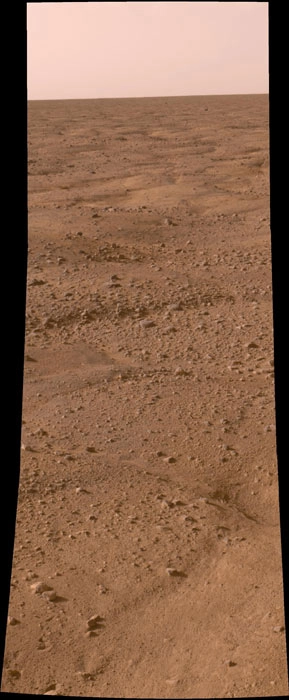
PASADENA, Calif. - NASA?s Phoenix Mars Lander has returned its first imagesfrom the surface of Mars, showing that the probe?s vital solar arrays havesuccessfully deployed and giving scientists their first up-close glimpse of theMartian arctic surface.
Phoenix landed in a northern polar region of Mars called VastitasBorealis late Sunday, with mission controllers here at NASA?s Jet PropulsionLaboratory (JPL) receivingtheir first signals from the spacecraft at about 7:53 p.m. EDT (2353 GMT).
The first image Phoenix was instructed to take was of its solar arraysso that engineers could make sure the craft was getting power. The batteriesPhoenix flew in on have only enough power to last about 30 hours, which wouldhave significantly hampered the lander?s abilities to perform its plannedthree-month mission.

?Phoenix has spread her wings. Is that a pretty sight or what,?exclaimed one engineer when looking at the solar array images in a missionsupport room at Lockheed Martin Space Systems, which built the spacecraft inDenver, Colo. ?We can toss away the contingency plans now,? cried out another.
Applause broke out at Lockheed when the first image of the deployedsolar arrays - and the fact they were latched in position - were relayed homefrom Mars.
"I can hardly contain my enthusiasm,? said Phoenix principalinvestigator Peter Smith of the University of Arizona in a statement from thespacecraft?s control room at JPL. ?The first landed images of the Martian polarterrain will set the stage for our mission."
The images were all in black-and-white, and mostly geared at checking onthe health of the spacecraft, but included the first-ever images of the terrainabove Mars? arctic circle taken from the surface. They showed a surrounding landscapethat looked flat as a pancake.
?This confirms what we saw from orbit,? said Dan McCleese, chiefscientist at JPL. ?Looks like a good place to start digging.?
Scientists weren?t sure they would get any images of the surface so soonafter landing, but were overjoyed at the message they held.
?These images are telling us that we?ve got a healthy configuration forthe spacecraft,? McCleese said.
In addition to the solar arrays, Phoenix?s stereo camera also imaged thecraft?s footpad flat on the dusty Martian surface.
Launched last August, Phoenix?s $420 million mission is aimed at probingbeneaththe Martian arctic surface for water ice to determine whether the regionmay have once been habitable for primitive life. The spacecraft carries arobotic arm, small ovens and beakers, as well as a Canadian-built weather stationto study the northern polar plains of its landing site.
There have been some indications that NASA?s overflying Mars ReconnaissanceOrbiter (MRO) may possibly have snagged imagery of Phoenix drifting under itsparachute as the probe headed down toward its arctic touchdown. If MRO wassuccessful in using its sharp-shooting camera, imagery will be released onMonday.
MRO, NASA?s Mars Odyssey orbiter and the European Space Agency?s MarsExpress spacecraft watched over Phoenix?s seven-minute plunge through theMartian atmosphere and relayed back the probe?s first signals from its landing site.
?It was right down the middle,? said Tim Gasparrini, deputy programmanager for the Phoenix entry, descent and landing at Lockheed Martin SpaceSystems. ?It?s funny. You spend so much time trying to design for stuff that?snot nominal?and then it was as good as it could get,? he told SPACE.com.
- Video: The Nail-Biting Landing of Phoenix on Mars
- Video: Looking for Life in All the Right Places
- The Top 10 Martian Landings of All Time
