





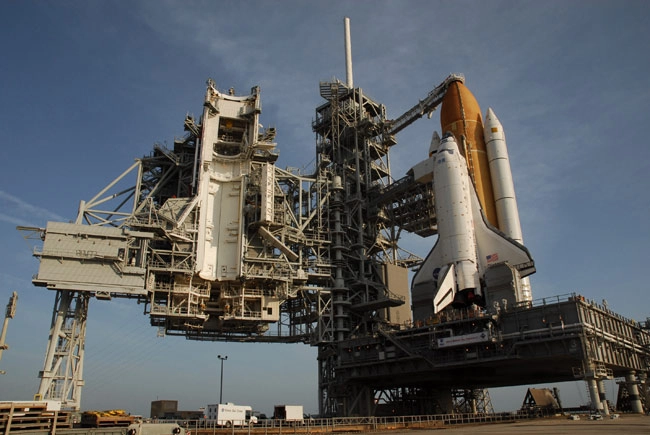
NASA?sshuttle Discovery and its seven-astronaut crew are cleared to launch toward theInternational Space Station (ISS) on May 31 to deliver the high-flying laboratory?slargest orbital room, mission managers said Monday.
Discoveryis officially set to lift off from NASA?s Kennedy Space Center in CapeCanaveral, Fla., on a two-week mission to install Japan?smassive Kibo laboratory at the space station. The shuttle will launch at5:02 p.m. EDT (2102 GMT) on May 31.
?It?s achallenging mission,? said John Shannon, NASA?s space shuttle program manager,during a mission briefing today. ?It?s the largest international partnerlaboratory flown.?
Commandedby veteran shuttle flyer Mark Kelly, Discovery?s STS-124 astronauts plan toperform three spacewalks during their 14-day mission to attach the 37-foot(11-meter) segment of Japan?s Kibo lab, relocate the tour bus-sized module?s attic-likestorage compartment and perform other station maintenance.
They willalso replace American astronaut Garrett Reisman with fellow U.S. spaceflyerGregory Chamitoff during the spaceflight despite an ongoing investigation into theRussian Soyuz spacecraft that serve as emergency lifeboats for station crews.
Soyuzlanding issues
NASAshuttle and station officials considered delaying Discovery?s mission due to anongoing investigation into last month?s harrowing,off-target landing of a Russian Soyuz spacecraft returning three astronautshome from the ISS. Russian engineers are working to identify the exact cause ofthe malfunction - the second in a row for Russia?s Federal Space Agency.
The SoyuzTMA-11 vehicle returned to Earth on April 19 with U.S. station commander Peggy Whitsonand two crewmates aboard. But the spacecraft experienced a module separation problemand a glitch that sent it into a backup, ballisticlanding mode that reentered the Earth?s atmosphere at a steeper-than-normalangle that landed short and subjected the astronauts to extreme G-forces.
AnotherSoyuz spacecraft currently docked at the station, however, is clear for use inan emergency, leaving NASA officials confident that it is safe to replace Reismanwith Chamitoff during Discovery?s STS-124 mission after next week?s launch. Chamitoffis due to return to Earth in November during a subsequent shuttle flight.
?We now knowthat the Soyuz is acceptable for emergency return; it?s acceptable to leave Gregon orbit,? said NASA?s space operations chief Bill Gerstenmaier. ?So that?s ourbasic plan, and that?s the way we?re heading.?
Gerstenmaiersaid that while Russian engineers hope to release their initial findings by theend of the month, a final answer on whether Soyuz spacecraft are clear forroutine use is still pending.
?I don?tthink they?re near a final resolution,? he added. ?It?s going to take a littlebit time for them to work through this to understand what they?ve got and whatthe root cause is.?
New fueltank to fly
Discovery?sMay 31 launch will also include the first flight of an external shuttle fueltank built from scratch with all of the safety modifications stemming from the2003 Columbia accident. A piece of fuel tank foam insulation popped free duringthe shuttle Columbia?s Feb. 1, 2003 launch and damaged the orbiter?s heatshield, leading to its destruction and the loss of seven astronauts duringreentry.
?Thisessentially is the completed return-to-flight tank,? Shannon said of Discovery?sfuel tank. ?I expect this to be the best performing tank that we have had todate.?
Discovery?sSTS-124 mission will mark NASA?s third shuttle flight of the year to deliver anew international room to the space station. The shuttle mission is the thirdof up to five planned for 2008, is the 10th flight since the Columbia accidentand will leave 10 more to follow by 2010, when NASA retires its three-orbiterfleet to make way for its Orion capsule successor.
Theremaining flights this year include NASA?s last flight to overhaulthe Hubble Space Telescope, tentatively slated for an Oct. 8 launch, and aplanned Nov. 10 flight to deliver supplies and equipment to the ISS.
?This flightof STS-124 is going to be something of a milestone in the space shuttleprogram,? Shannon said. ?We?re really hitting the halfway point here.?
- VIDEO: Space Shuttle Bloopers
- VIDEO: Danger on the Pad
- Image Gallery: Shuttle Mission Diary: NASA's STS-123
