


This story was updated at 11:54 p.m. EDT.
HOUSTON — With warm hugs and some laughs, seven astronauts aboard NASA's shuttle Endeavour bid farewell to the crew of the International Space Station (ISS) late Friday after a record construction flight.
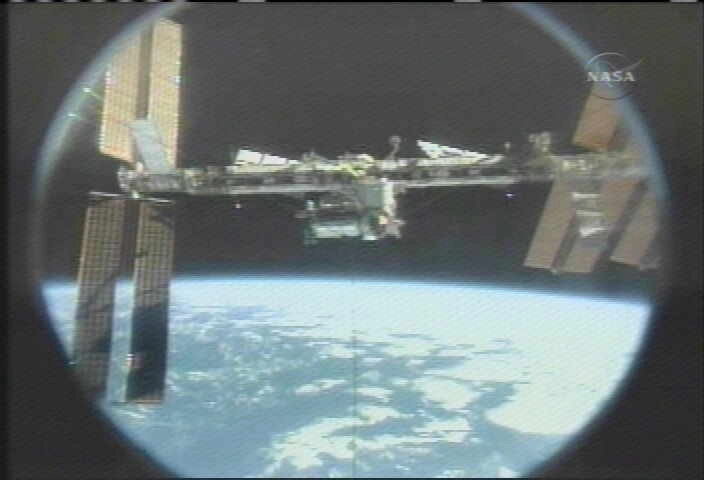
Shuttle commander Dominic Gorie and his crew undocked from the space station at 8:25 p.m. EDT (0025 March 25 GMT) as both spacecraft flew high above the west coast of Australia.
"Thanks, my friends, we'll see you on the ground in about a month," Gorie told the station's crew as the shuttle pulled away.
Gorie and his crew spent 12 days docked at the space station, where they swapped out one crewmember and performed a record five spacewalks to install the Canadian-built Dextre maintenance robot and the first segment of Japan's Kibo laboratory. They are set to land Wednesday night at 7:05 p.m. EDT (2305 GMT) at NASA's Kennedy Space Center in Florida to conclude their 16-day shuttle spaceflight — the longest ever sent to the ISS.
"We really appreciate everything you've done for us over the last couple of weeks," station commander Peggy Whitson told the departing shuttle crew. "Thanks a bunch, and especially thanks for being such a great bunch of guys."
An unsecured solar wing on the station's port side delayed Endeavour's undocking by about a half-hour, but eventually latched into place to protect the array from damage.
Heading home
Endeavour's STS-123 crew spent the bulk of three spacewalks constructing the Canadian Space Agency's Dextre robot, a $209-million automaton with two 11-foot (3.4-meter) long arms designed to replace astronauts on simple repair jobs outside the ISS.
They delivered and opened an attic-like storage room for Kibo, a massive, school bus-sized laboratory built by the Japan Aerospace Exploration Agency and scheduled to launch aboard NASA's shuttle Discovery on May 25. On their two last excursions, spacewalkers tested a shuttle tile repair method and attached Endeavour's heat shield inspection boom to the station's exterior to await Discovery's crew later this year.
"Getting through five [spacewalks] were pretty scary hurdles to overcome and you guys made it easy," Gorie told the station's crew. "It's a strange feeling to want to see our families, but not want to leave a wonderful place."
NASA astronaut Garrett Reisman, who launched aboard Endeavour on March 11 to relieve French astronaut Leopold Eyharts as an ISS flight engineer, rang the station's bell in a tradition adopted from naval departures.
"It's still hard for me to feel like it's already finished," said Eyharts, who has lived at the station since early February. "This was a great time. It has not been boring at all."
Reisman said he was looking forward to his two-month stay aboard the ISS, but lamented the departure of his friends aboard Endeavour.
"I already feel the nostalgia coming on about the STS-123 crew," said Reisman, who participated in the first of the mission's five spacewalks with crewmate Rick Linnehan. "It's just been a wonderful chapter in my life — I'm going to miss you all, except you Rick."
Laughter, a common occurrence during the docked mission, erupted with Resiman's joke.
"We had a great time with you guys," said Whitson, her voice breaking at times. "It's a lot of fun spending time with people you can laugh and joke with. We did a little of that, as well as getting a lot of work done."
A global space station
Endeavour's crew not only completed Canada's three-piece robotics system with the assembly of Dextre, but also delivered Japan's first habitable room in space to mark an ISS milestone, mission managers said.
"We now have all of the international partners represented in orbit," said Mike Suffredini, NASA's space station program manger, late Monday.
Aside from a minor lighting glitch inside the new Kibo module, and a required software patch to fix joint glitches on Dextre, both station additions are doing well, station managers said.
Japan"s Kibo storage module joins the station's U.S., Russian, Canadian and European segments even as another international component — Europe's first unmanned cargo ship Jules Verne — prepares for a series of docking tests and a planned April 3 arrival at the ISS.
"I am very happy to be neighbors of all of our partners now," Tetsuro Yokoyama, operations project deputy manager for Japan's Kibo, after Endeavour's station departure.
NASA is broadcasting Endeavour's STS-123 mission live on NASA TV. Click here for SPACE.com's shuttle mission coverage and NASA TV feed.
