


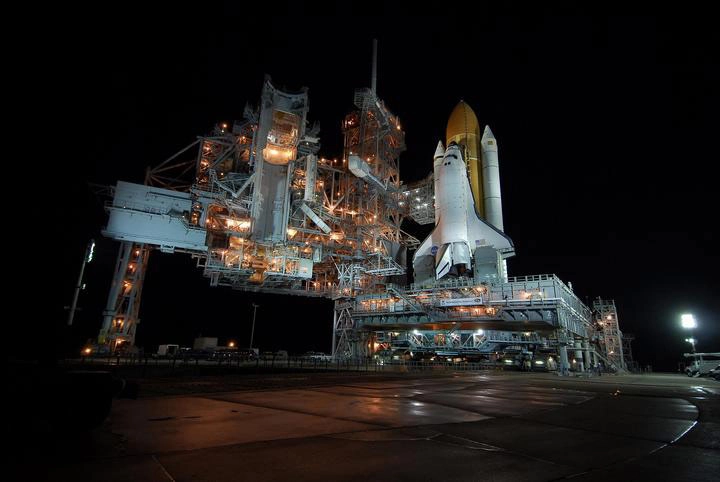
CAPE CANAVERAL, Fla. — NASA'sspace shuttle Endeavour is on track to light the predawn Florida sky ablaze earlyTuesday as it rockets toward the International Space Station (ISS) with sevenastronauts on board.
Led by commander DominicGorie, Endeavour'sSTS-123 crew will install the first piece of Japan's three-part Kibolaboratory, assemble a monstrous, two-armed Canadian robot and deliver a suiteof on-orbit experiments during their mission. The shuttle iscounting down toward a planned 2:28 a.m. EDT (0628 GMT) launch on Tuesday fromNASA’s Kennedy Space Center in Cape Canaveral, Fla.
Gorie and his crew plan to spend16 days executing their mission, which is the longestspace station-bound flight NASA has ever concocted. And with no less thanfive spacewalks on tap, the astronauts consider their mission as one of the mostintense and exhilarating, too.
"If you go to adrawing board and describe an exciting mission from scratch, I think you'd endup with STS-123," Gorie said. "We've got everything on this missionthat you could imagine."
Joining the veteranspaceflyer aboard Endeavour will be pilot Gregory H. Johnson, missionspecialists Robert Behnken, Mike Foreman, Rick Linnehan and JAXA astronautTakao Doi. Rookie spaceflyer Garrett Reisman will stay behind as a member ofthe Expedition 16 space station crew, allowing European Space Agency (ESA) astronautLeopold Eyharts to return home.
A successful launch willmark the second space station assembly mission of 2008, as well as the second ofup to six NASA shuttle missions planned for the year.
Clear skies?
Endeavour has a 90 percentchance of favorable weather conditions at launch time, with the potential forthick clouds posing the only threat, said U.S. Air Force Lt. Col. Pat Barrett,NASA’s shuttle weather officer with the 45th Weather Squadron, in a Sundaybriefing.
"We are expectingfavorable conditions for launch. The only concern we have is a slight chance ofseeing some low-level clouds moving into the area from … the Atlantic," Barrettsaid, adding that cloud cover can interfere with tracking the 100-ton orbiteras it speeds to more than 17,500 mph (28,200 kph) during the trip to space.
If all goes as planned,Endeavour will be the second shuttle to launch in darkness since the 2003Columbia tragedy, and the 30th total night launch, following the shuttle Discovery'sDecember 2006 liftoff.
Shot in the dark
Darkness can be dangerousbecause technicians have a tough time spotting errant chunks of ice orinsulating foam that can shed from an orbiter's 15-story fuel tank — debriswhich can damage the heat-resistant underbelly of a space shuttle.
But LeRoy Cain, chair of NASA'smission management team, said the agency has addressed these risks by improvingthe external fuel tank and adding extra cameras to the launch vehicle.
"We feel verycomfortable to go fly at night," Cain told reporters during a Sundaybriefing. One of the new improvements flying aboard Endeavour is a flashunit for a belly-mounted camera to help photograph the shuttle’s fuel tank afterseparation.
"This will be thefirst time that we've flown that," Cain said, noting that it should put onquite a show when Endeavour sheds its orange fuel tank high above the Earth. "Youcan expect to see some pretty brilliant flashes in a sequence [in videofootage] after we have physical separation from the external tank."
International cargo
Shortly after reaching thespace station some 212 miles (340 kilometers) above the Earth, the crew willdeliver the cylindrical Japanese Logistics Pressurized (JLP) module.
"Japanese people havebeen waiting a very long, long time," Yoshiyuki Hasegawa, ISS programmanager for JAXA, said of the JLP's launch and delivery to the space station."It will be an unforgettable event."
Two days after Japan'sfirst orbital room is stowed in a temporary berth at the space station, spacewalkersLinnehan, Foreman and Behnken will piece together Dextre — the Canadian SpaceAgency's (CSA) maintenance robot that weighs more than 3,440 pounds (1,560kilograms).
The giant robot, oftenpersonified by the STS-123 crew as "Mr. Dextre," will have an armspan of about 30 feet (9 meters) and stand 12 feet (3.7 meters) tall. Byguiding highly precise "hands" from inside the space station, astronautscan perform basic space station maintenance without having to venture into theunforgiving space environment outside.
"As spacewalkers, wedon't want to put ourselves out of the job," Foreman said of the robot'sabilities. "But I think … Dextre will be a boon to the space station whenit gets built and put into work."
If the shuttle's Tuesdaymorning launch attempt is foiled, NASA will try again no earlier than 2:02 a.m.EDT (0602 GMT) on Wednesday with a less encouraging 70 percent chance ofliftoff. Clouds may botch a second attempt, with the added threat of rainshowers, shuttle weather officials said. Should further delay be required,Endeavour would stand down until after March 15 to allow an unmanned Delta 2rocket to launch a navigation satellite from the nearby Cape Canaveral AirForce Station.
Endeavour is scheduled to returnto Earth on March 26 at 8:35 p.m. EDT (0035 GMT March 27) at Kennedy Space Center.
NASA will broadcast thelaunch of Atlantis' STS-123 mission live on NASA TV beginning at 9:30 p.m. EDT(0130 March 11 GMT). Click herefor SPACE.com's STS-123 mission coverage and NASA TV feed.
- NEWVIDEO: Danger on the Pad: Shuttle Astronauts Practice Escape Drill
- VIDEO:ESA's New Science Laboratory
- VIDEO:Part 1: Europe's First ISS Cargo Ship, Part2