





Thisstory was updated at 2:50 p.m. EST.
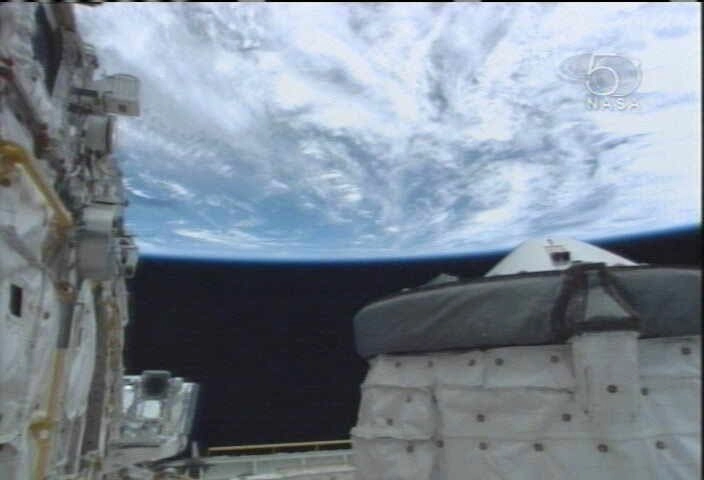
Astronautsaboard NASA’s shuttle Atlantis scanned their spacecraft’s heatshield today for any signs of dings or divots as they prepare for a weekendarrival at the International Space Station (ISS).
Commanded by veteran shuttle flyer Stephen Frick,Atlantis’ seven-astronaut crew used a sensor-tipped extension of theirshuttle’s robotic arm to hunt for any damage caused by falling debrisduring its Thursdaylaunch into orbit. Their detailed inspection wrapped up around 2:40 p.m. EST(1940 GMT) Friday.
Cameras watching Atlantis’ liftoff and mounted to itsexternal tank returnedviews of what appeared to be three small pieces of foam insulation fallingfrom the orbiter’s 15-story fuel tank about two minutes and 15 secondsafter liftoff.
“It’s really hard to tell what they are,”said William Gerstenmaier, NASA’s associate administrator forspace operations, just after launch. “It’s fairly small foamloss.”
But, Gerstenmaier said, engineers will have a betterhandle on the extent of the debris and any possible impacts after completingtheir analysis of video and images beamed back by the shuttle’s crew.
“We’lltake our time to make sure we understand what we’re seeing there,”said LeRoy Cain, chair of Atlantis’ mission management team, afterThursday’s launch.
NASA has kept a close eye on fuel tank foam and other debrisat launch since the tragic loss of theshuttle Columbia and its seven-astronaut crew on Feb. 1, 2003. The agencyheld a somber memorial last week to commemorate the fifth anniversary of thetragedy and honor the memories of the astronauts killed in the Columbia, Challenger and Apollo 1 accidents.
Frick and his STS-122 crewmates are flying a planned 11-dayflight to the ISS, where they will install the European SpaceAgency’s Columbus laboratory during their mission’s threespacewalks. They are due to dock at the space station at 12:25 p.m. EST (1725GMT) on Saturday.
Mission control roused the spaceflyers earlyFriday with the song “Book of Love” by Peter Gabriel, a tune chosenfor STS-122 mission specialist Leopold Eyharts by his wife and children.
“Happyto hear this song,” said Eyharts, an ESA astronaut who will join thespace station’s Expedition 16 crew during STS-122. He thanked his familyand friends in English and French for choosing it. “It has been asomewhat hard day for them.”
An up-close look
Atlantis astronauts grappled Atlantis’ 50-foot(15-meter) inspection boom with the shuttle’s robotic arm to begintoday’s heat shield survey and returned it after the scan finished.
“It takes about six hours to do, it’s a longday,” said Atlantis mission specialist Stanley Love, the chiefshuttle robotic arm operator, in a NASA interview. “We’ll rotatefour of our crewmembers through it so just about everybody gets a shot.”
Heat shield inspections are a now-standard activity forevery NASA shuttle mission since the agency resumed orbiter flights in 2005following the Columbia accident.
In addition to today’s inspection, astronauts aboardthe ISS routinely conduct a photographic survey a shuttle’s heat shieldjust before docking and return the images to Earth foranalysis. A second detailed inspection near the end of a shuttle mission allowsengineers to search for damage caused by micrometeorites and orbital debris.
Laser sensors and cameras at the tip of Atlantis’inspection boom, which effectively double’s the reach of theorbiter’s robotic arm, allow engineers an extremely detailed look at theheat-resistant carbon composite tiles and panels that protect a shuttle againstthe searing heat of reentry during landing.
“Of course, you’ve got a total of about a 100feet of articulated robotic machinery out there and it’s fairly close toyour sensitive heat shield,” said Love, adding that he and his crewmateswill take great care in wielding the inspection boom to avoid bumping theirheat shield. “So it takes a lot of vigilance from the crewmembers to runthe surveys.”
Staff writerDave Mosher contributed to this report from Johnson Space Center in Houston, Texas.
NASA isbroadcasting Atlantis' STS-122 mission live on NASA TV. Click here for SPACE.com's shuttle mission coverage and NASA TV feed.
- SPACE.com Video Interplayer: NASA's STS-122: Columbus Sets Sail for ISS
- Test Your Smarts: Space Shuttle Countdown Quiz
- Complete Space Shuttle Mission Coverage
