


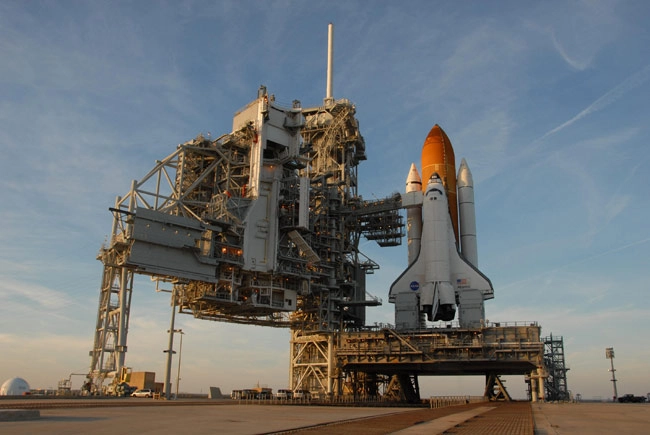
CAPE CANAVERAL, Fla. - NASA will attempt to launch the shuttleAtlantis and a European-built lab toward the International Space Station (ISS)on Sunday despite suspect sensors inside the orbiter?s orange external tank,top mission managers said today.
Atlantis and its STS-122 crew are set to rocket spacewardfrom their seaside launch pad at NASA?s Kennedy Space Center at about 3:20 p.m.EST (2020 GMT) with stricter flight rules in place to compensate for thespacecraft?s erraticfuel tank sensors.
?We had basically a unanimous decision to go forward,? NASAshuttle program manager Wayne Hale told reporters here in an afternoonbriefing.
Commanded by veteran shuttleastronaut Stephen Frick, the spaceflight has been delayed since Thursday,when two of four engine cut-off (ECO) sensors inside the liquid hydrogenportion of Atlantis? 15-story external tank faileda standard countdown check. A third sensor also gave erroneous readingsonce the tank was drained of its liquid hydrogen and liquid oxygen propellant.
Accordingto the agency?s flight rules, at least three of the four sensors, which serveas a backup system to ensure Atlantis? three main engines shut down before itsfuel tank runs dry, must check out during tests before a shuttle can launchspaceward.
Mission managers decided today to imposeeven stricter guidelines, which call for all four of the sensors and a set ofvoltage meters that monitor their performance, to function properly before a launchattempt can go forward. They also curtailed Atlantis? five-minute launch windowto just one minute in order to conserve fuel and ensure the shuttle?s fuel tankhas enough propellant to reach orbit should the sensors fail during liftoff.
While someshuttle engineering groups did suggest possible troubleshooting methods, nonevoted to abandon Sunday?s launch attempt, mission managers said. Launchcontrollers plan to begin fueling Atlantis with the more than 500,000 gallons(1.9 million liters) of super-chilled liquid hydrogen and liquid oxygenpropellant at about 5:55 a.m. EST (1055 GMT).
?We?ll fillup the tank and we?ll see what we get,? said LeRoy Cain, head of Atlantis?mission management team. ?If we meet our criteria, we?ll go fly and if we don?t,we?ll scrub and we?ll get a good tanking test and we?ll go forward from there.?
Intermittentglitches with the fuel sensors haveplagued NASA since 2005, when the space agency resumed shuttle flightsafter the Columbia tragedy. Despite some design modifications and the newvoltage meters, the sensors continue to behave erratically for reasonsengineers have yet to understand.
?I would like to quit talking about ECO sensors,? Hale said,adding that he has directed engineering team to reevaluate the sensor systemfor signs of the glitch. ?We?re going to have to pursue it at an even morevigorous level.?
The agency also plans to upgrade equipment in space shuttle mainengines and revisit protocols overseeing external tank propellant reserves toincrease flight safety, Hale added.
Atlantis? seven-astronaut crew will deliver the EuropeanSpace Agency?s Columbus laboratory to the ISS during a planned11-day mission. Current forecasts predict an 80 percent chance of goodweather at launch time, with low clouds and nearby rain showers posing the onlyconcern.
?Ican tell you that the launch team is extremely excited about having the opportunityto make a launch attempt tomorrow,? said Doug Lyons, NASA?s STS-122 shuttle launch director.
NASA must launch Atlantis by Thursday in order to fly theSTS-122 mission to sun angles become unfavorable for docked operations. If theshuttle cannot launch Sunday, the next opportunity opens up on Monday at 2:55p.m. EST (1955 GMT).
Atlantis? STS-122 mission will mark NASA?s fourth shuttleflight of 2007 and the second this year to deliver a new orbital room to the high-flyingspace station.
NASA is broadcasting Atlantis' STS-122 mission?s Sunday launch live on NASA TVbeginning at 5:00 a.m. EST (1000 GMT). Click here for SPACE.com's shuttle mission coverage and NASATV feed.
- SPACE.com Video Interplayer: NASA's STS-122: Columbus Sets Sail for ISS
- Test Your Smarts: Space Shuttle Countdown Quiz
- VIDEO: ISS Commander Peggy Whitson Takes Charge
