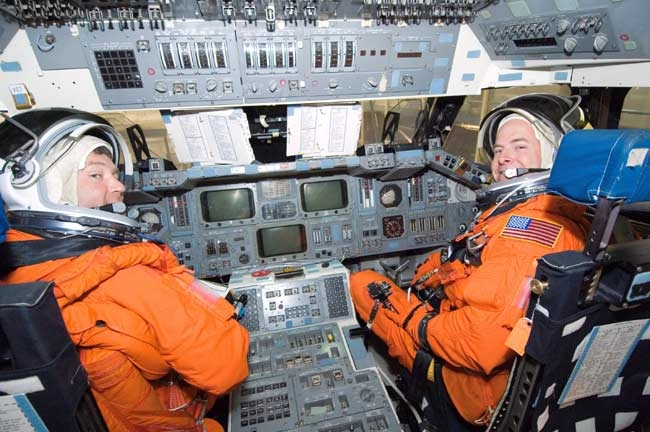
NASA'sshuttle Atlantis will launch toward the International Space Station (ISS) thisweek with mix of experience at the helm to deliver a European addition to thehigh-flying laboratory.
Leading theorbital charge is shuttlecommander Stephen Frick, a veteran NASA astronaut, with first-time spaceflyer Alan Poindexter serving as mission pilot. They are eagerly awaiting their planned Thursday launch to haul the European Space Agency?s (ESA) Columbus lab to the ISS with the help of five crewmates.
"Attitudeis everything up on orbit," said Frick, adding that his crewmates arededicated not only to their STS-122 mission, but also oneanother. ?I got very lucky with my crew.?

Frick,Poindexter and their crewmates plan to launch toward the ISS on Dec. 6 at 4:31p.m. EST (2131 GMT) to deliver Columbus, swap out one ISS crewmember and stage three spacewalks during their planned 11-day mission.
?[H]aving the opportunity to work on the space station reallyis the leading edge,? Frick said in a NASA interview. ?We?ve never doneanything like this in space before and we?re learning a tremendous amount.?
Atlantisredux
Frick, 43,is a commander in the U.S. Navy and a native of Gibsonia, Pa.,where he grew up watching NASA?s Apollo moon missions and Skylab space stationflights.
?Flying,itself, was something I always wanted to do from my earliest memories, and whatcould be more interesting than flying outside of the atmosphere and getting tosee basically all of the Earth in one 90-minute pass?? said Frick. ?Just theidea of that was mesmerizing.?
Frickjoined NASA?s astronaut ranks in 1996 after a decade flying with the U.S. Navy,where he made 370 aircraft carrier landings and flew 26 combat missions duringOperation Desert Shield and Desert Storm. He first reached orbit in April 2002,when he launched aboard Atlantis as STS-110mission pilot to help install the space station?s S0 truss during a 10-day spaceflight.But now, Frick is ready to command that same spaceship.
?I have toadmit, I?m a little partial to Atlantis,? Frick told reporters in a missionbriefing. ?There is something special about flying on the same vehicle twice.?
Fricklikens the risks of launching spaceward today to those facing explorers on theocean hundreds of years ago as they crossed between continents and sailedthrough arctic and Antarctic waters.
?I thinkit?s the same in space,? said Frick, who is married and holds degrees inaerospace and aeronautical engineering. ?It?s a place we have to go.?
In additionto successfully delivering Columbus to the ISS, Frick hopes to take some personal time to hunt for his hometown from orbit. During STS-110, his attempts to spot the Gibsonia from orbit werethwarted three separate occasions.
?All threetimes it was overcast,? said Frick, adding that a wintry December is probablynot the best time to try to spot Pittsburgh from space. ?[B]ut I really do want to see it with myown eyes.?
Orbitaldebut
Like Frick,Poindexter is a U.S. Navy commander and veteran test pilot, though STS-122 willmark his first foray into space.
?I?mlooking very much forward to flying and getting Columbus on orbit,? Poindexter told reportersin a mission briefing.
Hailingfrom Rockville, Md., Poindexter holds degrees in aerospaceaeronautical engineering and credits a chance meeting with former astronautRichard Truly, a retired U.S. Navy vice admiral, for pointing him toward orbit.
?Admiral Truly spoke about his first night launch and night landingon STS-8, and I was very intrigued with it and got to talk to him afterwards,?said Poindexter, who was attending Georgia Tech University at the time. ?Ever since then, I?ve sort of aspired to come here and be anastronaut.?
Poindexter,46, joined the Navy in 1986 and served in Arabian Gulfduring Operations Desert Storm and Southern Watch before joining the branch?stest pilot ranks. NASA selected him to join the astronaut corps in 1998. Inaddition to his role as shuttle pilot, Poindexter will also serve as an orbitalchoreographer during the STS-122 mission?s three planned spacewalks.
?Mychallenge is to keep an eye out for their well being, to try to make theirtimeline as optimum as possible and look out for potential pitfalls,?Poindexter said of his spacewalking crewmates.
But thepayoff, he added, will come once Columbus isinstalled, giving Europe its first permanentorbital laboratory space at the ISS.
?We?rereally looking forward to it,? said Poindexter. ?Working with people fromdifferent backgrounds and different cultures is one of the big benefits ofworking here.?
Poindexterand his wife Lisa have two grown sons, ages 22 and 18, but the family is proudof his upcoming launch despite the risk of human spaceflight because of thelengths NASA has gone increase shuttle flight safety.
?They know,as well as I do, that NASA does a really good job of minimizing the risks,? theshuttle pilot said.
But whilehuman spaceflight will never be risk-free, it is an endeavor that continues tobe vital to push science, and civilization forward, Poindexter said.
?You know,we need to go off and find out what?s around the next corner, and what?s justbeyond what we already know,? he added. ?It?s part of our moral fiber to go offand explore.?
- VIDEO: Stephen Frick: STS-110 Pilot
- NEW IMAGES: Discovery's STS-120 Mission in Pictures
- The Orbital Chef: The Top 10 Space Foods
