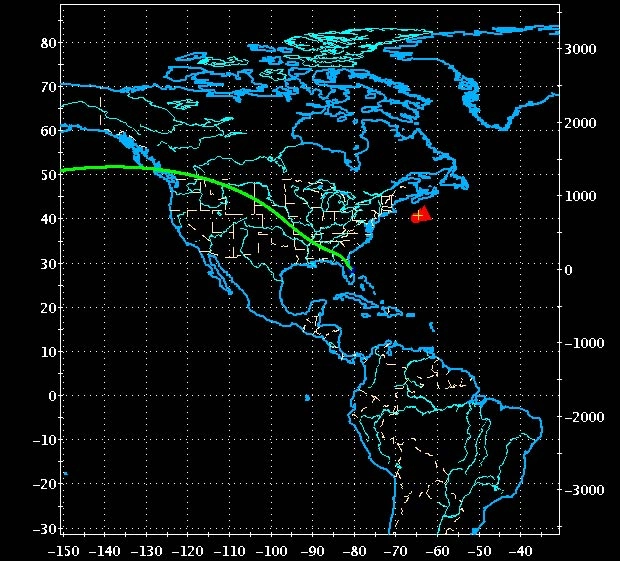
CAPECANAVERAL, Fla. - Clear skies and a slight breeze await space shuttle Discoveryand its seven-astronaut crew as they maneuver toward a landing at Kennedy SpaceCenter (KSC) this afternoon.
If the weatherholds, Discovery will make a one-hour descent across the heartland of America in broad daylight for a 1:01 p.m. EST (1801 GMT) touch down. The 15-day missiondelivered a bus-sized room to the International Space Station (ISS), made anemergency repair of a torn solar wing and dropped off a new member of theorbital laboratory's crew.
So far,weather forecasts call for a picture-perfect day here at KSC, and missionmanagers said that only slight northerly winds concern them.

PamelaMelroy, the STS-120 mission's commander and a retired U.S. Air Force colonel onher third spaceflight, said today's landing promises to be a highlight of herpiloting career.
"I'mactually the one who gets the land the shuttle," said Melroy, who isNASA's second femaleshuttle commander, earlier in the spaceflight. "That is going to be avery thrilling moment for me."
NASAoriginally scheduled the orbiter to land before dawn but Melroy opted for adaylight landing. Mission managers called the sleeping schedule adjustments tomake the landing attempt a "college sleep shift."
"Justlike driving ? making a landing is easier in the daylight," Melroy saidfrom space Tuesday afternoon. "But the real reason we asked for the switchis because the sleep shift involved shifting later instead of earlier, and sothat's a little easier to do."
Cominghome
Beforeundocking from the space station on Monday morning, five-month spaceflyer ClayAnderson climbed aboard Discovery and swapped places with astronaut Dan Tani. Atearful goodbyeceremony preceded the changeover, but Anderson said yesterday that he'sprepared for his return to Earth.
"Physicallyand mentally I'm really ready to be home," Anderson toldSPACE.com from the mid deck of Discovery on Tuesday. He said thathe's looking forward to juicy steaks, ice cold drinks and the sights and soundsof Earth. "You just can't get that on the International SpaceStation."
Anderson rides back today in a specialrecumbent seat, which will lay him down during the sonic-boom breaking entryinto the planet's atmosphere. The Nebraska native mentioned he's optimisticabout beating out the effects of readjusting to being earthbound--but perhapsoverly so, he said.
"I'veworked very hard on my physical exercise since I arrived with [STS-117] back inJune," he said.
But teasingcommander Melroy, Anderson explained he's not sure how his internal equilibriumwill react. "I've been off the planet with minimal gravity for fivemonths," he said, "and I'll come thumping back to the ground--I'msorry, Pam--I'll smoothly come back to the ground."
Speaking onbehalf of both rookie and veteran spaceflyers on board Discovery, Melroy saidthe time in space has been a dream.
"We'rethrilled and excited and ready to come," she said yesterday.
Constructionin space
Duringtheir 11 docked days with the space station, the crew of Discovery installedthe 31,500-pound (14,288-kilogram) Harmony module to the space station. Theyalso relocated the massive Port 6 solar array truss segment from the top of theISS to its port-most end, then looked on as two twin sets of solar array wingsdeployed.
One ofthose snagged and tore during its unfurling, however, sending NASA into ascramble to have spacewalkers Scott Parazynski and Doug Wheelock repair thewing with handcrafted "cuff links."
WithDiscovery now homeward bound, space station astronauts have somemajor housekeeping to pull off in November. The three-person Expedition 16crew will need to relocate the module with an attached mating adapter,configure the stack and finally hook up coolant, power and avionics lines toit.
Onceconfigured, Harmony will serveas a gateway for future modules like the Columbus laboratory, set for departureaboard space shuttle Atlantis on an ambitious launch date of Dec. 6.
Pilot androokie astronaut George Zamka will assist Melroy with landing from Discovery'scockpit while mission specialists Stephanie Wilson and Wheelock sit behindthem. In the mid deck below the control-packed cockpit, astronauts Anderson,Parazynski and Italian spaceflyer Paolo Nespoli will return to Earth.
If thefirst attempt at landing goes as planned, Discovery will pass over 12 U.S. states before its scheduled landing precisely at 1:01:50 p.m. EST (1801:50 GMT).Should foul weather show up, flight controllers will instruct the crew to waituntil they can use another opportunity to land at 2:36 p.m. EST (1936 GMT).
If thatchance is ruined, the space shuttle will try again Thursday at 11:33 a.m. EST(1633 GMT) and may also aim for landing sites at California's Edward's AirForce Base or New Mexico's White Sands Space Harbor later in the day. NASA hasnot activated the two backup landing sites for tomorrow's landing because ofthe unusually fair forecast.
Staffwriter Tariq Malik contributed to this report from New York City.
NASA isbroadcasting Discovery's STS-120 mission live on NASA TV. Click here formission updates and NASA TV from SPACE.com.
- VIDEO: Discovery's STS-120 Astronaut Crew Speak Out
- NEW IMAGES: Launch Day for Shuttle Discovery
- SPACE.com VIDEO Interplayer: STS-120 Mission Brings 'Harmony' to ISS