HOUSTON - Astronauts aboard NASA?s shuttleDiscovery began their first full day in orbit Wednesday with a heat shieldinspection as they head toward an orbital rendezvous with the InternationalSpace Station (ISS).
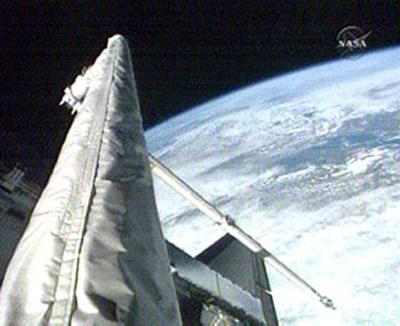
Discovery?sseven-astronaut crew wielded a laser sensor-tipped extension of their shuttle?srobotic arm to scan heat shield panels along the orbiter?s wing edges and nosecap one day after rocketingspaceward from the Kennedy Space Center in Florida.
?Ipersonally did not see anything of significance,? said NASA?s lead STS-120 shuttleflight director Rick LaBrode, adding that a completeanalysis of the heat shield survey is still under way.

Commandedby veteran shuttle flyer Pamela Melroy, Discovery?sSTS-120 astronaut crew launched on a 14-day construction mission that NASA hasdescribed as its most challenging todate. The shuttle astronauts will deliver Harmony, a vital hub-likemodule that will anchor future laboratories to the ISS, during the first offive planned spacewalks outside the orbital laboratory.
Later inthe flight, the STS-120 crew will also move a massive solar power segment tothe port-most edge of the station?s backbone-like main truss and unfurl itsexpansive arrays. Discovery is also ferrying U.S. astronaut Daniel Tani to the ISS, where he will replace fellow NASA spaceflyer Clayton Anderson as a member of the station?sthree-person Expedition 16 crew.
Discoverymission specialist Stephanie Wilson, the lead robotics operator for STS-120,oversaw today?s heat shield inspection, which was primarily aimed at scanningthe reinforced carbon-carbon (RCC) panels that line the orbiter?s wing edgesand nose cap. Melroy, shuttle pilot George Zamka and mission specialists Scott Parazynski,Paolo Nespoli also participated in the RCC panelsurvey.
BeforeDiscovery?s launch, an independent NASA engineering group called for thereplacement of three of the spacecraft?s 44 wing-mounted RCC panels due toapparent defectsin their exterior coating. Mission managers cleared the shuttle for flight, but modified today?s inspection to geta clearer view of the heat shield panels.
?We areslowing down just one of the scans, one pass on each of the wings, just to giveus an opportunity to get a little bit higher-fidelity imagery with ourlaser scans,? LeRoy Cain, who chaired NASA?s STS-120Mission Management Team for the mission?s launch.
On Earth,analysts will study the imagery and video from today?s inspection to determinethe health the Discovery?s heat shield. They will also study images fromDiscovery?s launch and a detailed photographic survey of the orbiter?sheat-resistant tiles, to be conducted by the ISS crew before the shuttle docksat the station, as well.
Mission managers said about six pieces of foam insulation brokefree from Discovery?s fuel tank during its Tuesday launch, but all of them occurred too latein the ascent to pose a risk to the shuttle. NASA has kept a close watch onfuel tank debris during liftoff and shuttle heat shield integrity since the 2003 Columbia accident.
LaBrodesaid he was confident that a glitch with Discovery?s computer network, whichcould delay the delivery of some digital images from today?s inspection, wouldbe resolved soon. The shuttle?s crew worked to fix the glitch during the survey.
NASA?s Mission Control hereat the Johnson Spaceawoke Discovery's crew today at 1:38 a.m. EDT (0538 GMT) with the song ?Lord of the Dance? byJohn Langstaff.
?Good morning Discovery,and a special good morning to you Pam,? NASA astronaut Shannon Lucid told thecrew from Mission Control. ?Welcome to your first full spaceday for the STS-120.?
?Thanks Shannon,that was one of my favorite songs from the Christmas Rebels,? Melroy said. ?Thanks to my husband Doug. I love you.?
Melroy and her STS-120 crewmates are dueto arrive at the ISS on Thursday, with docking scheduled for 8:35 a.m. EDT(1235 GMT).
NASA is broadcastingDiscovery's STS-120 launch and mission operations live on NASA. Click here for mission updatesand NASA TV from SPACE.com.
- SPACE.com Video Interplayer: Delivering 'Harmony' with NASA's STS-120 Mission
- Test Your Smarts: Space Shuttle Countdown Quiz
- Complete Space Shuttle Mission Coverage
