


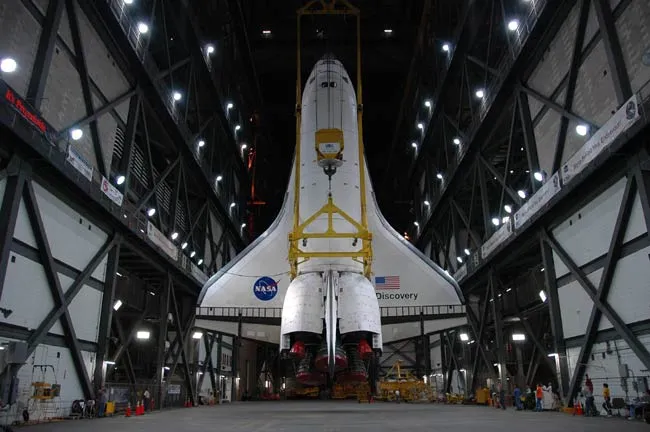
NASA's space shuttle Discovery moved a step closer toward launch Monday as engineers worked to join the orbiter with the twin rocket boosters and fuel tank that will aid its flight into space next month.
Engineers hoisted Discovery up inside the cavernous Vehicle Assembly Building (VAB) today at the Kennedy Space Center in Cape Canaveral, Fla., to attach the 100-ton shuttle to its 15-story external fuel tank, said NASA spokesperson George Diller. The orbiter rolled over to the VAB from its protective hangar Sunday afternoon.
"We're in good shape to roll out to the launch pad on Sept. 30," Diller told SPACE.com.
Discovery's short trip to the VAB was delayed several days as NASA engineers replaced a leaky hydraulic seal and three others on a shock absorbing strut attached the orbiter's right main landing gear. The repair work went smoothly, allowing NASA to maintain the planned Oct. 23 launch target for Discovery's STS-120 construction mission to the International Space Station (ISS).
Shuttle workers used four of five padding days built into Discovery's launch preparation schedule to replace the hydraulic seals, leaving one extra day available for any future issues, Diller said.
Earlier this month, NASA engineers also completed work to trim away internal insulation layers from four of five brackets onDiscovery's foam-covered fuel tank after an X-ray survey found cracks in their cork-like material. Similar cracks may have led to the launch debris that dinged the underside of the shuttle Endeavour during its Aug. 8 liftoff, NASA officials have said.
Commanded by veteran NASA spaceflyer Pamela Melroy, Discovery's seven-astronaut crew will deliver a new connecting node to the ISS that will serve as the foundation for future international laboratories. The astronauts will also move an older solar array segment and test shuttle heat shield repair techniques during the five spacewalks planned during their 14-day mission.
