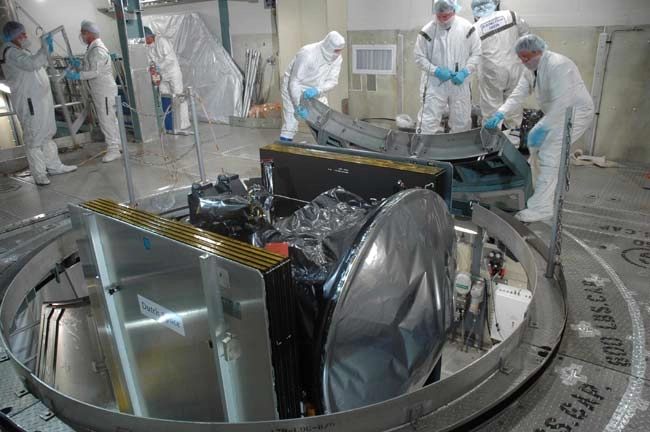
NASA's Dawnprobe will spend at least one more day on Earth before launching toward twolarge asteroids after a lightning threat prevented fueling of its Delta 2rocket on Sunday.
Lightningwithin five miles (eight kilometers) of Dawn'sPad 17B launch site at Florida's Cape Canaveral Air Force Station kept padcrews from loading propellant into the second stage of the asteroid probe'sDelta 2 booster, NASA spokesperson George Diller said.
"Thesecond stage is fully fueled now," Diller told SPACE.com, addingthat pad crews caught up on their lost work Monday.

Originallyscheduled to launch early Wednesday, Dawn is now set to lift off Thursday at 7:20a.m. EDT (1120 GMT) on an eight-yearmission to the asteroids Vesta and Ceres.
Themission's liftoff has been delayed since July due to a series of glitchesranging from poor weather and rocket booster glitches to difficulties securinga launch tracking aircraft and ship. Mission managers said in July that thedelays could add $25 million to Dawn's $449 million mission cost.
Powered bya novel ion propulsion system, NASA's Dawn probe is expected to rendezvous withVesta in 2011, and then head off for a February 2015 arrival at Ceres.
Both Vestaand Ceres sit in the belt of space rocks that circle the Sun in the gapbetween the orbits of Mars and Jupiter. While Vesta is bright and dense, Ceres islarge enough to be considered a dwarf planet. Researchers hope that by studyingthe two massive space rocks, they will shed new light on the origin of thesolar system and its planets.
- VIDEO: The Asteroid Paradox
- GALLERY: Asteroids
- How NASA's Dawn Spacecraft Will Explore Solar System's Origin
