





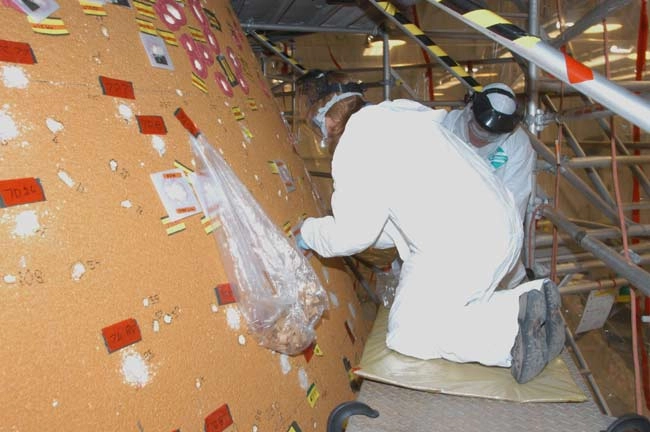
NASA is targetingan early June launch for its space shuttle Atlantis and will complete repairsto the orbiter's hail-battered external fuel tank rather than replace the15-story vessel with a pristine one, mission managers said late Tuesday.
Atlantisand its six-astronaut crew are now slated to launch towards the InternationalSpace Station (ISS) no earlier than June 8 to deliver new starboard solararrays and girders to the orbital laboratory.
"As ofright now we're going to stay with the tank," said NASA shuttle program managerWayne Hale of Atlantis' pockmarked fuel tank during a teleconference lateTuesday. "The entire team unanimously agreed that progress was being made to dothat."
Hale saidthat the ongoingrepair work to Atlantis' fuel tank would allow the orbiter to leave thecavernous Vehicle Assembly Building at NASA's Kennedy Space Center (KSC) inFlorida and return to its launch pad around May 6, but that would not allow theorbiter and its STS-117 crew to launch within the limited flight window thatcloses on May 21.
Since therepair work was making progress, and replacing the Atlantis' fuel tank with anew one would push the orbiter's launch date to no earlier than June 19, missionmanagers opted to keep the current fuel tank, Hale added.
The newlaunch window stretches from June 8 to about July 18, with the next flightopportunity occurring around Aug. 5, NASA officials said.
Atlantis' STS-117mission hasbeen delayed since Feb. 26, when a severe thunderstorm battered theorbiter's fuel tank with golf ball-sized hail at its launch pad just weeks shyof a planned March 15 liftoff. The hail gouged more than 2,600 dings in thevital foam insulation covering the fuel tank.
Since thatfreak February storm, which appeared to occur right over Atlantis' Pad 39Alaunch site, engineers have been hard at work sanding the tank's surface andfilling in divots with new foam, while another team analyzes the fixes toensure they are sound.
Repairwork underway
JohnHoneycutt, head of NASA's external tank project, said there are some 2,664damaged areas on Atlantis' external tank. About 700 of them require workers topour new foam insulation into the divots, a task that is about half complete,he added. Other areas will require a sand and blend approach, while still othersmay require a spray technique.
Shuttleworkers are also removing the Atlantis' three main rocket engines to inspectits propellant lines for silicone contamination akin to that found in thepropellant lines of Atlantis' sister ship Discovery, NASA officials said, addingthat the work is not expected to affect the orbiter's launch date.
Commandedby veteran shuttle flyer Rick Sturckow, Atlantis' six-astronaut crew is gearingup to install the 17.5-ton Starboard 3/Starboard 4 trusses and twin solararrays during threespacewalks planned for their 11-day mission. He and his crew have usedtheir extra time on Earth to continue their mission training and spend timewith family and friends.
"They'retaking it in good spirits," Hale said of the STS-117 crew. "They want to have agood safe launch vehicle."
Atlantis'launch delay does mean that one NASA astronaut, spaceflyerSunita Williams currently aboard the ISS, will have to wait a bit longer toreturn to Earth.
Williamswas scheduled to return home aboard NASA's Endeavour orbiter during the STS-118mission in July. Atlantis' launch slip to June pushes Endeavour's plannedliftoff to early August, though Williams remains on schedule to return to Earthwith the STS-118 crew.
"Right nowwe're staying with the current scenario," William Gerstenmaier, NASA'sassociate administrator for space operations, told reporters.
Williamscould conceivably come home earlier aboard Atlantis, which would then bring NASA astronaut Clayton Anderson as a replacement, if the STS-118 flight slippeddeep into fall, Gerstenmaier added, but stressed that it is not the currentplan.
An eyeon foam
The layersof foam insulation covering a shuttle's external tank prevent the vessel'ssuper-cold load of liquid hydrogen and liquid oxygen propellant from buildingup ice on its aluminum exterior, NASA officials have said. Some foam at thetank's nose provides protection from aerodynamic stresses during launch, theyadded.
The foam'sintegrity has been a prime concern since the 2003, when an errant chunk of tankfoam fell free during the launch of NASA's Columbia orbiter, piercing its leftwing leading edge heat shield and leading to the loss of the shuttle and itsseven-astronaut crew as they reentered the Earth's atmosphere.
NASA hassince made a series of modifications to shuttle fuel tanks to eliminate foamwhere possible and limit the amount of material shed during launch. Shuttle andISS astronauts also perform meticulous robotic and photographic inspections ofan orbiter's heat shield while in space.
Atlantis'STS-117 mission is expected to be the first of about four planned NASA shuttlemissions to continue ISS assembly in 2007. NASA hoped to squeeze in a fifthshuttle flight during December, though mission managers have said thatspaceflight will likely slip to 2008. Even launching four shuttle flights thisyear may prove challenging, they added.
"I would saythat flying four flights is not outside the realm of possibility," Hale said. "Butwe want to do this in a safe and orderly manner."
- STS-117 Power Play: Atlantis Shuttle Crew to Deliver ISS Solar Wings
- IMAGES: The Spacewalks of NASA's STS-116 Mission
- Complete Shuttle Mission Coverage
- All About the Space Shuttle
