


Sevenastronauts may be the most visible participants in NASA's planned launch of theshuttle Discovery this week,but the orbiter is also hauling a cargo bay full of vital supplies andcomponents to the InternationalSpace Station (ISS).
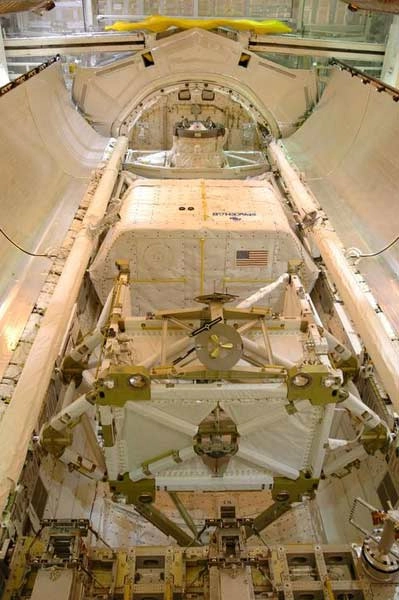
Ridinginside Discovery's 60-foot (18-meter) payload bay will be a pressurizedSPACEHAB cargo container, a spare parts platform also laden with ready-to-launchmicrosatellites, and--as the centerpiece--an $11-million addition for the spacestation's main truss.
"It's anexciting mission," Sharon Castle, NASA's launch package manager for Discovery'sSTS-116mission. "It's packed with everything."
Altogether,Discovery's STS-116astronauts will haul more than 5,000 pounds (2,267 kilograms) of internalcargo and 800 pounds (362 kilograms) of external hardware--not counting thetruss--to the ISS when their construction mission launches on Dec. 7. Theshuttle is expected to return some 4,400 pounds (1,195 kilograms) when its12-day mission returns to Earth.
One of themost precious of items sitting in Discovery's payload bay is the Port 5(P5) truss. The spacer-like addition fits at the portside (or leftmost) endof the space station's Port 3/Port4 (P3/P4) solar array segment, which arrived during September's STS-115shuttle flight.
"It's asmall structure compared to the other major elements," Chuck Hardison, ISS sitemanager for P5's builder Boeing, told SPACE.com. "But its function isabsolutely critical."
With itsattached power and data lines, P5 is designed to serve as a bridge betweenP3/P4 and an older solar array that will be moved into position during a futureshuttle mission.
The4,110-pound (1,864-kilogram) P5 truss segment runs about 11 feet (3.3 meters)long, about 14 feet (4.5 meters) wide and stands about 13 feet (4.2 meters)high. The ISS segment arrived at NASA's Kennedy Space Center in 2001, and nowsits between the SPACEHAB module and a cargo palette inside Discovery's cargobay.
"It lookedgreat out there in the payload bay," Hardison said, adding that he has alreadysaid his goodbye's to the boxy station piece. "We're really looking forward toseeing it go."
Castle saidthat a variety of supplies and spare parts are stuffed inside the SPACEHABmodule, which astronauts can reach via aconnection at Discovery's airlock. SPACEHAB, Inc. officials added that their module is filledwith crew provisions, such as food, spacewalking tools and health equipment.
Missionspecialist JoanHigginbotham will serve as Discovery's loadmaster to oversee cargo transferduring the STS-116 mission. She is also charged with launching a trio of small,experimental microsatellites currently stowed in a cylindrical containerattached to the SPACEHAB-built Integrated Cargo Carrier riding in the aft ofshuttle's cargo bay.
The cargocarrier is also laden with a series of debris panels that will shield the spacestation's Russian-built Zvezda service module from micrometeorite damage onceinstalled. The panels will be arranged in a configuration known as the"Christmas Tree" for delivery to the ISS exterior during a planned Dec. 14spacewalk.
"It'sappropriate that we're moving a Christmas tree around at that time of year,"STS-16 mission specialist NicholasPatrick said in a NASA interview. "I should add to that end, [it's]essentially a Christmas present for the space station."
- Space Shuttle Launch Visible Across Eastern U.S. Thursday
- Images: Ready to Fly: STS-116 Training
- Images: Shuttle Discovery Poised for STS-116
- STS-116 Video: Major Tasks
- STS-116 Video: Power is Everything
- STS-116 Video: Back in Business
- STS-116 Video: Building Blocks
- Mission Discovery: The ISS Rewiring Job of NASA's STS-116
- Complete Space Shuttle Mission Coverage
- The Great Space Quiz: Space Shuttle Countdown
- All About the Space Shuttle
