





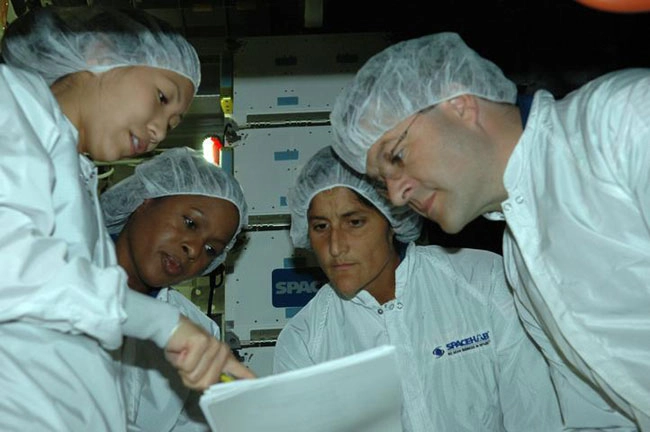
Seven astronauts are getting up close andpersonal with NASA's shuttleDiscovery this week as engineers ready the space plane's boosters and fueltank for flight.
Discovery'sSTS-116 astronauts, commanded by shuttle flight veteran Mark Polansky, are atNASA's Florida-based Kennedy Space Center (KSC) spaceport poring over theirorbiter, its cargo and the tools they will use during a planned December missionto rewire the powergrid aboard the InternationalSpace Station (ISS).
JessicaRye, a NASA spokesperson at KSC, saidthe astronauts were set to examine Discovery's heat shield, payload bay, crewcabin and windows during a multi-day Crew Equipment Interface Test (CEIT).
Theastronauts are set to launch no earlier than Dec. 7 at 9:38 p.m. EST (0238 Dec.8 GMT) to haul a Spacehab module and the new Port 5 section of the space station's main truss to the orbital laboratory, where they will stage three spacewalks to wire two recentlyinstalled solar arrays into the ISS power grid.
WhilePolansky and his STS-116 crew looked over Discovery in the shuttle's OrbiterProcessing Facility, engineers in NASA's massive Vehicle AssemblyBuilding connected the spacecraft's 15-story external tank to the two solidrocket boosters that will help launch the astronauts spaceward.
"We matedthe external tank and boosters early this morning," NASA spokesperson BruceBuckingham told SPACE.com.
Polansky, STS-116pilot William Oefelein and mission specialists Joan Higginbotham, NicholasPatrick, Robert Curbeam, Christer Fugelsang - of the European Space Agency - andISS flight engineer SunitaWilliams arrived at KSC over Wednesday and Thursday. Their CEIT trainingsession ends on Saturday.
NASA's STS-116 mission will mark theagency's third shuttle flight in 2006 and the second this year dedicated to ISSconstruction. The previous mission - STS-115aboard Atlantis - delivered two massivetrusses and a pairof new solar wings to the orbital laboratory in September.
NASA plansabout 14 more shuttle missions to completethe ISS by September 2010, when the space agency is expected to retire itsthree-orbiter fleet to make way for the capsule-based Orion program.
- VIDEO: STS-98: Mark Polansky's Destiny in Space
- Complete Space Shuttle Mission Coverage
- The Great Space Quiz: Space Shuttle Countdown
