


Two seniorNASA officials who voted not to proceed with a July1 launch of the space shuttle Discovery said Monday that astronaut safetyis foremost in their minds, and that the upcoming spaceflight holds no threatto the STS-121 crew's safe return.
"Crewsafety is our first and most important concern," read the statement prepared byNASA's chief engineer Christopher Scolese and Bryan O'Conner, a formerastronaut and the space agency's chief safety and mission assurance officer. "Webelieve that our crew can safely return from this mission."
NASAofficials said in a June 17 briefing that Scolese and O'Conner offered dissentingopinions on whether the Discovery orbiter was ready for a July 1 launch.The upcomingspaceflight will mark NASA's second shuttle flight since the 2003 Columbia accident andfollows the STS-114 missionthat launched last year.
WilliamGerstenmaier, NASA's associate administrator of space operations, said in theJune 17 briefing that the dissent revolved primarily around a series of foam-coveredramps that prevent ice from building up on brackets that connect cables andpressurization lines to the exterior of Discovery's external tank. Scolese andO'Conner voted to delay the STS-121 launch until engineers developed a properfix for the icefrost ramps, he added.
OnSaturday, NASA decided to launch Discovery's STS-121 mission on July 1 knowingthat some of the 34 ice frost ramps on shuttle tanks could shed foam debrisduring launch. In the past, top shuttle program officials have said that icefrost ramp foam debris could inflict serious damage to an orbiter and futurefixes are planned for the problem.
But NASAchief Michael Griffin said Saturday that - given NASA's ability to inspectspacecraft in orbit, some rudimentary repair methods, and the option to keep astronautsaboard the International Space Station (ISS) in an emergency - ice frost rampfoam should not lead to a crew-loss situation for the STS-121 mission.
Scolese andO'Conner added in their statement that, the orbiter aside, ice frost ramp foamloss should not pose a threat to crew safety.
"Weboth feel that there remain issues with the orbiter - there is the potentialthat foam may come off at time of launch. That's why we feel we should redesignthe ice/frost ramp before we fly this mission," the statement reported. "We do not feel, however, that these issues are a threatto safe return of the crew. We have openly discussed our position in the FlightReadiness Review - open communication is how we work at NASA."
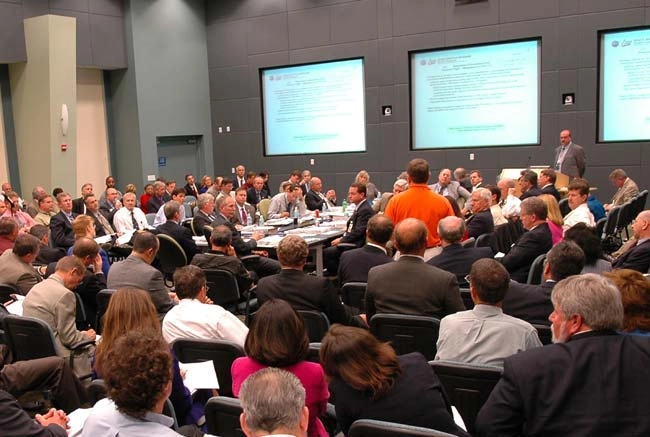
Thestatement by Scolese and O'Conner reported that all different engineeringpositions were heard during NASA's two-day STS-121 mission Flight ReadinessReview (FRR). The statement also reported that the FRR meeting's board membersand Griffin made an "informed decision and the agency is accepting this riskwith its eyes wide open."
- Launch Date Set: STS-121 Crew to Fly July 1
- STS-121 Shuttle Commander: 'We're ready.'
- NASA Shuttle Managers Discuss STS-121 Launch Plan
- Return to Flight: NASA's Road to STS-121
