


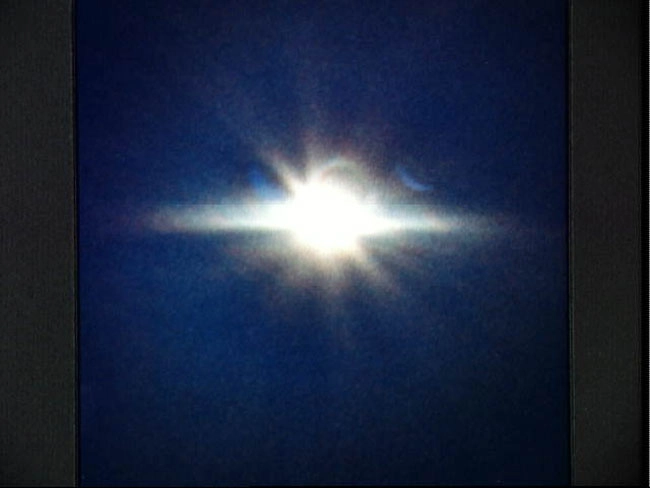
Crewmembers aboard the International Space Station will have a rare opportunity to witness the Moon's shadow racing across the face of the Earth during a total solar eclipse Wednesday.
The eclipse will be carried live on the Internet via NASA TV starting at 5 a.m. ET Wednesday.
The ISS will not be in the direct path of the eclipse, so they won't see the Sun totally blocked by the Moon. But NASA astronaut Bill McArthur and Russian cosmonaut Valery Tokarev will have a clear view of the event from their orbital perch, NASA spokesperson Kylie Clem told SPACE.com.
The ISS will be over the Mediterranean Sea and near the African Coast when the total eclipse occurs.
What won't happen
Earlier this month, rumors circulated on the Internet that an orbital maneuver scheduled for March 15 would place the ISS directly in the path of totality. However, NASA later confirmed that the maneuver would have had very little effect, if any, on the overall trajectory of the space station and that in any case, the maneuver had been reschedule for April 19.
There are no station-based scientific missions or scheduled photo sessions centered on the eclipse. However, the two-man crew is aware of the event and might take pictures of the shadow on Earth if time allows, Clem said.
Total solar eclipses occur roughly every 18 months on average, but there have only been a few times in human spaceflight history that astronauts have been able to observe one from space.
Previous views
In 1966, a Gemini mission altered course to intercept a total solar eclipse over the Eastern Pacific. And in 1999, the Mir space station crew observed the shadow cast on Earth by totality as the craft passed over Europe. The ISS was positioned to see another such shadow on Dec. 4, 2004.
In 2003, NASA's Aqua satellite captured a dramatic view of a solar eclipse's shadow on our planet.
Wednesday's total eclipse will cast a narrow path of near-darkness over parts of Brazil, Africa, and western Asia.
- Gallery: Eclipse Photos from 2005
- Viewer's Guide to the March 29 Eclipse
- Myth and Mystery Surround Wednesday's Solar Eclipse
- Solar Eclipse Facts