


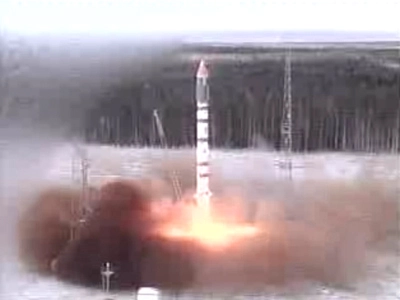
A Russiansatellite launched into space with several other spacecraft Thursday fellsilent after failing to separate from its booster properly, according to newsreports from Russia.
Russia's Mozhayets-5 satellite reportedly failed to reach itsdesignated orbit after launchinginto space atop a Kosmos-3M rocket early Thursday, and appears not to havepopped free from the booster's final stage, the country's Itar-Tass, RiaNovosti and Interfax news agencies said.
"Attemptshave failed so far to assume control over Mozhayets," a source with the MozhiaskyMilitary Space Academy in St. Petersburg, which commissioned the satellite,told Interfax.
SSETI Express in "safe mode"
Meanwhile,another satellite launched into orbit with Mozhayets-5 - the European Space Agency's (ESA)student-built SSETIExpress spacecraft - is in a "safe mode" after reaching its own properorbit, ESA officials said.
"SSETI Express went into a safe mode due to an undervoltagecaused by battery charging problems," the ESA said in a statement.
SSETIExpress, short for Student Space Exploration Technology Initiative (SSETI)Express, is Europe's first satellite built primarily by university students. Thespacecraft is designed primarily to photograph the Earth and serve as atransponder for amateur radio operators.
ESAofficials said the $121,185 (100,000 Euro) SSETI Express spacecraft entered aprotective "safe mode" after accomplishing many of its initial objectives,including the deployment of three small, cube-shaped satellites built by universitiesin Germany, Japan and Norway.
The two-pound(one-kilogram) CubeSats - each four inches (10 centimeters) wide per side - deployedabout 64 minutes after launching into space at 2:52 a.m. EDT (0652 GMT) on Oct.27.
Since then,Japan's XI-V satellite, from the University of Tokyo, and Germany's UWE-1spacecraft built by the University of W?rzburg havereturned strong signals to their respective ground station, ESA officials said.Student's controlling Norway's Ncube2 satellite have not yet heard from theirspacecraft, they added.
Meanwhile,SSETI Express' operations team is currently working to resume normal flightoperations and has been aided by the amateur radio community, ESA officials said.
Russianspaceflight woes
TheMozhayets-5 glitch follows a series of problems afflicting Russian launchersand satellites this month, including the loss of Europe's Cryosatspacecraft and the Demonstratorspacecraft, an inflatable reentry vehicle that appeared to launch properly but couldnot be found later by recovery crews.
OnOct. 19, Russia's Federal Space Agency reported that control of itsEarth-watching Monitor-E satellite was lost. Later, the launch of Europe's VenusExpress probe atop a Russian Soyuz-Fregat rocket was delayedafter insulation contamination was detected inside the spacecraft's rocketfairing.
Researchersfor Venus Express, which is designed to study Venus' atmosphere for the ESA, areconfidentit will launch before its flight window closes on Nov. 24, ESA officials havesaid.
