





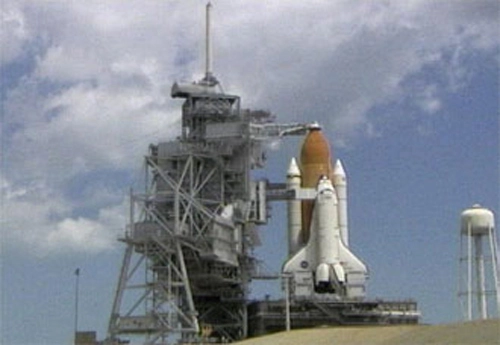
NASA onceagain fueled the space shuttle Discovery's external tank for Friday in a testto iron out sensor and valve glitches.
Over thecourse of 11 hours, shuttle workers pumped and drained more than 500,000gallons (1.9 million liters) of supercold propellant into Discovery's externaltank, which stands upright with the rest of the launch stack at Kennedy SpaceCenter's Pad 39B in Cape Canaveral, Florida.
Unlike anApril 14 test,engineers detected no fuel gauge sensor malfunctions during the fuelingprocess, but did monitor an identical pressure valve anomaly from the earlierrun.
"We hadjust a perfect test as far as I'm concerned," said William Parsons, NASA's shuttleprogram manager, during a post-test teleconference. "[But] we still have a lotof data to look at."
Ripe weatherfor launch
IfDiscovery's STS-114 crew - NASA's first shuttle astronauts to fly since the2003 Columbia disaster - had been aboard the orbiter, conditions would havebeen ripe to launch them into space.
"It was agood day," said Sandy Coleman, NASA's external tank project manager, during theteleconference. "We could have launched today."
Thehumidity today allowed more ice to form on Discovery's tank today than in theprevious test, but amounted to little more than frost, shuttle officials said.
Concernsover the potential fatal danger posed by icedebris shaking off the tank prompted shuttle engineers to devise a newheater to limit the hazard.
Discoveryand the STS-114 crew are set to launch no earlier than July 13 on mission totest new hardware and procedures expected enhance space shuttle safety. Theirspaceflight will also deliver vital consumables, science equipment and othercargo to the International Space Station, where the Discovery crew plans toperform no less than three space walks.
NASA'sspace shuttle fleet has been grounded since Feb. 1, 2003, when the Columbiabroke apart during reentry, killing its crew. Investigators later found thatlaunch debris, which struck Columbia's left wing during liftoff, caused theaccident.
Potentialdelay
Despitetoday's test, Discovery will eventually fly with a completely differentexternal tank, one which already stands ready to accept the orbiter at themassive 52-story Vehicle Assembly Building (VAB) just over four miles away fromthe launch pad. The tank was original slated for NASA's follow-up mission toSTS-114, STS-121 aboard Atlantis.
But thereare no current plans to check that replacement tank as well by pumping it fullof the liquid oxygen and liquid hydrogen fuel Discovery consumes duringliftoff. NASA officials, however, could call for that extra test afterreviewing data from Friday's activity.
"Right now,I don't have a third tanking test in my plan," Parsons said, conceding thatsome shuttle officials believe such a test could be warranted, but have agreedto look over the data from today's test first. "But I wouldn't rule it outcompletely."
NASA launchdirector Michael Lienbach said the addition of a third tanking test could pushDiscovery up to a week into its current launch window, which runs from July 13to July 31. If shuttle engineers push hard, however, they could accomplish thefeat by the window's opening, he added.
Shuttleengineers will soon install the new heater to the expandable bellows portion ofa liquid oxygen feed line on Discovery's replacement fuel tank to prevent icebuildup.
Anotherconcern revolving adequate clearance between Discovery's new orbitalboom - which astronauts will use to scan the orbiter for damage - and avital communication antenna has been addressed, NASA officials said, addingthat the separation between the two devices is slim during deployment.
"We've beenaware of this and we have a way to ensure we deploy the [boom]," Parsons said."I don't believe this is going to be a real big problem, this is just anoperational workaround."
Gettingthe kinks out
Shuttlemanagers ordered Friday's test to reexamine a set of four sensors that monitorliquid hydrogen propellant levels inside Discovery's external tank to ensuremain engine cutoff during launch. The sensors make sure Discovery's engine shutdown before its fuel tank runs completely dry, NASA officials said.
Launchrestrictions require that all four sensors function properly before liftoff,though two of the devices cut out in the April 14 test. Since then, padengineers have swapped out wiring and rechecked the connections running betweenDiscovery and its tank. The result, apparently, was a fully function sensorsuite during the second test fueling.
"The mainengine cutoff sensors worked perfectly," Parsons said. "It probably points tothe fact that...some kind of connection wasn't exactly right."
More tounravel
One concernnot solved in the May 20 test revolved around a pressurization valve at thevery top of Discovery's external tank. The valve apparently cycled the exactnumber of times - 13- as it did during the April 14 tanking test, which is justshy of breaching launch restrictions for an actual space shot. In a normallaunch, the valve cycles between eight and nine times.
"We've gotto understand it," Coleman said of the glitch. "We don't like flying right onthe edge."
Colemansaid one potential culprit is a defuser, a sort of mesh screen that that sitsat the very top of the hydrogen tank and disperses fuel in a manner thatprevents hot spots from developing on the tanks aluminum skin. The defuser onDiscovery's tank is different from those on all past external tanks and willeventually be swapped out with an older version, she added.
Lienbachsaid that Discovery will begin to make the 4.2-mile (6.7-kilometer) journeyback to the VAB no earlier than May 24, after any remaining hydrogen has boiledout of its external tank.
There, the171,000-pound (77,564-kilogram) orbiter will be demated from its launch stackand attached to its new one. The enter assembly should once again reach thelaunch pad by mid-June, shuttle officials said.
- Fixing NASA: Complete Coverage of Space Shuttle Return to Flight
