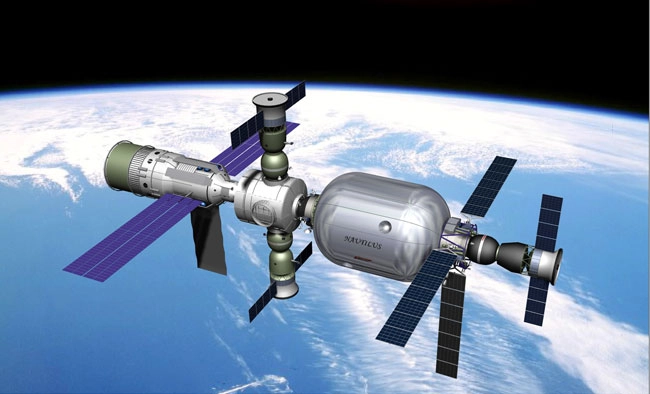
Space entrepreneur Robert Bigelow has been making quiet inroads into the development of Earth orbiting inflatable modules. The privately built and financed habitable structures would be available for research, manufacturing, and other uses, including lodging for future space tourists.
Bigelow Aerospace of North Las Vegas, Nevada is eying launch early next year of Genesis Pathfinder spacecraft - a shakeout of systems to be used on a full-scale inflatable space structure dubbed the Nautilus, and now referred to as the BA-330.
The original plan scripted by Bigelow Aerospace called for launch late this year of the firm's inflatable design aboard the Falcon V - a derivative of the behind-schedule Falcon 1 booster being developed by Space Exploration Technologies (SpaceX) of El Segundo, California, bankrolled and led by chief rocketeer, Elon Musk. But delays in getting the Falcon 1 airborne have pushed that date back.
Bigelow now intends to loft a Genesis Pathfinder module early next year using a Dnepr booster under contract with ISC Kosmotras, a Russian and Ukrainian rocket-for-hire company.
Ground testing
"Over the next few months, and the remainder of this calendar year, Bigelow Aerospace will be laser-focused on the preparation of both our initial and second Genesis Pathfinder spacecrafts for launch in 2006," said Mike Gold, corporate counsel for Bigelow Aerospace in Washington, D.C.
Bigelow Aerospace engineers are meeting their schedule goal in prepping its first Genesis Pathfinder for the launch target originally slated for year's end.
"We have spoken to our other launch provider, ISC Kosmotras, and they are amenable to moving the launch schedule up. Therefore, we now anticipate that the first Genesis Pathfinder spacecraft will be launched aboard a Dnepr in the 1st quarter of next year," Gold said.
Gold said ground tests were recently completed to prove the Genesis Pathfinder's ability to withstand the various pressures of launch and orbital deployment. Specifically, hardware underwent vibration tests, load analyses, and was exposed to vacuum. The testing was performed at the Jet Propulsion Laboratory in Pasadena, California, he told SPACE.com.
"The results were excellent, and helped bolster our confidence in regard to the Genesis design and the robust nature of inflatable space habitat technology," Gold added. There will be additional ground testing conducted later this year, he said, in the form of a "fit-check" to support the smooth and safe integration of the Genesis Pathfinder with the Dnepr launcher.
The silo-launched Dnepr rocket is a retired and converted R 36-M ballistic rocket, also tagged as the SS-18 missile in Western circles.
Usable volume
Robert Bigelow, owner of the Budget Suites of America Hotel Chain, among other ventures, is investing his own money in the inflatable space module idea.
At launch, Genesis will weigh roughly 3,000 pounds (1,360 kilograms) with dimensions about 15 feet (4.6 meters) in length and 6.2 feet (1.9 meters) in diameter. The structure is to essentially double in diameter size once in orbit.
Sub-scale testing of Genesis would evolve to the BA-330. This larger inflatable design is expected to tip the scales at between 45,000 to 50,000 pounds (20,000 to 23,000 kilograms). Once fully-inflated this module would be roughly 45 feet (13.7 meters) long and 22 feet (6.7 meters) in diameter, offering 330 cubic meters of usable volume.
Update: America's Space Prize
Meanwhile, Bigelow Aerospace is also backing America's Space Prize to the tune of $50 million. Offered late last year, the prize is meant to spur the growth of privately-built Earth orbiting spaceships. As one of a set of prize rules, a winning design must demonstrate the ability to dock with Bigelow Aerospace's inflatable space habitat, and stay docked to the complex for up to six months.
A key ambition of the Bigelow Aerospace cash reward is to break the monopoly on crew transport to space currently held by Russia's Soyuz spacecraft.
Since America's Space Prize was announced, Bigelow Aerospace has received many responses from a wide variety of entities, Gold said.
"Both small entrepreneurial groups as well as large traditional aerospace companies have communicated their interest in potentially pursuing America's Space Prize. We can't predict how many of these groups will eventually take the next step to formally enter the competition and begin vehicle development, but, thus far, we've been pleased with the level of response," Gold concluded.