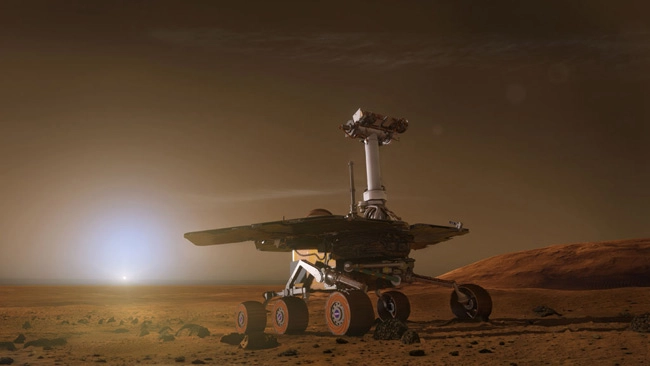
Mars,the red planet, these are the journeys of the rovers Spirit and Opportunity,their five year missions to explore strange new surfaces, to seek out new waterevidence and new signs of life, to boldly roll where no rovers have gone before...
The trek ofNASA'sMars Exploration Rovers across the fourth planet from the Sun is the focusof "Five Years on Mars," a new one-hour special airing on the NationalGeographic Channel on Sunday. The show, which uses photo-realisticanimation based on the rovers' own photos to dramatize their trials andtribulations, features several of the twins' drivers, as well as theirprincipal investigator Steven Squyres.
"Astonishinglyaccurate," Squyres said of the program's recreations of the Martian surface."The guy who did that was a guy named Dan Maas, who I've known 10 yearsnow and has been working on this stuff forever. He is just a real stickler fordetail, so both depictions of the Martian terrain and depictions of the roversare as accurate as I think anyone can possibly make them."
"Theyare the closest I think that you can come to what it would be like standingthere, looking at it onthe Martian surface," continued Squyres. "Dan's animations asthey were produced for ["Five Years on Mars"] are just lovinglycreated over months and months of work and we don't have that luxury, so whatwe use to operate the rovers is not nearly as good as what you see in theshow."
Exploring oppositesides of Mars since January 2004, the two golf cart-size rovers' adventuresunfold during "Five Years" in soap opera fashion, as the focus isalternated between the "lucky" Opportunity and the not-so-fortunateSpirit.
"Thatwas certainly the way it was at first," Squyres told collectSPACE.comin an interview, "Opportunity was definitely the lucky one, with all thesexy evidence of water and everything laid out right in front, literally sevenmeters in front of the rover when we landed."
As theprogram shows, Opportunity's landing in a shallow crater in Meridiani Planumgave Squyres and his team a first look at a rock outcropping on Mars, which inturn led to the discovery of "blueberries," small hematite spheresthat provided the direct evidence of past water. From that point forward,Opportunity's luck just grew. From the wind gusts that cleaned its solar panelsto its mostly smooth transit across the Martian dunes (less a particularlytrying sand trap), Opportunity's eight miles on Mars have proved its name to beappropriate.
IfOpportunity was taking full advantage of its opportunity for discovery,Spirit's landing left Squyres' spirit decidedly down.
"Spiritgot lucky too, but much later," he admitted. In the show, Squyres goes onto say that while he was reluctant to say it at the time, Spirit's landing sitewas a "crushing disappointment".
Touchingdown two weeks before its twin, Spirit landed in Gusev crater, which was believedto be the site of a past lake. Instead of finding evidence of water however,Spirit found only volcanic rock. Making the best of the situation Squyresdirected the rover team to drive to the nearby but yet more distant than anyonehad planned Columbia Hills. Spirit, as Squyres acknowledged, ultimately did getlucky but only after losing use of one of its wheels, which led to it scrapingaway the Martian soil to discover silica, a clue towards the existence ofmicrobial life.
Whetherfaced with good or bad luck, the rovers' teams at NASA's Jet PropulsionLaboratory became attached to 'their' rover, rooting for its success, thoughnot Squyres.
"I amdeeply attached to both of these things. They have both done magnificently. It'slike I have kids and it's like asking which of my two kids I love better,"he said. "They are different, but I love them both."
Clickthrough to collectSPACE.com to continue reading whyno one expected the rovers to last five years and view a video preview of"Five Years on Mars".
"FiveYears on Mars" debuts on the National Geographic Channel on Sunday,Nov. 2, 2008 at 8 p.m. ET/PT.
- Video - Unfinished Business: Scientists Ponder Mars Rovers' End
- Top 10 Mars Rover Discoveries
- Vote - The Best of the Mars Rovers