





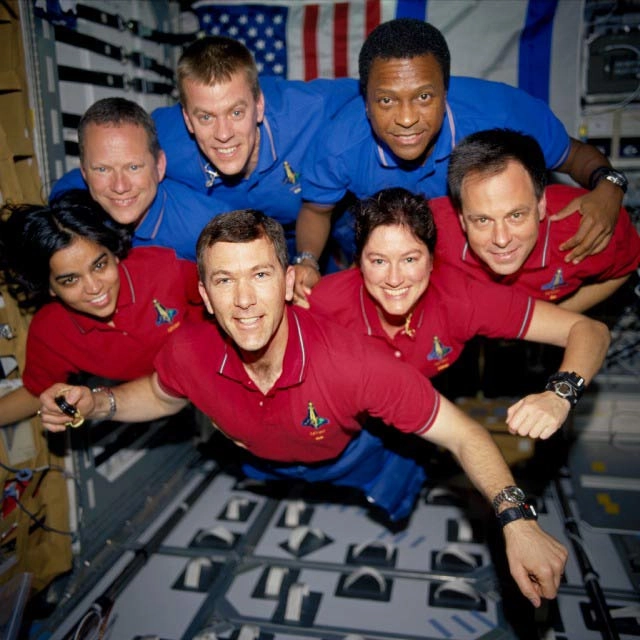
It is rarethat outsiders catch a glimpse of the private lives of astronauts, especiallythose who gave their lives in the pursuit of space exploration.
But a newdocumentary, "Astronaut Diaries: Remembering the Columbia Shuttle Crew," providesan intriguing look at the dedication and humor that spurred the sevenastronauts aboard NASA's ill-fated STS-107 mission, which ended in disasterwhen the Columbia orbiter broke apart over Texas during reentry on Feb. 1,2003, killing its crew.
At the sametime both touching and heart-wrenching, "Astronaut Diaries" is a one-hourwindow into the two years of training that prepared the STS-107 astronauts fortheir flight, based on 150 hours of personal video shot by Columbia astronautDavid Brown and his crewmates. Brown was planning to make a personal film abouthis first spaceflight and recorded video throughout his crew's training and upto the point when he entered Columbia's hatch, where onboard cameras took over.The documentary will debut on the Science Channel on May 14 at 9:00 p.m. (Check local listings)EDT/PDT (0100 May 15 GMT).
"While thiswas not the film Dave was going to make...we'd talked about if for so long, thatit was unfinished business," said Doug Brown, David Brown's brother, during atelephone interview. "But it really tells what it's like. You're seeing a filmfrom the astronaut's point of view."
Launchedon Jan. 16, 2003, NASA's STS-107 spaceflight was an ambitious research missionto perform 79 science experiments in 16 days. Commanding the flight was U.S.Air Force Col. Rick Husband, with first-time flyer William McCool serving aspilot. Astronauts Mike Anderson, Laurel Clark, Kalpana Chawla, Ilan Roman andBrown rounded out the STS-107 crew, which worked around the clock in two shiftsto complete their science objectives.
But the mission was lost during reentry,when hot atmospheric gases penetrated Columbia's left wing through a holegouged weeks earlier at launch. A suitcase-size chunk of foam insulation, whichseparated from Columbia's external tank and struck the orbiter's wing, waslater identified as the cause of the accident.
"AstronautDiaries" blends together David Brown's video with interviews and comments fromthe STS-107 crew's spouses and families, which gives a depth to the lostastronauts that NASA press conferences and media interviews sometimes can't convey.
"We can allbe very proud about what they did with STS-107," says Evelyn Husband, of herhusband Rick and the STS-107 crew. "But we're all personally thankful for whatthey are as men and women."
Theprogram, produced by Brooke Barrows and BellaSwartz Productions, wasspearheaded by Doug Brown, who said that the relative anonymity of the lost 1986Challenger astronauts - who were killed shortly after liftoff in an explosion -in the public's eye pushed his effort forward.
"MakingDave's movie was closure for me personally," he said, adding that he hopes publicwill see the human side of NASA's astronaut program. "People don't know that astronauts are people too. I hope people canrelate, and that this program can relate, that it's still difficult anddangerous work."
While thedocumentary shows some long-running, but little-seen, astronaut traditions -such as a card game that every shuttle crew plays before walking out to theirshuttle on launch day - it is the smaller touches that drive the documentary'shuman message home.
At onepoint, Chawla helps Clark tie up her hair so it will fit inside her spacesuithelmet. Earlier - during training with the European Space Agency - Anderson andhis fellow crewmates, all highly trained professional astronauts, marvel attheir ability to get lost driving around Amsterdam while searching for thehistoric Anne Frank house. Later, after finally finding a parking space,Anderson puzzles over how to pay. The crew's enthusiasm, even afterexperiencing several launch delays and hearing rumors of more, also crosses thelens.
"What doyou mean, 'Why is this exciting,' we go into space, for the first time at leastfor us," Ramon, Israel's first astronaut to fly, explains to the camera andDavid Brown. "For me, it's exciting."
During avideo conference with his wife Lani, McCool describes the majesty of the Earthseen from space and how it doesn't hold a candle to his spouse. He then readsher a poem.
"Lanisupplied the tape," Doug Brown said. "And it is a powerful event."
While thewonder of human spaceflight, particularly to the STS-107 crew, is highlightedin "Astronaut Diaries," what is missing is a post script. The documentaryfollows the crew up to the final minutes before Columbia's destruction, withplasma flashes lighting up the orbiter's window during reentry, but shuttleofficials did know after launch that the orbiter had been struck with debris.Any discussions between the crew, the ground or each other about possibledamage, which engineers at the time did not believewould be fatal, are unseen. Also missing is the accident's effect on NASA'sspace shuttle program, likely due to time limitations.
The spaceagency grounded its three remaining space shuttles after the Columbia accident,effectively cutting off its independent ability to launch humans into space.Now, after an extensive investigation and two years of work by engineers torevamp shuttle flight safety, NASA is again poised to launch a space shuttleinto orbit.
The spaceshuttle Discovery and STS-114 crew, commanded by veteran astronaut EileenCollins, is expected to launch no earlier than July 13 of this year. Themission, delayed since March 2003, will test shuttle and external tank enhancements.A follow-up return to flight mission, STS-121 aboard the Atlantis orbiter isslated to fly in September 2005, with astronaut Steven Lindsey commanding.
"I hope weget back into space soon," Doug Brown said, adding that he hopes the public will thinkabout the rest of NASA's astronauts waiting to fly. "I hope they admire thecurrent astronauts, and I hope their hearts are with Eileen and her crew, andSteve Lindsey and his."
"Astronaut Diaries: Remembering the Columbia Crew" will air on the Science Channel on May 14 at 9:00 p.m. (Check local listings)EDT/PDT (0100 May 15 GMT). (Documentary, 60 minutes).
- Fixing NASA: Complete Coverage of Space Shuttle Return to Flight
- Columbia is Lost: SPACE.com's Complete STS-107 Story Archive
- Mission Columbia: STS-107 Story and Multimedia Archive
- STS-107 Mission Update Archive
