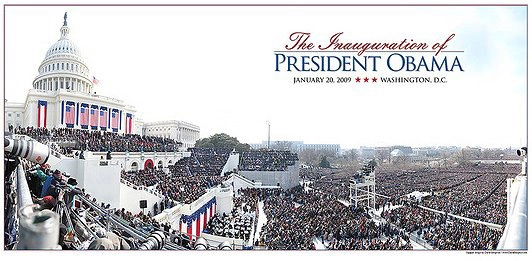
Millions ofAmericans used their personal cameras to snap photos of U.S. President BarackObama?s inauguration last month, but one photographer borrowed alesson from NASA?s Mars rovers to record the moment.
PhotographerDavid Bergman used the same technology behind the panoramic vision of NASA?s Spiritand Opportunity rovers on Mars to capture a massive panoramic photo ofPresident Obama?s inauguration on Jan. 20.
The ultrahigh-resolution picture is a stunning 1,474 megapixel panorama. Most ordinarydigital photographs contain less than 10 megapixels.
"Covering theinauguration of President Obama was one of the biggest thrills of mylife," said Bergman. "Little did I know that it would be topped bythe reaction to a photo I made that day. ?With the ability to zoom in and movearound the photo, it turned into an international game of 'Where's Waldo?' Inthe first 5 days, the image was viewed by millions of people in 186countries."
To capture the image, Bergmanused a camera system called Gigapan, which evolved from the mast-mountedPanoramic Camera (Pancam) system developed by NASA?s Jet Propulsion Laboratoryand Cornell University to give the rovers Spirit and Opportunity theirhigh-resolution vision.
Each of the rover?s Pancam systemscan tilt 180 degrees and rotate 360 degrees, which allows Spirit andOpportunity snap photos in all directions. The individual 1-megapixel digitalimages are then stitched together using computer software to create a high-resolutionpanorama that smoothes out anomalies.
OnSpirit and Opportunity, the Pancam system sits atop a mast at about theeye-level of a human and yields high-resolution images that allow scientists tozoom in on rocks or other Martian topics of interest. The rovers have usedtheir camera eyes for more than five years and continue to explore the Martiansurface at their respective landing sites on opposite sides of Mars.
Gigapan was designed by RandySargent at NASA's Ames Research Center and Illah Nourbakhsh at Carnegie MellonUniversity, who were inspired by the Pancam system?s success on Mars and wantedto apply the technology on Earth. Sargent worked with Rich LeGrand of CharmedLabs LLC to design and produce the Gigapan products.
For Bergman?s inaugurationphoto, 220 individual photographs were combined into a single image. Theprocess took about 15 minutes to capture all of the photographic pieces.
"I'm really atraditional, still photographer," Bergman said. "I had seen theGigapan system but never used it. Up until the day of the inauguration, I hadno idea how to set it up. I fiddled around with it for a while in the hotelroom to figure it out. That's a testament to how easy it is to use."
Getting through theInauguration Day security was the biggest challenge, he added.
"I had to be there at6:00 in the morning and had to pass through three capitol police securitycheckpoints. I didn't have to face any Martian dust storms like the rovers do,but it was bitterly cold, and the ceremony didn't start until 11:30 a.m. I hadno room for a tripod, so I had to clamp the Gigapan assembly to a rail and hopeit worked."
Gigapan has been used formore than President Obama?s inauguration. Relief workers have usedGigapan-generated overlays on Google Earth to pinpoint areas in the mostdistress after natural disasters, such as Hurricane Katrina and the 2005Kashmir Earthquake, while other scientists employed it to document Earth?scultures and ecosystems, NASA officials said.
Click here to see Bergman?sultra high-resolution Inauguration Day image.
- Video - Five Years on Mars for NASA Rovers
- The 10 Best Mars Images Ever
- Digital Secrets: How The Spirit Rover Makes Great Photos