The White House rolled out a sweeping national space policy for the United States on Monday, one that aims to boost international cooperation and reiterates plans to send Americans to visit an asteroid by 2025.
The 14-page space policy reaches beyond President Barack Obama's plans for NASA — which would shift the goal of U.S. human spaceflight from the moon to visiting asteroids and Mars, according to a plan unveiled in February — touching on future needs for Earth observation, space debris and space security.
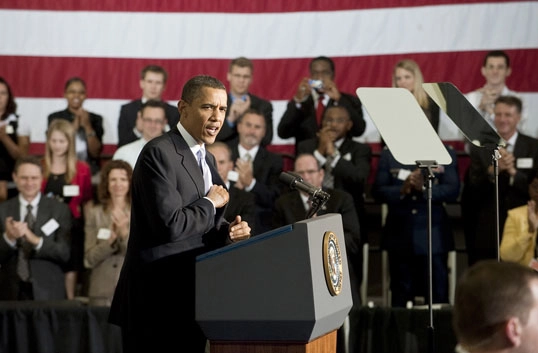
"We are releasing a new national space policy, designed to strengthen America's leadership in space while fostering untold rewards here on Earth," President Obama said in a statement Monday. "For even as we continue our relentless focus on the serious challenges we face at home and abroad, our long-term success and leadership as a nation demands that we do not lose sight of the promise of the future."

International cooperation is key on all fronts included in the new space policy, White House officials said.
"If there's one really broad theme it is international cooperation, which is woven throughout the new policy and it's our sort of foundational emphasis for achieving all of our goals in space," said Barry Pavel, senior director for defense policy and strategy for the National Security Council.
The to-do list
More robust cooperation will be vital to develop more comprehensive systems to track global climate change and space weather from orbit, as well as keep taps on the growing risk of space debris collisions with satellites and other vehicles, White House officials said.
The new national space policy reiterates President Obama's proposed new direction for NASA, which calls on the space agency to target missions beyond low-Earth orbit — such as to an asteroid — by 2025 with the goal of sending astronauts to Mars in the mid-2030s. [FAQ: NASA's New Direction]
Obama proposed the course change for NASA, which includes canceling the agency's Constellation program building rockets and spaceships to return astronauts to the moon, in February, then in April announced the goal of exploring asteroids by 2025.
The International Space Station, which was slated to end its orbital life in 2015, has been extended through 2020 under the new plan.
"NASA has a key role in achieving the goals defined in the new policy," said NASA chief Charles Bolden on Monday. "We are committed to working with other agencies, industry, and international partners to achieve national goals in exploration — human and robotic — and technology development that will ensure a robust future for the U.S. and our friends around the world."
Under NASA's new space plan, the agency will retire its space shuttle fleet by early 2011 and then rely on Russian Soyuz spacecraft to ferry astronauts to and from the space station until U.S. commercial spacecraft are available.
Commercial spaceflight push
Supporting that nascent U.S. commercial spaceflight industry is a vital part of the country's future in space, President Obama said.
In his statement, President Obama said "this policy is about the boundless possibilities of the future. That is why we seek to spur a burgeoning commercial space industry, to rapidly increase our capabilities in space while bolstering America's competitive edge in the global economy."
Despite the new space policy's focus on international cooperation, it is still too early to know if particular countries such as China will be able to participate in current projects involving NASA, such as the International Space Station, or on future U.S. space projects.
NASA officials have dismissed recent reports from Russia suggesting that Russian space officials invited China to join the International Space Station project. The $100 billion space station has been under construction by 16 different partner countries since 1998 and is now nearly complete.
"I think it's a little bit premature to talk about China and the space station. It's obviously a very complex issue," said Jim Kohlenberger, chief of staff for the White House Office of Science and Technology Policy. "There're no imminent plans to include China at this point and obviously we'd have to discuss it with our international partners.
Analysts of President Obama's new space policy said it goes further toward international partnerships than the previous policy laid down by former President George W. Bush.
While the Bush-era policy took a unilateral approach to U.S. activities in space, the Obama administration's policy would open up some areas — such as new arms control agreements and space security issues — to international input.
"That's critically important," said Laura Grego, a senior scientist with the Union of Concerned Scientists. "There is no way we can achieve lasting space security independently. We are going to have to coordinate and cooperate with other spacefaring nations. That's the nature of space.
